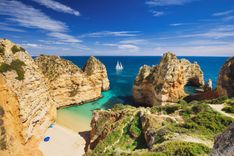
Explore Portugal
Accommodation in Portugal is pretty good value, certainly compared with many other European countries. In almost any town you can find a basic pension or small hotel offering a simple double or twin room for as little as €30, though you’ll pay more than this in Algarve resorts in summer, in the mountains in the winter, or year-round in Lisbon. Moving upmarket, you’re often spoilt for choice by some wonderful manor houses and a network of comfortable hotels known as pousadas, many in historic buildings or sited in places of natural beauty. Even in high season you shouldn’t have much of a problem finding a bed in most regions, though the best places in Lisbon and the Algarve are often booked up days ahead, so advance reservations here are advised.
A quarto duplo has two single beds, and a quarto casal has a large double bed for a couple. A single room – quarto solteiro or individual – is a little cheaper, but almost always proportionately more expensive per person than if you were to share. Ask to see the room before you take it, and don’t be afraid to ask if there’s a cheaper one available (rooms without private bathrooms are often considerably less). In higher-graded hotels, you’ll often get a better rate either by booking online or simply by asking, especially out of season or at the end of the day.
Lastly, a word of warning: between November and April, give or take a month, night-time temperatures throughout Alentejo, the mountain Beiras and Trás-os-Montes can plummet to below freezing, and even along the coast temperatures of under 5°C are common. However, few pensions have any form of heating other than the odd plug-in radiator, so check out the facilities before taking a room, or you’ll find yourself wearing the entire contents of your luggage for the night. Similarly, in the height of summer check for a fan or air conditioning, as nights can remain very warm.
Private rooms and B&B
Rooms in private houses – dormidas or quartos – are most commonly available in seaside resorts, either advertised in windows or hawked at bus and train stations; the local turismo may also have a list of available rooms. Rates average around €30 a night, though on the Algarve in high season expect to pay up to twice as much. Room quality and facilities vary greatly; some are no more than a bed in a converted attic; others come with modern bathrooms and air conditioning. Always ask where the room is before you agree to take it – you could end up far from the town centre or beach. Breakfast is not usually included.
Bed-and-breakfast (B&B) places on the UK model do exist, though are not widespread – owners tend to be foreigners living in Portugal, renting out rooms or cottages by the night for extra cash. Keep an eye out in turismos and cafés for business cards and flyers, particularly on the Algarve, in the Alentejo and the Beiras.
Pensions
Regular budget accommodation is in a pensão (plural pensões) or residencial (residenciais), officially graded in three categories and charging from €30–50 double, depending on season, location and facilities. They often occupy old buildings with plenty of character, sometimes with owners to match – at the cheapest end of the scale rooms rarely come with bathrooms or indeed much else other than the bed, a heavy and almost never used wardrobe, and perhaps a chair or table. More upmarket places will have modern en-suite rooms, plus TVs, heaters and air conditioning; the fanciest tend to style themselves an albergaria (inn). Breakfast is usually included, but don’t expect much more than coffee, bread and preserves, and possibly some sliced ham and cheese.
Hotels and inns
Hotels are all classified with one to five stars. A one-star hotel usually costs about the same as a higher-grade pension (around €40) and often doesn’t show any notable difference in standards. At two- and three-star hotels, en-suite doubles cost up to €80; many three-star places these days have air-conditioned rooms with cable/satellite TV, and even swimming pools, so they can be pretty good value. For rooms with all mod cons in four- and five-star hotels, you’ll pay anything from €100 to €200, while the very fanciest places can pretty much charge what they like – boutique hotels in the Algarve such as Estalagem Vila Joya or luxury hotels in Lisbon such as the Lapa Palace attract an international clientele paying top rates. An estalagem – an inn – is a cosier place of four- or five-star quality, often in a converted historic building or manor house. All hotels and inns serve breakfast, usually (though not always) included in the price. In one- and two-star hotels it tends to be continental-style; more substantial buffet breakfasts are provided at three-star places and up.
Pousadas
Pousadas de Portugal (wwww.pousadas.pt) is a chain of over forty hotels that have either been converted from historic properties like old monasteries or castles or purpose-built in dramatic countryside settings. They are scattered across the country, with particular concentrations in the Alentejo and the north, but there are only four on the Algarve and none in the cities of Lisbon or Porto (though one is planned in the latter). The converted historic buildings are particularly fine, making full use of the old cloisters and chapels, etc, and some have been dramatically modernized by Portugal’s top architects. Others are more like small country houses, with an old-fashioned elegance and charm, while facilities and service throughout are equivalent to those in four- and five-star hotels. Standard rooms as well as suites are available; there’s almost always a swimming pool, lovely gardens and a good restaurant.
Prices vary considerably depending on the season, day (more expensive Fri & Sat nights) and location, but rates start at around €100–120 per night, rising to €170–200 for the finest properties. That said, a whole host of special promotions (through the official website) offer rooms from around €90, and there are good deals most of the year for anyone over 55. Another popular approach is to book a self-drive holiday based around the pousadas, with seven nights’ accommodation plus car starting at around €700.
All pousada details are on the website, where you can also make reservations, or contact the official pousada agents, Keytel in the UK (wwww.keytel.co.uk) or Petrabax in the US (wwww.petrabax.com).
Rural tourism: country and manor houses
An increasingly popular mid-range alternative is to stay in a privately owned country or manor house, promoted under the banner of Turismo no Espaço Rural (TER). You may also encounter the following terms: “TR” or Turismo Rural (country houses); “TH” or Turismo de Habitação or Solares/Turihab (old manor houses and palaces); “CC” or Casas no Campo (simpler country houses); and “AT” or Agro-Turismo (farmhouses, often on working farms or wine estates).
You can use the umbrella organization CENTER (Central Nacional de Turismo no Espaço Rual t258 931 555, wwww.center.pt) to make reservations for many of these properties, or visit the websites of the organizations they represent (namely wwww.solaresdeportugal.pt, wwww.aldeiasdeportugal.pt and wwww.casasnocampo.pt). CENTER in particular is a non-profit-making organization which aims to help residents maintain their properties and traditional ways of life – without their support, many houses would either be sold, developed or abandoned.
Properties range from simple farmhouses offering a couple of rooms on a bed-and-breakfast basis, to country manors complete with period furnishings. Quintas or herdades are farm estate houses, and you can even stay in palaces (palácios), owned by Portuguese aristocrats who have allowed their ancient seats to become part of the scheme.
There are hundreds of properties available, all of which have been inspected and approved by the government tourist office. Rates start at around €60 a night, though the grandest places might charge up to €120 for a double/twin room, or a little more for self-contained apartments or cottages within the grounds (sleeping up to six). Large breakfasts are invariably included, while many will provide dinners made from local ingredients, sometimes accompanied by wine and other produce made on the estate. Others offer activities like fishing, rambling, horseriding and wine tasting.
Owners tend to join one of the marketing organizations mentioned above, though you can book directly with the houses themselves or via specialist holiday operators in your own country.
Villas and apartments
Virtually every area of the country has some sort of self-catering villa or apartment available for rent, from basic one-room studios to five- or six-bedroom houses complete with grounds and pool. Most UK and European tour operators can find you a suitable place (usually but not exclusively in the Algarve), though note that in summer the best places are booked up months in advance. The minimum rental period is usually a week, and the best deals are often packages, including flights and car rental, with endless tour companies such as First Choice (wwww.firstchoice.co.uk/villas) and Thomson (wwww.thomson.co.uk), or specialists such as Portuguese Affair (wwww.portugueseaffair.com). Outside peak summer season you should be able to turn up and bag somewhere for the night – the local turismo will usually be able to help. While the Algarve has a year-round international trade, and prices to match, other Portuguese resorts (such as Peniche, Figueira da Foz or Viana do Castelo) are pretty quiet outside Easter, July and August and will have plenty of locally available accommodation.
Youth hostels
There are around fifty youth hostels (pousadas de juventude) in Portugal, under the umbrella of the youth organization Movijovem and affiliated to the Hostelling International network (wwww.hihostels.com). You’ll need a valid membership card, available from your home-based youth-hostel association, or you can join on your first night at any hostel. There are full details of each hostel on the wwww.pousadasjuventude.pt website (also in English), and you can book directly with the hostels, or online or call central reservations on t707 303 030.
Some hostels are a bit on the basic side, and others are geared towards schools and groups, but they are all in convenient locations for sightseeing or outdoor activities. Some of the newer ones – at Parque das Nações (Lisbon), Lousã, Idanha-a-Nova and Guimarães, for example – have been very well designed, while many others feature internet access, cafés, bars and bike rental as standard. At Alcoutim and Portimão (Algarve) there are great swimming pools; stylish Arrifana (Algarve) has a great cliff-top position; while other great hostel locations include Vilarinho das Furnas (in Peneda-Gerês National Park), Areia Branca (on the beach, close to Peniche), and Lagos and Leiria (good buildings in historic towns).
Prices vary according to season, location and facilities, but dorm beds in most cost between €11 and €16 per person (high season is basically July, August, Easter, Christmas and other public holidays); you’ll pay a couple of euros more in Lisbon and on the Algarve, while over 25s pay €3 more a night. Many hostels also have simple double/twin rooms, costing €25–35 without a private bathroom, €25–45 with, and in some places there are larger family rooms or apartments available.
There’s also a growing network of independent and boutique hostels, particularly in surf resorts in the Algarve, Alentejo and Estremadura coast, and also increasingly in Lisbon and Porto. Prices are similar to those at the pousadas de juventude, though the vibe tends to be more backpacker-than family-oriented – and some of the new boutique city hostels (such as the Rivoli Cinema Hostel in Porto and Oasis Hostel in Lisbon) are very classy indeed.
Camping
There are hundreds of campsites, though many are huge, town-sized affairs by or near the beach that also have space for campervans/RVs, caravans and permanent bungalows and apartments. Needless to say, these get very crowded with Portuguese families in summer, though there are also plenty of smaller rural sites offering a quieter experience. The Roteiro Campista (wwww.roteiro-campista.pt; useful website also in English) booklet includes details of over 200 of the country’s campsites, and is widely available in bookshops in Portugal.
Charges are usually per person and per caravan or tent, with showers and parking extra; even so, it’s rare that you’ll end up paying more than €8 per person, although those operated by Orbitur (wwww.orbitur.com) – usually with bungalows on site as well – are more expensive. The cheapest place to camp is usually the municipal campsite in each town, though these vary in quality and can be very crowded – they are not always recommended.
A few sites require an international camping card which gives discounts at member sites and serves as useful identification: many campsites will take it instead of your passport, and it covers you for third-party insurance when camping. The card is available from most home motoring or cycling organizations and camping and caravan clubs, or you can get a national card from the Federação de Campismo e Montanhismo de Portugal (wwww.fcmportugal.com).
Camping outside campsites is legal, though there are restrictions – for example, you can’t camp on tourist beaches or in natural parks (other than in designated camping areas). With a little sensitivity you can pitch a tent for a short period almost anywhere else in the countryside, but it’s always best to ask locally first – the potential fire risk is taken very seriously in Portugal.
Read More