Explore Campania
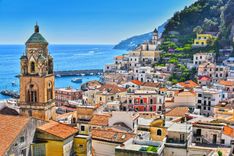
Naples spreads right around its bay in an almost unbroken ribbon of docks, housing and development whose appeal is hard to discern, and only really becomes apparent the further away from the city you get. It’s one of the most geologically unstable regions in the world, a fact that becomes obvious west of the city, where volcanic craters, hot springs and fumaroles make up the area known as the Campi Flegrei, the Phlegrean Fields of classical times, a mysterious place in turn mythologized by Homer and Virgil as the entrance to Hades. These days most of the mystery is gone – like most of the bay, the presence of Naples dominates in the form of new, mostly illegal, construction – and much of the volcanic activity is extinct, or at least dormant. But parts of the area still retain some of the doomy associations that first drew the ancients here, and there are some substantial remains of their presence at Pozzuoli, Baia and Cumae. In the opposite direction, the coast east from Naples is even more built up, the Circumvesuviana train edging out through derelict industrial buildings and dense housing that squeezes ever closer to the track. Most people come here for the ancient sights of Herculaneum and Pompeii, or to scale Vesuvius – or they skip the lot for the resort town of Sorrento. All are easy day-trips, and Sorrento, though overdeveloped, is worth a little more time and makes a good springboard for seeing some of the Amalfi Coast.
Read More-
Pozzuoli
Pozzuoli
Heading west, the first town that can really be considered free of Naples’ sprawl is POZZUOLI, which sits on a stout promontory jutting out from the slender crescent of volcanic hills behind. Despite achieving some glamour as the home town of Sophia Loren, it’s an ordinary little place, nothing special but likeable enough, with ferry connections to the islands of Procida and Ischia. And although you wouldn’t want to stay here, it’s a good first stop before travelling on to the rest of the Campi Flegrei.
Pozzuoli has suffered more than most of the towns around here from the area’s volcanic activity and subsidence is still a major – and carefully monitored – problem. In town there are a number of well-preserved relics of the Romans’ liking for the place.
-
Herculaneum
Herculaneum
East of Naples the first real point of any interest is the town of Ercolano, the modern offshoot of the ancient site of HERCULANEUM, which was destroyed by the eruption of Vesuvius on August 24, 79 AD, and is situated at the seaward end of the town’s main street. The site of Herculaneum was discovered in 1709, when a well-digger accidentally struck the stage of the buried theatre. Excavations were undertaken throughout the eighteenth and nineteenth centuries, during which period much of the marble and bronze from the site was carted off to Naples to decorate the city’s palaces, and it wasn’t until 1927 that digging and preservation began in earnest. Herculaneum was a residential town, much smaller than Pompeii, and as such it makes a more manageable site, less architecturally impressive but better preserved and more easily taken in on a single visit. Archeologists held for a long time that unlike in Pompeii, on the other side of the volcano, most of the inhabitants of Herculaneum managed to escape. However, recent discoveries of entangled skeletons found at what was the shoreline of the town suggest otherwise, and it’s now believed that most of the population was buried by huge avalanches of volcanic mud, which later hardened into the tufa-type rock that preserved much of the town so well. In early 2000 the remains of another 48 people were found; they were carrying coins, which suggests they were attempting to flee the disaster.The site
After the ticket office, but before you enter the city proper, there is a new pavilion housing the remains of a boat which archeologists have surmised was thrown onto the beach by the force of the earthquake and smashed against the ruins of houses. As well as the boat, and a serpent prow, finds include a coil of rope and a leather sheet (with signs of stitching) fused to scorched wooden planks.
Because Herculaneum wasn’t a commercial town, there was no central open space or forum, just streets of villas and shops, cut as usual by two very straight main thoroughfares that cross in the centre. Start your tour just inside the entrance at the bottom end of Cardo III, where you’ll see the House of the Argus (Casa d’Argo) on the left, a very grand building judging by its once-impressive courtyard – although upstaged by the so-called Hotel (Casa del Albergo) across the street, which covers a huge area, though you can only really get a true impression of its size from the rectangle of stumpy columns that made up its atrium.
Cardo IV
Further up, Cardo III joins the Decumanus Inferiore, just beyond which is the large Thermae or bath complex on the corner of Cardo IV – the domed frigidarium of its men’s section decorated with a floor mosaic of dolphins, its caldarium containing a plunge bath and a scallop-shell apse. Still intact are the benches where people sat and the wooden, partitioned shelves for clothing. On the far side of the baths, the House of Neptune and Amphitrite (Casa di Nettuno ed Anfitrite) holds sparklingly preserved and richly ornamental wall mosaics. Adjacent is the House of the Beautiful Courtyard (Casa del Bel Cortile) where skeletons of bodies still lie in the positions they fell. From here you can stroll back down to the seaward end of Cardo IV, where the House of the Wooden Partition still has its original partition doors (now under glass).
Cardo V
Turning right at the top of Cardo IV takes you around to Cardo V and most of the rest of the town’s shops – including a baker’s, complete with ovens and grinding mills, a weaver’s, with loom and bones, and a dyer’s, with a huge pot for dyes. Behind the ones on the left you can see the Palestra, where public games were held, opposite which there’s a well-preserved Taverna with counters and, further down Cardo V on the right, another tavern, the Taverna del Priapo, with a priapic painting behind its counter.
Further down Cardo V, the House of the Deer (Casa dei Cervi) was another luxury villa, its two storeys built around a central courtyard and containing corridors decorated with richly coloured still-lifes. From here, the end of Cardo V, the path descends under a covered passageway down to the so-called Suburban Baths on the left: one of the most impressive – and intact – structures in Herculaneum, complete with extremely well-preserved stuccowork and a pretty much intact set of baths; it also has a complete original Roman door, the only one in Herculaneum that wasn’t charred by fire.
-
Pompeii
Pompeii
The other Roman town to be destroyed by Vesuvius – POMPEII – was a much larger affair than Herculaneum and one of Campania’s most important commercial centres – a moneyed resort for wealthy patricians and a trading town that exported wine and fish. In effect the eruption froze the town’s way of life as it stood at the time; indeed the excavations have probably yielded more information about the ordinary life of Roman citizens during the imperial era than anywhere else: their social conventions, class structure, domestic arrangements and (very high) standard of living. Some of the buildings are even covered with ancient graffiti, either referring to contemporary political events or simply to the romantic entanglements of the inhabitants; and the full horror of their way of death is apparent in plaster casts made from the shapes their bodies left in the volcanic ash – with faces tortured with agony, or shielding themselves from the dust and ashes.
Vesuvius had been spouting smoke and ash for several days before the eruption on 24 August, 79 AD. Fortunately most of Pompeii had already been evacuated when disaster struck: out of a total population of 20,000 it’s thought that only 2000 actually perished, asphyxiated by the toxic fumes of the volcanic debris, their homes buried in several metres of volcanic ash and pumice. Pliny, the Roman naturalist, was one of the casualties – he died at nearby Stabiae (now Castellammare) of a heart attack. But his nephew, Pliny the Younger, described the full horror of the scene in two vivid letters to the historian Tacitus, who was compiling a history of the disaster, writing that the sky turned dark like “a room when it is shut up, and the lamp put out”.
The first parts of ancient Pompeii were discovered in 1600, but it wasn’t until 1748 that excavations began, continuing more or less without interruption until the present day. Indeed, exciting discoveries are still being made. A privately funded excavation some years ago revealed a covered heated swimming pool, whose erotic wall paintings have been deemed by the Vatican to be unsuitable for children. And, in a further development, a luxury “hotel” complex was uncovered in 2000 during the widening of a motorway, slabs of stacked cut marble suggesting it was still under construction when Vesuvius erupted. Recently, a flood of new funds is being used to excavate a further twenty hectares of the site; it is hoped to resolve whether or not the survivors attempted, vainly, to resettle Pompeii after the eruption.
The site
The site covers a wide area, and seeing it properly takes half a day at the very least; really you should devote most of a day to it and take plenty of breaks – unlike Herculaneum there’s little shade, and the distances involved are quite large: flat, comfortable shoes are a must.
All of this makes Pompeii sound a bit of a chore – which it certainly isn’t. But there is a lot to see, and you should be reasonably selective: many of the streets aren’t lined by much more than foundations, and after a while one ruin begins to look much like another. Again, many of the most interesting structures are kept locked and only opened when a large group forms or a tip is handed over to one of the many custodians. It’s worth studying the site map, which you’ll find at every entrance – pins on the map indicate which areas are currently closed, as the site is in continuous restoration. To be sure of seeing as much as possible you could take a tour, although one of the pleasures of Pompeii is to escape the hordes and absorb the strangely still quality of the town, which, despite the large number of visitors, it is quite possible to do.
The western sector: from the Forum to the House of the Vettii
Entering the site from the Pompeii-Villa dei Misteri side, through the Porta Marina, the Forum is the first real feature of significance, a long, slim, open space surrounded by the ruins of what would have been some of the town’s most important official buildings – a basilica, temples to Apollo and Jupiter, and a market hall. Walking north from here, up the so-called Via di Mercurio, takes you towards some of the town’s more luxurious houses. On the left, the House of the Tragic Poet (Casa del Poetica Tragico) is named for its mosaics of a theatrical production and a poet inside, though the “Cave Canem” (Beware of the Dog) mosaic by the main entrance is more eye-catching. Close by, the residents of the House of the Faun (Casa del Fauno) must have been a friendlier lot, its “Ave” (Welcome) mosaic outside beckoning you in to view the atrium and the copy of a tiny, bronze, dancing faun (the original is in Naples) that gives the villa its name.
On the street behind, the House of the Vettii (Casa dei Vettii) is one of the most delightful houses in Pompeii and one of the best maintained, a merchant villa ranged around a lovely central peristyle that gives the best possible impression of the domestic environment of the city’s upper middle classes. The first room on the right off the peristyle holds some of the best of Pompeii’s murals: the one on the left shows the young Hercules struggling with serpents. There are more paintings beyond here, through the villa’s kitchen in a small room that’s normally kept locked – erotic works showing various techniques of lovemaking together with an absurdly potent-looking statue of Priapus from which women were supposed to drink to be fertile.
The eastern sector: the Grand Theatre to the Amphitheatre
Cross over to the other side of the site for the so-called new excavations, which began in 1911 and actually uncovered some of the town’s most important quarters. The Grand Theatre, for one, is very well preserved and is still used for performances, overlooking the small, grassy, column-fringed square of the Samnite Palestra – a refectory and meeting-place for spectators from the theatre. Walk around to the far left side of the Grand Theatre, down the steps and up again, and you’re in front of the Little Theatre – a smaller, more intimate venue also still used for summer performances and with a better-kept corridor behind the stage space.Walk up from here to rejoin the Via dell’ Abbondanza, where there’s lots of interest – the Lararium has a niche with a delicate relief showing scenes from the Trojan War; the Fullonica Stephani is a well-preserved laundry, with a large tiered tub for washing; the House of the Venus in the Shell is named after the excellently preserved painting on its back wall; while next door, the House of Octavius Quartio is a gracious villa fronted by great bronze doors, with paintings of Narcissus gazing rapt at his reflection in the villa’s lovely garden, which has been replanted with vines and shrubs.
Just beyond here is the town’s Amphitheatre – one of Italy’s most intact and accessible, and also its oldest, dating from 80 BC; it once had room for a crowd of some 12,000 – well over half the town’s population. Next door, the Palestra is a vast parade ground that was used by Pompeii’s youth for sport and exercise – still with its square of swimming pool in the centre. It must have been in use when the eruption struck Pompeii, since its southeast corner was found littered with the skeletons of young men trying to flee the disaster.
Villa dei Misteri
One last place you shouldn’t miss at Pompeii is the Villa dei Misteri. This is probably the best preserved of all Pompeii’s palatial houses, an originally third-century-BC structure with a warren of rooms and courtyards that derives its name from a series of paintings in one of its larger chambers: depictions of the initiation rites of a young woman into the Dionysiac Mysteries, an outlawed cult of the early imperial era. Not much is known about the cult itself, but the paintings are marvellously clear, remarkable for the surety of their execution and the brightness of their tones and colours.
-
Sorrento
Sorrento
Topping the rocky cliffs close to the end of its peninsula, 25km south of Pompeii, the last town of significance on this side of the bay, SORRENTO is solely and unashamedly a resort, its inspired location and mild climate drawing foreigners from all over Europe for close on two hundred years. Ibsen wrote part of Peer Gynt in Sorrento, Wagner and Nietzsche had a well-publicized row here, and Maxim Gorky lived for over a decade in the town. Nowadays it’s strictly package-tour territory, but not too much the worse for it, with little of the brashness of its Spanish and Greek equivalents but all of their vigour, a bright, lively place that retains its southern-Italian roots. Cheap restaurants aren’t too hard to find, nor – if you know where to look – is reasonably priced accommodation; and it’s a handy place outside Naples itself from which to explore the rugged peninsula (even parts of the Amalfi Coast) and the islands of the bay.