Lough Gill
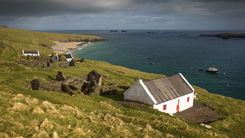
To the east of Sligo town lies one of Ireland’s most entrancing lakes, Lough Gill, set beneath wooded slopes which provide the backdrop to almost all its 40km shoreline. The best route around the lough, and one easily navigable in less than a day’s cycling, is to follow the shore clockwise by following the R286 from Sligo town, and taking in the plantation Parke’s Castle, just inside County Leitrim, from where you can board a cruise boat and catch a sight of idyllic Innisfree.
Parke’s Castle
Some 11km northeast of Sligo, towards the eastern extremity of Lough Gill, Parke’s Castle is a picturesque plantation fort erected by Captain Robert Parke in the 1620s and elegantly restored in the late twentieth century by the Office of Public Works. A moated tower house once stood here, home of the Irish chieftain Brian O’Rourke, who in 1588 was charged with high treason after sheltering Francesco de Cuellar, one of the few survivors of the Armada ships wrecked off the Sligo coast. O’Rourke was hanged at Tyburn in 1591 and his lands confiscated, later being distributed to the Leitrim planters, whose number included Parke. Reconstructed inside are some of the features of the inner courtyard, such as a blacksmith’s forge, a well and a water gate. You can wander around the battlements, admire expansive views of the lough and also take in an exhibition on the remodelling of the castle with displays on other notable vernacular buildings.
Innisfree
From the pier beside Parke’s Castle the Wild Rose of Innisfree waterbus operates a tour of Lough Gill, taking in views of Yeats’s beloved isle of Innisfree, and featuring recitals of the poet’s works by the skipper, almost certainly including the poet’s Lake Isle of Innisfree:
I will arise and go now, and go to Innisfree,
And a small cabin build there, of clay and wattles made:
Nine bean-rows will I have there, a hive for the honey-bee,
And live alone in the bee-loud glade.
Alternatively, head a few kilometres southwards through Dromahair and pick up the R287. About 4km along this a signposted lane leads down to the water where there’s a fabulous view of the lough and Innisfree in all its serene beauty.
North Sligo
The majority of North Sligo’s attractions are easily accessible from the county town. Much of the landscape is irrevocably associated with W.B. Yeats, particularly Benbulben Mountain, under whose green-tinged slopes and surmounting tableland the poet is buried at Drumcliffe. To the mountain’s south lie the magical waters of Glencar Lake with its exhilarating waterfall, while to its west is Lissadell House, home to Yeats’s friends, Eva Gore-Booth and Constance Markiewicz, tours of which provide valuable insights into the poet’s social milieu. The coastline is less stimulating, though does include a fine beach at Mullaghmore, a quaint harbour village not far from one of Ireland’s major funerary monuments, Creevykeel Court Tomb.
Rosses Point
Eight kilometres northwest of Sligo town, off the N15, ROSSES POINT is a picturesque seaside resort which has not moved with the times and is all the better for its lapse. There’s a grand beach, ideal for swimming, and splendid views across the bay, both of which provided inspiration for Jack B. Yeats, the poet’s artist brother. From here there are fine, often blustery walks around the headland.
Drumcliffe
Eight kilometres due north of Sligo along the N15, the tiny seaside village of DRUMCLIFFE is the site of a monastery established in 574 by St Colmcille, though only a round tower and an eleventh-century high cross, set on opposite sides of the main road, remain today. The graveyard of the adjacent and somewhat stark nineteenth-century church is where the poet W.B. Yeats is buried and, as a consequence, is very much on the tourist trail. Yeats died in 1939 in Roquebrune, France, but before doing so requested that his body be interred locally for “a year or so” before being returned to Sligo. His wishes were granted in 1948 when his remains were transferred from France to Drumcliffe, where his great-grandfather had been rector, and buried, as one of his last poems stated, “Under bare Ben Bulben’s head”. His headstone, which also marks the resting place of his wife George, bears the last three lines of that poem, Under Ben Bulben:
Cast a cold Eye
On Life, on Death.
Horseman, pass by!
Glencar Lake
Heading east from Drumcliffe along minor roads you’ll come to Glencar Lake after some 8km, gorgeously set amid tree-lined slopes. Near the eastern extremity of its northern shore a signposted footpath leads up to an impressive fifteen-metre-high waterfall, cascading down into a deep pool from the rocky mountainside above, which provided the inspiration for part of Yeats’s poem The Stolen Child:
Where the wandering water gushes
From the hills above Glencar,
In pools above the rushes that
Scarce could bathe a star.
Mullaghmore Head
MULLAGHMORE is an enticing village set around a secluded, walled harbour with a glorious expanse of sandy beach just to its south, offering fabulous views north to the mountains of Donegal and back towards Benbulben.
West Sligo
Sligo’s western shoreline, stretching from near Sligo town almost as far as Mayo’s Ballina, is probably the least visited in the county. Yet set against the looming southern backdrop of the Ox Mountains, it offers plenty of diversions including bracing seascapes at Aughris, exhilarating surfing at Easkey and a dazzling beach at Enniscrone. A little way inland, the memorable funerary sepulchres at Skreen are well worth a detour en route.
Easkey
The somewhat decaying small village of EASKEY, 15km west of Aughris, began life as a monastic community, much later becoming the base for the MacDonnells, originally gallowglasses who served the ruling O’Dowd clan and built seaside Roslee Castle (now ruined) in the fifteenth century. Thanks to the constancy of its waves, Easkey is a popular surfing centre and houses the headquarters of the Irish Surfing Association (wwww.isasurf.ie).
Enniscrone
Some 14km southwest along the coast from Easkey, ENNISCRONE is blessed with a gorgeous, five-kilometre arc of golden strand. Its other main draw is Kilcullen’s Bath House, where you can wallow in a bath full of seaweed – the iodine-rich water is not only sheer relaxation but is also reckoned to offer relief for rheumatism and arthritis – before enjoying a hot steam in a cedarwood cabinet.
South Sligo
South Sligo’s attractions are spread over a wide area, ranging from the glorious Lough Arrow in the east, via megalithic sites, such as Heapstown Cairn and the atmospheric Carrowkeel Cemetery, set in the Bricklieve Mountains, to the equally gorgeous Lough Talt in the west. Above all, however, the area is renowned for its traditional music, especially within the triangle formed by the towns of Ballymote, Gurteen and Tubbercurry.
Castlebaldwin and Carrowkeel Cemetery
From Castlebaldwin, on the N4, minor roads of diminishing width and reliability lead towards the Bronze Age Carrowkeel Cemetery. The last kilometre or so has to be negotiated on foot, but your efforts will be rewarded by a spellbinding panoramic view of the surrounding countryside. Here on the uplands of the Bricklieve Mountains is a remarkable collection of fourteen cairns, plus an assortment of other stonework. Excavation in 1911 produced a wealth of jewellery and relics, and several of the cairns, consisting of roofed, cruciform passage graves, can be entered. The most striking is cairn K, which, in complete contrast to County Meath’s Newgrange, is illuminated by the sun’s rays during the summer solstice (June 21).
Ballymote
The largest place in southern Sligo is BALLYMOTE, 20km from the county town. Richard de Burgo built a castle here in 1300 which, switching ownership numerous times during its history, proved to be a veritable straw in the wind of Irish politics. In 1317 it fell to the O’Connors and remained in Irish hands until captured by Bingham, the governor of Connacht, in 1584. It was soon afterwards reclaimed by the McDonaghs who then sold it to Red Hugh O’Donnell – he marched from here to catastrophic defeat at Kinsale in 1601. Later taken by Cromwell’s army, it fell yet again to the O’Connors in 1690, before they in turn surrendered the castle to Williamite troops who determined to put an end to the whole farrago by tearing down much of the building and filling in the moat. The ruins lie just west of the town centre, and the stripped interior can be visited by acquiring a key from the Enterprise Centre on Grattan Street. Towards the end of the fourteenth century, the Book of Ballymote was assembled here, significant not just for the vast deal of information on Irish lore and history it contains, but also because it unlocks the secrets of the carved ogham letters that appear on numerous neolithic standing stones. The book is held by the Royal Irish Academy in Dublin.
Book things and tours in Dublin
Going on a trip to Ireland? Don't miss our important planning tips.
Gurteen
South of Ballymote the R293 runs parallel to the Dublin railway line before drifting away through fertile farmland and reaching the crossroads village of GURTEEN after 11km. Gurteen sits at the heart of South Sligo’s traditional-music scene, and its greatest son was the fiddler Michael Coleman. Right by the crossroads stands the Coleman Irish Music Centre (wwww.colemanirishmusic.com), which stages traditional music and dance shows, has a small interactive exhibition area, and a shop selling a very good range of books and CDs, including several collections of recordings from its own archives. Gurteen hosts the Coleman Traditional Festival over the last weekend in August, while regular sessions are held in the Teach Murray (Mon) and Roisín Dubh (Tues & Sat) pubs.
Tubbercurry
Some 30km southwest of Sligo, TUBBERCURRY is a rather docile small town but traditional music thrives here, focused on the week-long South Sligo Summer School (wwww.sssschool.org) held in mid-July, with various classes, pub sessions and concerts. Tubbercurry’s origins date back to the late fourteenth century when the O’Connors built a fortress here, but it remained a sleepy little settlement until becoming a stop on one of Bianconi’s coaching routes in 1853. The burgeoning town was all but destroyed by fire during a zealous Black and Tan reprisal in 1920, and little remains from earlier times.