Hook Head and the Barrow estuary
The sightseeing highlight of Wexford’s southwestern corner is the atmospheric ruin of Tintern Abbey, at the neck of the blustery Hook Peninsula, which is punctuated with sandy beaches and a fascinating medieval lighthouse. Circumnavigating Hook Head brings you to the pleasant little resort of Duncannon and nearby Ballyhack, whence car ferries cross the Barrow estuary to Passage East in County Waterford, a useful shortcut on an Ireland self-drive tour. This ferry service is 20km south of the first road crossing of the Barrow, at the busy town of New Ross, and is certainly worth taking if you’re short of time, but that way you’d miss out on a tight cluster of attractions on the east bank of the river, notably the glorious remains of Dunbrody Abbey, the John F. Kennedy Arboretum, and the charming Ros Tapestry and vivid Dunbrody Emigrant Ship at New Ross.
Tintern Abbey
On the broad neck of the Hook Head peninsula, 30km southwest of Wexford town off the R374, lies the dramatic ruin of Tintern Abbey, now surrounded by 3km of woodland trails and endowed with a café. This thirteenth-century Cistercian foundation was constructed by William Marshall, Earl of Pembroke, to give thanks for being saved from drowning at sea, and was populated by monks from its better-known namesake in Monmouthshire, Wales. After dissolution in 1536, the abbey was granted to one of Henry VIII’s officers, Anthony Colclough, who much modified the buildings, while subsequent additions, including the battlemented walls, were made by his descendants, who lived here until the 1960s. Only part of the original cruciform church is still standing but its tower is extant and includes a small exhibition on the abbey’s history.
Hook Head
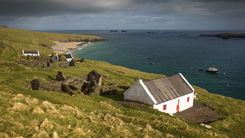
Hook Head is entirely exposed to the elements, serene in good weather – though very dangerous for swimming – and excitingly wild in a storm. The rocky shoreline has a wealth of fossils and it’s a popular location for birdwatchers, who visit to spot migrations, as well as whale- and dolphin-watchers. The Hook Lighthouse was built by William Marshall in the early thirteenth century to guide ships safely into the Barrow estuary on their way to his thriving port of New Ross, replacing an earlier beacon. Apart from a short period during the 1600s, it has functioned ever since and became fully automated in 1996. Guided tours lead to the lighthouse’s top, some 36 metres high, and recount its history, paying note to the monks who were the first light-keepers here.
Duncannon
DUNCANNON is a small, friendly village with a lovely Blue Flag beach protected from the elements by a rocky coastline at its southern extremity. Looming above from its lofty promontory is Duncannon Fort, constructed in 1586, on the site of a Celtic fort and a Norman castle, as a bulwark against Spanish invasion. Much remodelled since then, the fort was burnt down by the IRA in 1922. Though Ireland was officially neutral during World War II, the fort was rebuilt on its outbreak, becoming a base for the Irish Army until 1986. As well as art and crafts galleries and studios, a café and an internet café, the complex includes a small maritime museum, a dry moat with ten-metre-high walls, ramparts with great views of the Barrow estuary and down to Hook Head and, in a surviving older building, a fetid dungeon where the Croppy Boy, the subject of a well-known song of the 1798 Rebellion, was allegedly incarcerated.
New Ross
NEW ROSS squats besides the River Barrow, 12km north of the arboretum, its quayside marred by poor redevelopment and heavy traffic, but there’s still life in the old place, especially in the lanes behind the frontage. The river provided access to the upstream countryside of Wexford and Kilkenny, and the town’s importance beyond being a local embarkation point is emphasized by the quayside presence of the Dunbrody Emigrant Ship. Though this is a reconstruction of one of the nineteenth-century vessels that conveyed Irish emigrants to North America, particularly during the height of the Famine, it is actually a fully operable craft and occasionally takes part in tall ship races. Following a brief scene-setting video, the half-hour guided tour of the ship, complete with costumed actors role-playing passengers and crew, shows the conditions on board, stressing the variance between those who travelled steerage and first class. In the visitor centre, which houses a café, you can access a database of virtually everyone who emigrated to North America between 1846 and 1886.
The town’s tourist office is housed in the ship’s visitor centre. Ask here about the Ros Tapestry (www.rostapestry.com), an ambitious, ten-year project to embroider the history of New Ross in fifteen colourful panels – it’s nearing completion and will probably be hung in St Mary’s Church on Mary Street.
Inistioge
Eight kilometres down the Nore from Thomastown is the quaint village of INISTIOGE (pronounced “Inisteeg”), set around a tree-lined green, an old church and a narrow-arched stone bridge over the river. Unsurprisingly, the attractive location, with its verdant hills rising above the village, has drawn film-makers and both Circle of Friends and Widows’ Peak were shot here in the 1990s. The steep lane rising from the village green leads after a couple of kilometres to the Woodstock Demesne. When its owners left Ireland during the War of Independence, the estate’s Georgian mansion was taken over by the Black and Tans and, like many similarly tarnished dwellings, was burnt down after independence in 1922. However, since 1999 the county council have been restoring the Victorian gardens and you can enjoy walks lined by firs and monkey puzzles, an arboretum, rose gardens, rockeries and breathtaking views of the Nore valley, as well as a summertime tea room in a cast-iron conservatory.
Kilkenny city and around
Unquestionably Ireland’s most atmospheric medieval city, KILKENNY straddles the broad River Nore, doglegging past its imposing castle. Kilkenny’s medieval layout is centred on its hill and extravagant castle. Downhill from here the wide Parade leads down to the High Street, the main shopping district. This wends its way to the city’s other main landmark, the well-preserved, medieval St Canice’s Cathedral with its climbable round tower, en route passing Rothe House, architecturally impressive evidence of the city’s Tudor wealth. North of the city the major attraction is the strange calcite formations of Dunmore Cave.
Some history
The first known settlement at Kilkenny is believed to have been a sixth-century monastic community founded by St Canice (Cill Chainnigh means “the church of Canice”). After the arrival of the Anglo-Normans, Strongbow erected a motte and bailey fort, overlooking the Nore, in 1172, which was later replaced with a stone structure by his son-in-law, William, the Earl Marshal. The latter also built a city wall and towers and forced the local population to live outside its boundaries in an area still known as “Irishtown” today. Subsequently, the city’s ownership passed through various hands, before James Butler, the third Earl of Ormonde, purchased the demesne in 1391.
Following the 1641 Rebellion, Kilkenny became the focus for the Catholic Confederation, an unlikely alliance of royalists loyal to Charles I and Irish landowners dispossessed by the Plantation. This established a parliament in Kilkenny, aimed at attaining Irish self-government and, in the process, restoring the rights of Catholics. However, its powers were short-lived, and, after Cromwell’s arrival in 1650, the city’s prosperity began to wane.
Nonetheless, nowadays Kilkenny still possesses an undoubted grandeur, largely untarnished by inappropriate modern building developments and, thanks to its castle and numerous other sights, as well as a lively nightlife and cultural scene, has become an integral part of the Irish tourist trail.
Going on a trip to Ireland? Don't miss our important planning tips.