The Blasket Islands
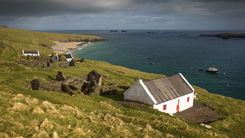
Just off Slea Head lie the Blaskets (Na Blascaodaí), dramatic island mountains with steep, gashed sides. Despite their inhospitableness, the largest island, Great Blasket (An Blascaod Mór), was inhabited by up to two hundred people for at least three centuries until 1953, when, with no school, shop, priest or doctor, it was finally abandoned. Because of their isolation, however, the islanders maintained a rich oral tradition in the Irish language, which in the early twentieth century, encouraged by visiting scholars, evolved into a remarkable body of written literature. Works such as An tOileánach (The Islandman) by Tomás Ó Criomhthain, Fiche Blian ag Fás (Twenty Years A-Growing) by Muiris Ó Súilleabháin and Peig by Peig Sayers (an oral account written down by her son) give a vivid insight into the hardships of island life.
The island’s story is told with great imagination at the Great Blasket heritage centre, Ionad an Bhlascaoid Mhóir, on the mainland opposite, at the north end of Dunquin. Though the building doesn’t look like much as you approach, inside is a beautiful museum space. There are excerpts from the island writers, and a moving section on Great Blasket’s abandonment in 1953 and the migration of many islanders to Springfield, Massachusetts – where they still receive the Kerryman newspaper from Tralee every week. Every October, the centre hosts a commemorative festival, featuring lectures, stage productions and other events (wwww.ceiliuradh.com).There’s a bookshop run by An Café Liteartha, and the café is a good spot for lunch, with fine views of the islands.
Once on Great Blasket, you can wander the white-sand beach, Trá Bán, at its eastern end and the grassy footpaths that cross its six-kilometre length, passing the ghosts of the old village. Accompanied by seals, puffins, storm petrels and shearwaters, you can contemplate the 3000km that separates you, here on Europe’s most westerly islands, from North America where most of the islanders ended up, and the treacherous 2km of Blasket Sound which made living on the island untenable.
Gallarus Oratory
The beautiful Gallarus Oratory is Dingle’s most compelling historic monument, dating from somewhere between the seventh and twelfth centuries. Built entirely of dry gritstone in the shape of an upturned boat, the church sits proudly in its field at the very western edge of Europe like a Platonic ideal of architectural purity, still quite intact and unadorned. Its stones, carefully selected and smoothed off inside and out, and gracefully corbelled to form the roof, are now weathered to soft tones of green, brown, purple and orange. It’s lit by a single window opposite the doorway, while the only features inside are two large, pierced stones above the lintel which probably served for the attachment of a flap-like door. Access to the oratory, which is in state care, is absolutely free, so there’s no need at all to pay €3 at the privately run visitor centre, which comprises a gift shop, café and fifteen-minute audiovisual, sitting between the most obvious car park and the church; instead, continue a short way along the hedgerowed lane to a tiny car park which gives direct access to the oratory.
North Kerry
North Kerry, flat, rich farming land that runs as far as the Shannon estuary, feels quite different from the rest of the county – and they’ve even been known to play hurling rather than Gaelic football up here. Instead of the remote, spectacularly set coastal villages of the peninsulas, you’ll find – or avoid – the traditional, kiss-me-quick resorts of Ballyheigue and Ballybunion, while the county town of Tralee seems quite anodyne if you’ve just come up from Dingle, for example. It is worth making time, however, for Listowel, a characterful small town that’s a hotbed of literary activity.
Tralee Practicalities
The train station, where buses also stop and which has left-luggage facilities, is just a few minutes’ walk northeast of the centre of town. The friendly and helpful tourist office (Jan & Feb Mon–Fri 9.15am–1pm & 2–5pm; March, Nov & Dec Mon–Sat 9.15am–1pm & 2–5pm; April & Oct Mon–Sat 9.15am–5pm; May, June & Sept Mon–Sat 9.15am–6pm; July & Aug Mon–Sat 9am–6pm, Sun 10am–6pm; t 066/712 1288), in the Ashe Memorial Hall underneath the Kerry County Museum, has maps of town and details of local traditional sessions. You can rent bikes from Tralee Gas Supplies in Strand Street on the west side of town (t 066/712 2018) and access the internet at Antech, northwest of the tourist office at 40 Bridge St, next to Sean Óg’s pub.
Denny Street, part of the town centre’s roughly clockwise one-way system, shelters a couple of good accommodation options among its lovely Georgian buildings. The Grand (t 066/712 1499, w www.grandhoteltralee.com; €121–150/£81–100) is a traditional county-town hotel whose rooms, most of which are set back from the busy street, have had a colourful, modern makeover with wi-fi installed. Further down the street, Finnegan’s (t 066/712 7610, www.finnegans.hostel.com; IHH) is a well-appointed hostel and B&B, with en-suite dorms (€20), doubles and twins (€60/£40 and under), a bar-restaurant, a large kitchen, internet access and laundry facilities. There’s also a well-equipped campsite at Woodlands Park, Dan Spring Road (t 066/712 1235, w www.kingdomcamping.com; mid-March to Sept, plus Oct bank-holiday weekend), ten minutes’ walk south of the centre of town.
Your best bet for somewhere to eat is Val’s on Bridge Street, home to a sleek lounge bar downstairs and an informal restaurant upstairs, with a Mediterranean feel and an open kitchen, offering reasonably priced bistro dishes such as pork loin with apple and mustard purée (t 066/712 1559; winter Wed–Sun only). Nearly a dozen of Tralee’s lively pubs boast regular traditional music, notably Seán Og’s opposite Val’s on Bridge Street (summer most nights, winter Thurs–Sun).
Next to the tourist office is the National Folk Theatre of Ireland, Siamsa Tíre (t 066/712 3055, w www.siamsatire.com), which fulfils its remit with excellent Irish shows in the summer, as well as hosting a varied international programme of drama, music, dance and literary events during the rest of the year. Towards the end of August, the five-day Rose of Tralee International Festival (w www.roseoftralee.ie) takes over the town. It’s a slightly questionable but generally good-natured beauty and talent contest, accompanied by much merry-making, which is open to women of Irish birth or ancestry. There’s also a family arts festival at Easter, Samhlaíocht, including puppet shows, exhibitions, music and street entertainment (w www.samhlaiocht.com), an eight-day film festival (w www.kerryfilmfestival.com) in early November, held in the town and around the county, and a three-day circus festival later in the month (w www.traleecircusfestival.com).