Belfast's Cathedral Quarter
The area north of Waring Street has seen much redevelopment in recent years, with plenty of new restaurants and bars opening up – some of which offer a wide range of entertainment, such as the excellent John Hewitt – leading to its acquisition of the term Cathedral quarter to suggest a Parisian ambience, though one as far removed from the Left Bank as it’s possible to imagine.
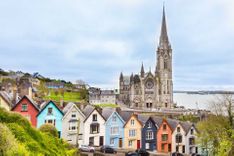
A couple of hundred yards up Donegall Street you’ll find the most monolithic of all the city’s grand buildings, the Protestant St Anne’s Cathedral, a neo-Romanesque basilica started in 1899, but not fully completed until 1981. Entrance is via the huge west door, immediately to the right of which is the baptistery, with an intricately designed representation of the Creation on its ceiling consisting of 150,000 tiny pieces of glass. Most significant, however, is the cathedral’s only tomb, marked by a simple slab on the floor of the south aisle, which contains the body of Lord Edward Henry Carson (1854–1935). The symbol of Partition, he’s seen either as the province’s saviour or as the villain who sabotaged Ireland’s independence as a 32-county state.
Lord Edward Carson
Lord Edward Carson is a name that Northern Ireland has never forgotten. A Dubliner of Scots-Presbyterian background, he took the decision in 1910 to accept the leadership of the opposition to Home Rule, which in effect inextricably allied him to the Ulster Unionist resistance movement. Yet, though this association is about the only thing for which he is remembered, his personality and integrity went far deeper than this. He abhorred religious intolerance, and behind the exterior of a zealous crusader was a man who sincerely believed that Ireland couldn’t prosper without Britain and only wished that a federalist answer could have involved a united Ireland. Nonetheless, this was the same man who, as a brilliant orator at the bar, and in the role he loved the most, brought about the humiliating destruction of Oscar Wilde at the writer’s trial in 1895.
The Laganside
On Donegall Quay is the ambitious Laganside development project, the first component of which to be completed was the Lagan Weir, designed to protect the city against flooding. Millions of pounds have been pumped into dredging the river to maintain water levels and revive the much depleted fish population – successfully it seems: there was salmon fishing on the weir’s inauguration day. However, little can be done to restore the river’s erstwhile crucial role in the successful development of the city as a centre for industries as diverse as linen, tobacco, rope-making and shipbuilding – a glance across the river to the Harland & Wolff shipyard confirms that the last-named still survives.
If the sea air’s twitching your nostrils, head a few hundred yards further north towards the ferry terminals, where you’ll find the restored Harbour Office and nearby Sinclair Seamen’s Church on Corporation Square. The latter is yet another Lanyon design, but it’s the contents that are most intriguing. Sailors must have felt truly at home among the cornucopia of maritime equipment – an old-fashioned wooden wheel, the bell from HMS Hood, assorted navigation lights and a ship’s prow for a pulpit.
The most obvious changes to the city’s skyline can be seen from almost any river viewpoint: further south along Oxford Street sits the glittering two-thousand-seater Waterfront Hall concert venue, a housing development and a Hilton hotel.
The Odyssey
Across the river on Queen’s Quay, the massive Odyssey leisure complex features a ten-thousand-seater indoor arena, cinemas and a complex of bars, restaurants and shops. Also here is the Whowhatwherewhenwhy scientific discovery centre, known as W5 with over 150 interactive exhibits, aimed primarily at children. Best of these is the See/Do section in which you can create your own animated cartoon and have a go at composing on a laser harp. From mid-July to August, W5 also runs a series of special workshops for children – the subjects change annually.
The Golden Mile
The strip of Belfast running south along Great Victoria Street to Shaftesbury Square and thence to the university area and beyond is ascribed the name of the “Golden Mile”, though in its present state its middle is, in truth, mostly a pretty depressing stretch of boarded-up businesses and building sites.
It begins at the grandiose, Victorian Grand Opera House, which sits just a short distance west of Donegall Square at the northern end of Great Victoria Street. At the northern head of the street, almost opposite the Europa Hotel, stands one of the greatest of Victorian gin palaces, the Crown Liquor Saloon. The saloon has a glittering tiled exterior resembling a spa baths more than a serious drinking institution, while inside the scrolled ceiling, patterned floor and the golden-yellow and rosy-red hues led John Betjeman to describe it as his “many coloured cavern”. Once armed with drinks (and if it’s not too crowded, or lunchtime when they’re reserved for diners only), grab one of the snugs and press the button to receive service. If the snugs are all busy, it’s still a great experience to sit or stand at the bar, with its carved-timber dividing screens, painted mirrors and frieze-decorated oak panelling.
Before heading into the university quarter, sidestep off Great Victoria Street into Sandy Row, which runs parallel to the west. A strong working-class Protestant quarter (with the tribal pavement painting to prove it), it’s one of the most glaring examples of Belfast’s divided world, wildly different from the city centre’s increasingly cosmopolitan sophistication, yet only yards away. In Blythe Street and Donegall Road, off to the west, are some of the murals that characterize these sectarian areas (see Belfast’s murals). Sandy Row used to be the main road south and, although hard to credit today, it was once a picturesque stretch of whitewashed cottages.
South Belfast
Towards the Golden Mile’s southern extremity lies the university area, the focal point for South Belfast’s attractions (wwww.visitsouthbelfast.com). You’re likely to spend much of your time in the area, since it boasts plenty of eating places, pubs and a range of accommodation. Near Queen’s University are the lush Botanic Gardens, within which sits the vast Ulster Museum, displaying everything from dinosaur bones to contemporary art. Heading south from here along Stranmillis Road it’s a relatively short step east to the Lagan Towpath, running several miles southwest to Lisburn, while a detour along the way leads to the Neolithic earthwork known as the Giant’s Ring.
The university quarter
Towards the Golden Mile’s southern extremity lies the university quarter. You’re likely to spend much of your time in the area, since it boasts plenty of eating places, pubs and a range of accommodation. Just south of Shaftesbury Square stand three churches – Moravian, Crescent and Methodist – whose distinctive steeples frame the entrance to the university quarter. From here, leading up to the university buildings, the roads are lined with early Victorian terraces that represent the final flowering of Georgian architecture in Belfast. The Upper Crescent is a magnificent curved Neoclassical terrace, built in about 1845 but sadly neglected since; it is now used mainly for office space. The Lower Crescent, perversely, is straight.
Queen’s University is the architectural centrepiece of the area, flanked by the most satisfying example of a Georgian terrace in Belfast, University Square, where the red brickwork mostly remains intact, with the exception of a few bay windows added in the Victorian era. The university building itself was constructed in 1849 as a mock-Tudor remodelling of Magdalen College, Oxford, to a design by Lanyon, and houses a visitor centre, which provides information about the university, hosts a series of art exhibitions, and runs guided tours. Across the road from here is the Students’ Union, a white 1960s design. The Italianate Union Theological College, nearby on College Park, also by Lanyon, was temporarily the site of the Northern Ireland Parliament until 1932 when Stormont was built. A little further south down University Road, the university bookshop is especially good for Irish history and politics and has particularly impressive fiction, drama and poetry sections.
The Ulster Museum
Within the Botanic Gardens is the Ulster Museum which reopened in 2009 after a long redevelopment programme. Retaining its original eighty-year old shell, the Museum now incorporates a bold modernist design and sheds light both literally and figuratively on subjects from the North’s troubled history to Ireland’s geological past. The grand open-plan ground floor, which also features a much-improved café, introduces some of the museum’s themes via its “Window on the World” displays which include everything from an impressive dinosaur skeleton to an Alexander McQueen dress. From here it’s best to head up to the third floor to explore the art exhibits. The undoubted highlights here are the modern art collection (featuring Francis Bacon’s macabre Head II, Bridget Riley’s unnerving Cataract IV and Stanley Spencer’s parochial The Betrayal), and the stunning landscapes and rural scenes by painters such as Belfast’s Sir John Lavery, plus Turner’s highly symbolic Dawn of Christianity.
The second floor features the “Nature Zone”, depicting the Earth’s origins and Ireland’s development up to the Ice Age. Far more engrossing are the first floor’s history galleries which begin with Neolithic remains and Bronze Age finds (including a remarkable three-foot wide decorated shield), before taking a detailed look at the medieval period – two exhibits to look out for here are the somewhat skew-whiff stone inauguration chair of the O’Neills of Clandeboye and the silver gilt arm-reliquary supposedly created to house St Patrick’s hand. The Armada gallery includes plenty of relics from the ill-fated Girona which sank off the Antrim coast in 1588, while the Ascendancy section includes a remarkable rag-bound tally-stick, used to record the number of prayers said during the then illegal outdoor Catholic service, as well as highlighting the effects of the Great Famine.
From here the exhibits quicken up a pace, especially when focusing upon the War of Independence and the North’s resistance to Dublin rule, before looking at Belfast during World War II and concluding with a disappointingly bland space devoted to The Troubles.