The Wicklow coast
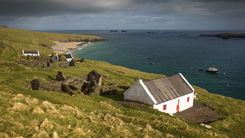
County Wicklow’s main draw is without doubt the stunning scenery of the inland mountains, but the coast can offer some very attractive beaches, notably at Brittas Bay, south of Wicklow town, and is easily accessible from Dublin. The N11 runs the length of the county roughly parallel to the sea, while by train, the DART service runs as far as Bray and Greystones, and the scenic mainline to Enniscorthy, Wexford and Rosslare Harbour stops at Bray, Greystones and Wicklow town. Keen to maintain its independence from Dublin, Bray is a lively, sometimes rowdy, resort and commuter town, which offers an expansive beach and the finest walk along this coast, across Bray Head to the village of Greystones. Halfway down the county’s seaboard, Wicklow town enjoys a fine setting and a good choice of upmarket places to stay – if you have your own transport, this would make a good base for exploring the mountains. Concentrated in the coastal strip, the Wicklow Gardens Festival runs from Easter to September every year, when a wide variety of privately owned gardens throw open their gates to the public (wwww.visitwicklow.ie/gardens).
Book tickets and tours in Wexford
A walk over Bray Head to Greystones
There’s an excellent two- to three-hour walk from Bray seafront south across Bray Head to Greystones, a small commuter town at the end of the DART line with several pubs serving food. You can follow the comparatively flat cliff path that runs above the rail tracks for most of the way, giving close-up views of rocky coves and slate pinnacles, lashed by magnificent waves on windy days. Alternatively, if you have more time, take on the steep climb over the top of Bray Head for great views of Killiney Bay and the cone-shaped hills inland known as Little Sugar Loaf and Great Sugar Loaf, with a distant backdrop of the Wicklow Mountains. The latter route ascends rapidly from the end of Bray seafront through pine woods and over gorse slopes to a large cross, 200m above sea level, which was erected to mark the Holy Year of 1950; from here a track winds across the ridge below the 240-metre summit of Bray Head, before you turn sharp left down to join the cliff path which will bring you into Greystones.
County Kildare
In contrast to the harsh landscape of the Wicklow Mountains to the east, County Kildare is prosperous farming country, which was gladly seized and fortified by the English as part of the medieval Pale. Rich pasture for cattle and horses in the north of the county gives way to fertile ploughland in the south, the Bog of Allen in the northwest providing the only unproductive blot on the landscape. The county’s main attractions for visitors are neatly concentrated in two areas. Servicing the bloodstock farms on the Curragh’s lush heathland, Kildare town is generally a low-key affair, where you can explore the monastery and church founded by St Brigid in the fifth century, and see what all the equine fuss is about at the fascinating National Stud. To the north of town, you can trace the develop- ment of the Bog of Allen at the nature centre in Lullymore. Meanwhile up on the county’s northern edge lie the motley attractions of Larchill Arcadian Gardens, as well as one of Ireland’s finest stately homes, Castletown.
Kildare town
In KILDARE’s quiet moments, of which there are many, you are keenly aware that the pre-eminent local business all takes place outside of town. For the Curragh, which stretches east from the town to the River Liffey, is Ireland’s horse-racing centre. The underlying limestone of this huge plain, the largest area of semi-natural grassland in Europe, is good for a horse’s bone formation, and the grass is said to be especially sweet. Consequently, the Curragh is home not only to a famous racecourse, but also to dozens of stud farms and stables, engaged in the multimillion-euro pursuit of breeding and training racehorses, one of the country’s biggest sources of income – as vividly illustrated at the National Stud.
The Bog of Allen
To the north of Kildare town lies the great Bog of Allen, Ireland’s most famous peatland. Actually a complex of bogs that once covered two thousand square kilometres between the rivers Liffey, Barrow, Shannon and Boyne, it’s now much diminished by drainage and stripping. The best place to get a handle on the bog is LULLYMORE, a tranquil parish and former monastic settlement on the road to nowhere 16km north of Kildare, which sits on an island of mineral soil, surrounded by peat. Here you’ll find the Bog of Allen Nature Centre, run by the Irish Peatland Conservation Council, a charity whose aim is to ensure the conservation of a representative sample of Irish bogs. Informative exhibits at the centre, which is housed in the farm buildings of nineteenth-century Lullymore Lodge, trace the development of bogs, as well as their significance as habitats for rare animals and plants. The latter include species such as sundews, butterworts and pitcher plants, which have developed the capacity to eat insects, as the peat they grow on is deficient in nutrients; a small greenhouse in the centre’s back garden displays carnivorous plants from Ireland and around the world, and their various methods of drugging, gluing or otherwise catching the poor critters. Next to the centre, a hundred-metre boardwalk has been built over Lodge Bog, a small raised bog that’s home to around 150 species of plants, including carnivorous round-leaved sundews, as well as mountain hares, foxes and over seventy species of butterflies and moths.
Castletown
The oldest and largest Palladian country house in Ireland, Castletown is also one of the very finest. Its plain, grey but elegant facade, built in the style of a sixteenth-century Italian town palace, conceals a wealth of beautiful and fascinating interior detail. The house was built for William Conolly, son of a Donegal publican who, as legal adviser to William III, became the wealthiest man in Ireland from dealing in forfeited estates after the Battle of the Boyne. Though construction began in 1722, under first the Italian architect Alessandro Galilei and then his acquaintance, Edward Lovett Pearce, the interior was still unfinished at the time of Conolly’s death seven years later. A second phase of work began in 1758, when great-nephew Tom Conolly married the 15-year-old Lady Louisa Lennox, who set about altering and redecorating the house to restrained, Neoclassical designs by Sir William Chambers, the architect of the Casino at Marino, Dublin.
Larchill Arcadian Gardens
Larchill Arcadian Gardens, 5km north of Kilcock, are well worth a short detour off the M4 to the northwest of Celbridge. Painstakingly restored, Larchill is the only complete surviving example in Europe of a ferme ornée (“ornamental farm”), the first type of garden to feature, under the influence of eighteenth-century Romanticism, elements of the natural landscape. Such gardens attained a degree of modishness among wealthy landowners during the latter half of the century, inspired by the influence of Versailles. Beautiful parkland walks, along beech avenues and past ornate bridges, statuary and gazebos, link ten follies, in both Classical and Gothic style. These include Gibraltar, a lake island with a copy of the fortress on the Rock of Gibraltar, where mock naval battles were fought in the eighteenth century, and Foxes’ Earth. This grassy mound, pierced with tunnels, was constructed for a reformed fox-hunter, who, believing that he was to be punished in the next life by being reborn as a fox, needed somewhere to get away from the hounds.
The Grand and Royal canals
County Kildare is traversed by the Royal and Grand canals, which run from Dublin to the River Shannon. Reminders of Ireland’s mercantile confidence in the eighteenth century, before the disenfranchisement of the Act of Union, they were built to service the mills, distilleries and breweries of a minor industrial revolution. Passenger boats on both canals were soon eclipsed by the railways and stopped running around 1850, but freight services continued until as late as 1960.
Completed in stages between 1779 and 1805, the Grand Canal heads out from south Dublin to Robertstown in County Kildare, where it splits into two branches. The 50km southern branch (aka the Barrow Line), completed in 1791, meets the River Barrow at Athy in the south of the county, allowing passage as far south as Waterford; the main waterway runs west via Tullamore in County Offaly to Shannon Harbour, a total of 114km from Dublin.
The Royal Canal, a rival northern route opened between 1796 and 1816, was never quite as successful, though it managed to reach a peak tonnage of 112,000 in 1847. It runs along the northern border of County Kildare, before heading northwest to Mullingar and joining the Shannon, 144km from north Dublin, at Cloondara in County Longford.
The canals are flanked by a series of pleasantly undeveloped – and easy-to-follow – trails, the Royal Canal Way, the Grand Canal Way and the Barrow Way. Go to www.kildare.ie/tourism for full details and descriptions of the routes as they pass through Kildare. It’s also possible to rent a narrowboat from Royal Canal Cruisers in Dublin (t01/820 5263, wroyalcanalcruisers.com) or, for the Grand Canal and the Barrow, from Canalways, Rathangan, Co. Kildare (t087 243 3879, wwww.canalways.ie), or Barrowline Cruisers, Vicarstown, Co. Laois (t05786/26060, wwww.barrowline.ie).
The National Stud
The National Stud shows the highly evolved business of horse breeding in action. Here, you can look round the stables themselves and stroll through two attractive on-site gardens (included in the admission price). Based at Tully on the south side of Kildare, it’s a well-signposted 2km from the town centre, across the M4.
The stud farm was established here, by the mineral-rich River Tully, in 1900 by Colonel William Hall Walker, of the famous Scotch whisky family. Hall Walker’s methods were highly successful, though eccentric: each newborn foal’s horoscope was read, and those on whom the stars didn’t shine were immediately sold, regard- less of their lineage or physical characteristics. In 1915, the colonel presented the farm to the British government – who promptly made him Lord Wavertree – on condition that it became the British National Stud. It was finally transferred to the Irish government in 1944 at an agreed valuation.
Within the attractive grounds, with their various yards, paddocks and stallion boxes, as well as a café, you can watch traditional saddlers and farriers at work. But the highlight of the tour has to be the horses themselves. They include fallabellas from Argentina, the smallest horses in the world (above pony height), as well as top stallions who command up to €75,000 for what’s quaintly called a live cover and who jet as far afield as Australia to mate with local mares. From February until July, you should be able to see mares and their young foals in the paddocks.
The beautiful and playful Japanese Garden was created by Colonel Hall Walker along with two Japanese gardeners on a reclaimed bog between 1906 and 1910. A product of the Edwardian obsession with the Orient, it symbolizes the life of man from oblivion to eternity. Over miniature hills and waterfalls, past colourful flowers and trees, you follow from birth to death a delightful numbered trail, which yields a choice between bachelorhood and marriage, as well as a few false leads along the way.
The recently created St Fiachra’s Garden close by is perhaps a little less compelling. St Fiachra was an Irish monk from a noble family who established a much-revered hermitage near Kilkenny town in the early seventh century.
Book things to do in Kilkenny
The hermitage became too popular for its own good, however, and the saint was forced to move to France, where he eventually founded another retreat near Meaux, 40km northeast of Paris, before his death in about 670. Fiachra always encouraged his disciples to cultivate gardens, from which they could distribute produce to the poor, and thus became the patron saint of gardeners – as well as of French taxi-drivers (after the cabs, known as fiacres, which used to take pilgrims from Paris to his shrine at Meaux). The garden comes across as a stylishly enhanced arboretum, encompassing a lake in which has been placed a group of 5000-year-old bog-oak trunks, branchless and blackened, suggesting not only death but also longevity.
County Meath
The rich limestone lowlands of County Meath, bisected by the River Boyne and supporting ample cattle pasturage, have always attracted settlers and invaders. The valley’s Neolithic people somehow found the resources and manpower to construct the huge, ornately decorated passage graves of Newgrange, Knowth and Dowth, part of the extraordinary landscape of ritual sites known as Brú na Bóinne, which is today one of the country’s most famous and best organized visitor attractions. In contrast, the Loughcrew Cairns, a similarly extensive grouping of burial mounds in the far northwest corner of the county beyond the small market town of Kells, have failed to garner present-day resources for excavation and tourist development, leaving you to explore this mysterious, hilltop landscape unaided and usually in solitude. The Hill of Tara started out as a Stone Age cemetery, too, but evolved into one of Ireland’s most important symbolic sites, the seat of the High Kings of the early Christian period. Meath also caught the eye of the Anglo-Norman invaders, who heavily fortified and held several parliaments at Trim, where you can visit the mighty castle and several other well-preserved medieval remnants. Meath’s other noteworthy sights are on either side of Brú na Bóinne in the northeast of the county: to the west Slane’s historic castle and monastery, which enjoy a picturesque setting on a steep, wooded hillside above the River Boyne; and to the east, the site of one of the most significant battles in Ireland’s history, the Battle of the Boyne, now commemorated by a high-tech visitor centre.
Trim
Fifty kilometres northwest of Dublin, TRIM is one of the most attractive towns within striking distance of the capital. Its imposing Anglo-Norman castle overlooks the curving, tree-flanked River Boyne and some picturesque ruins across on the north bank, while green meadows run downriver to the extensive remains of two medieval churches and a fine bridge. Trim is also the easiest jumping-off point for the Cistercian abbey of Bective, set in lush countryside to the northeast.