The Siege of Derry
Derry’s walls underwent – and withstood – siege on a number of occasions during the seventeenth century. The last of these, in 1688–89, played a key part in the Williamite army’s victory over the Catholic James II at the Battle of the Boyne, when the Derrymen’s obduracy crucially delayed the plans of James and his ally Louis XIV to maintain Catholic ascendancy over the kingdom.
The suffering and heroism of the fifteen-week siege, the longest in British history, still have the immediacy of recent history in the minds of Derry Protestants. James’s accession in 1685 had seen the introduction of a policy of replacing Protestants with Catholics in leading positions in the Irish administration and army. In December 1688, a new garrison attempted to enter the city, but was prevented when a group of young apprentices seized the keys and locked the city’s gates. Eventually, after negotiation, an all-Protestant garrison under Governor Robert Lundy was admitted. Over the following few months the city’s resident population of two thousand swelled to thirty thousand as people from the surrounding area took refuge from Jacobite forces advancing into Ulster. Fearing that resistance against the Jacobite army was futile, Lundy departed; his effigy is still burnt each December by Protestants. Around seven thousand Protestants died during the siege that followed, the survivors being reduced to eating dogs, cats and rats. Today, the siege is commemorated with a skeleton on the city coat of arms, and the lyrical tag “maiden city”, a somewhat sexist reference to the city’s unbreached walls.
The walls
The best approach to Derry's walls is from the Guildhall Square, once the old quay, east of Shipquay Gate. The Neogothic ecclesiastical appearance of the Guildhall belies its true function as the headquarters of the City Council. Inside, the city’s history is depicted in a series of stained-glass windows. Most of the city’s cannons are lined up opposite here, between Shipquay Gate and Magazine Gate, their muzzles peering out above the ramparts. A reconstruction of the medieval O’Doherty Tower here houses the Tower Museum, whose showpieces are a series of stimulating displays and galleries recounting the city’s history and a splendid exhibition, spread over four storeys, focused on Spanish Armada Treasures, which features gold artefacts and finely worked jewellery from La Trinidad Valencera, which sank in Kinnegoe Bay (off Inishower) in 1588.
Southern County Derry
The Derry–Antrim A6 road follows a river valley through fertile farming land before reaching Dungiven, a former political and religious power-base with ruined evidence of its former glories, then ascends to the Glenshane Pass on the northeastern fringe of the Sperrin Mountains. Southeast from here are Magherafelt and Moneymore, two attractive and entirely planned towns, the latter adjacent to the grand Plantation manor house of Springhill. The huge expanse of Ireland’s biggest lake, Lough Neagh, laps against the county’s southeastern corner and here too is one of the must-see sights of the entire North, Bellaghy Bawn castle.
Dungiven
DUNGIVEN, some twenty miles southeast of Derry, is a fairly unremarkable town, though it does harbour one or two ruins of interest, including the ruined Augustinian Dungiven Priory. Originally a stronghold of the O’Cahan clan, Dungiven was given to the Skinners’ Company of London to settle in the seventeenth century. The remains of the O’Cahan fortifications are incorporated into the newly restored castle, whose battlemented outline gives Dungiven a particularly historic aspect when approached from the south. The castle dates back to 1839 and is set in 22 acres of parkland with views across to the Sperrins. During World War II, it was used as a dance hall by American troops, and in 1971 it was the scene of an attempt to set up an independent Northern Ireland parliament. Following restoration work, it now houses upmarket guesthouse accommodation and a restaurant.
Book tickets and tours in Cork
Lough Neagh
East of Magherafelt and Moneymore are the fish-filled waters of the biggest lake in Ireland, Lough Neagh. Tributaries flow from every point of the compass: the Lower Bann, which drains the lake and runs north to Lough Beg (finally reaching the sea north of Coleraine), contains some huge trout, including the dollaghan, unique to these waters. Similar to salmon – which are also common – dollaghan grow by three pounds every year and can be caught by spinning, worming and fly-fishing: the Ballinderry Black and the Bann Olive are famous flies derived from this region. The best fishing is from mid-July to October but you will need a Fisheries Conservation Board Rod licence, available from tourist offices. Information on day-tickets for fishing and specialist boat-trips, respectively issued and run by the Lough Neagh Angling Association, can also be obtained from the tourist office.
Bellaghy Bawn
One of the best surviving examples of a plantation castle is Bellaghy Bawn, built in 1618 by the Vintners’ Company. Most of its fortifications were lost in 1641, but it still retains a striking circular flanker tower which has been well restored. Inside you’ll find fascinating interpretive displays explaining the 7000-year-old history of the settlements in this area, the construction of the village – today’s houses still occupy the same original allocated plots of land – and the diverse ecology of the Lough Beg wetland area. The real treasure here, however, is the dedication of much of the Bawn’s space to one of the world’s greatest living poets, Seamus Heaney, who was born and raised nearby. Heaney himself is the star of a unique and atmospheric film showing in the Bawn, A Sense of Place, in which he reflects on the influence of his upbringing, local character and landmarks on his poetry. His father, for instance, rented grazing rights on the strand at Lough Beg; in his poem Ancestral Photograph, Heaney recalls helping to herd the cattle that grazed there down Castle Street on their way to market. Prints of other poems are displayed on the walls of various rooms, and the Bawn’s library contains the ultimate collection of his works, including first drafts and extremely limited editions.
You can see the shimmering Lough Beg from the windows of the flanker tower, and a stroll down to the lake is well worthwhile. In summer, its waters recede and Church Island becomes accessible from the shore. Besides a walled graveyard, you’ll find the ruins of a medieval church here, said to have been founded centuries before by the ubiquitous St Patrick, with a tower and spire added in 1788 by the eccentric Frederick Augustus Hervey to improve his view from Ballyscullion House on the mainland nearby. He commissioned Charles Lanyon to build a huge replacement for the original house which stood here, with, apparently, 365 windows, but died abroad before ever moving in, and the building subsequently fell into ruin.
The plantation towns
Southeast of Dungiven and over the Glenshane Pass on the way to the northern tip of Lough Neagh, it is worth making a detour to see some interesting examples of town planning – the plantation towns of the London companies, most of them characteristically focused around a central Diamond.
One such town is MAGHERAFELT, granted to the Salters’ Company by James I, which has a wide, sloping main street and makes a reasonable base for exploring the lough and the Bellaghy area. MONEYMORE, about five miles further south, was originally constructed by the Drapers in the early seventeenth century (and restored by them in 1817), and was the first town in the North to have piped water – amazingly enough, as early as 1615.
A mile outside town off the B18, Springhill is a grand plantation manor-house built between 1680 and 1700 by William “Good- Will” Conygham in order to fulfil a marriage contract with the father of his bride- to-be, Anne Upton. Elegant both without and within, its sober whitewashed architecture houses fine rooms, equipped with original period furniture and paintings belonging to William and his descendants, who occupied the house until 1959. Upstairs, the Blue Room is said to be haunted by the ghost of Olivia Lenox- Conyngham, whose husband George was found shot here in 1816. Outside, the stables house a costume collection, which adopts a specific theme each year, drawing upon three thousand items collected from the mid-seventeenth century to the 1970s. There are also delightful gardens, a tower dating from the 1730s, which was probably originally part of a windmill, and a pleasant walk through beech and yew trees.
Seamus Heaney
It’s impossible to conceive of a contemporary poet, Irish or otherwise, whose works are more evocative of time and place than Seamus Heaney. He was born, the eldest of nine children, on the family farm of Mossbawn (itself the title of two poems in his fourth collection, North), in the townland of Tamniarn, near Bellaghy, on April 13, 1939. Heaney’s family background, his Catholic upbringing and his study of Irish at school imbued him with a strong sense of being Irish in a state that considered itself British, a paradox that would form a major motif in his work during the 1970s. While at Queen’s University, Belfast, he was further influenced by the literature he discovered in Belfast’s Linen Hall library, especially the works of John Hewitt, the Antrim-born “Poet of the Glens”, and the English “naturalist” poet Ted Hughes, in whose work he found an “association of sounds in print that connected with the world below”. The rural Monaghan setting of Patrick Kavanagh’s poetry further echoed his own experience and vision.
Book ticket and tours to EPIC Irish Immigration Museum
Heaney’s first poem, Tractors, was published in the Belfast Evening Telegraph in 1962. His first significant collection, Death of a Naturalist, followed in 1966 and was immediately recognized for its earthiness and command of diverse metrical forms. In the 1960s, while lecturing at Queen’s, Heaney’s career expanded into journalism and television and he became increasingly involved in the civil-rights movement. His response to the Troubles saw him seeking for “images and symbols adequate to our predicament” and he began to see poetry as a mode of resistance. Eventually, though, the violence so disturbed him that he moved with his family to County Wicklow, prompting Ian Paisley’s Protestant Telegraph to bid farewell to “the well-known papist propagandist” on his departure to his “spiritual home in the popish republic”. While his 1970s collections North and Field Work had mixed receptions – some saw the strong influence of Robert Lowell on the former – Heaney found himself turning increasingly to his Irish heritage as a source of inspiration, particularly the long medieval poem Buile Suibhne (The Madness of Sweeney), and published his own Sweeney Astray collection in 1983. The following year’s Station Island drew on his experiences as a participant in St Patrick’s Purgatory.
The hunger strikes of the early 1980s brought a new urgency to Northern politics and a revival of Heaney’s polemicism. Prompted by the staging in Derry in 1980 of Brian Friel’s play Translations, which showed English surveyors travelling through eighteenth-century Ireland anglicizing all the place names, Heaney cofounded the Field Day Theatre Company with Friel, his old friend and fellow academic Séamus Deane, the actor Stephen Rea and others. While the group’s theatrical activities were themselves controversial, it was their publications that engendered the most antipathy. Their pamphlets were criticized as attempts to over-intellectualize the Troubles and the 1991 Field Day Anthology of Irish Writing was decried for its under-representation of work by women writers, though a subsequent volume entirely devoted to them has since been published.
Heaney’s reputation, however, has remained largely unsullied, maintained not merely by the sheer literary strength of his work and its ready accessibility, but by his undoubted charisma and a lack of pomposity. In 1995, his body of work was more widely recognized by the award of the Nobel Prize for Literature. Heaney’s recent works include: a translation of the Anglo-Saxon epic poem Beowulf, his dramatic retelling of this tale of monster- and dragon-slaying managing to breathe new life into a work that was long considered too dense and metaphorical for a modern readership; and his collection, District and Circle, which won the prestigious T.S. Eliot Prize for Poetry in 2006.
Derry city
DERRY, which lies at the foot of Lough Foyle, is a crossroads city in more ways than one: roads from all cardinal points arrive here, but it was also a major point of emigration from the eighteenth century onwards, an exodus that reached tumultuous proportions during the Great Famine. Derry is the fourth largest city in Ireland and the second biggest in the North, but it has a markedly different atmosphere from Belfast, being two-thirds Catholic. While roads into the city are signposted in Irish welcoming visitors to Derry, the city still appears as “Londonderry” on many road maps and signs, a preference adhered to by the British government, Unionists and television news bulletins. Indeed, it has also acquired the nickname “Stroke City” – a reference to the tactful placating of both Nationalist and Unionist traditions by entitling it “Londonderry/Derry”. Whatever the case, locals of both persuasions now generally refer to their city as “Derry”.
Outside Ireland, the name of Derry recalls the Troubles and savage events like the Bloody Sunday massacre. Unlike Belfast, the cutting edge of violence receded considerably here even before the ceasefires, and the city is still imbued with a real sense of optimism, despite losing trade to nearby Letterkenny whenever the euro falls against the pound.
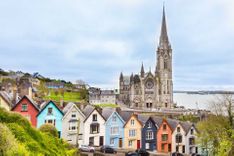
Approached from the east in winter twilight or under a strong summer sun, the city presents a beguiling picture, with the vista of the River Foyle and the rise of the city’s two hillsides, terraced with pastel-shaded houses and topped by the hueless stone spires of the ever-present religious denominations. With its rich history, Derry has several worthwhile attractions, mostly enclosed within the seventeenth-century walls, one of the best-preserved defences in Europe. A mile in length and as high as a two-storey house in places, the walls are reinforced by bulwarks and bastions and a parapeted earth rampart as wide as any thoroughfare. Within their circuit, the original medieval street-pattern has remained, with four gateways surviving from the original construction, albeit in slightly revised form. A tour of the walls also includes views of the Catholic Bogside area, whose political murals symbolize key moments in Derry’s history during the Troubles.