Mount Akrafjall
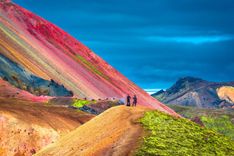
On approaching Akranes from the Ringroad you’ll have driven by Akrafjall mountain; at 643m, it dominates 200m higher than Reykjavík’s Mount Esja, and dominates the skyline east of town. The mountain offers one of the best panoramas in the west of Iceland, with spectacular views not only of Akranes but also, on a clear day, of Reykjavík. On a sunny day you’ll find most of the town out here, either climbing the flat-topped mountain itself or picnicking in the lush meadows at its foot – during summer you’ll also find copious numbers of seabirds, especially kittiwakes, nesting on Akrafjall’s craggy sides. Of the mountain’s two peaks, the southern one, Háihnúkur (555m), is easier to climb thanks to a well-defined path leading to the summit from the car park below. The higher northern peak, Geirmundartindur, is split from the other by a river valley, Berjadalur, through which most of Akranes’ water supply flows.
Glymur
From Mount Akrafjall, Route 47 winds its way east around the northern shore of Hvalfjörður towards Iceland’s highest waterfall, Glymur. The falls drop nearly 200m from the boggy ground to the west of Hvalvatn lake, but it can be difficult to find a vantage point from where to see the spectacle at its best. A rough track leads up through Botnsdalur valley at the head of Hvalfjörður towards the falls – allow about an hour from the road. Incidentally, according to Icelandic folklore, a mythical creature, half-man, half-whale, which once terrified locals from its home in the dark waters of Hvalfjörður, was tricked into swimming out of the fjord, up the river and the Glymur falls, before dying in the waters of Hvalvatn – where, oddly, whale bones have been found.
Borg á Mýrum
Another site mentioned in the sagas, the farm of Borg á Mýrum, is easily reached by buses to the Snæfellsnes peninsula. First settled by Skallagrímur Kveldúlfsson, Egill’s father, Borg á Mýrum is, to Icelanders at least, of double historical significance because of its association with one of Iceland’s greatest writers, Snorri Sturluson. It’s a popular spot with misty-eyed home-grown tourists, though few remain more than ten minutes or so, because the original farmhouse is long gone and there’s precious little to see here today other than a small white church, the borg (or large rock), after which Skallagrímur’s original farm was named, and a sculpture by Ásmundur Sveinsson entitled Sonatorrek, after Egill Skallagrímsson’s moving poem. Like so many of Iceland’s historical sites, archeological remains are thin on the ground, so you’ll have to arm yourself with the facts and let your imagination do the rest.
The men of Borg
Skallagrímur Kveldúlfsson ended up at Borg á Mýrum very much by chance after falling foul of his king, Harald Fairhair of Norway. Together with his father, Kveldúlfur (“Evening Wolf”, so-called because he grew violent and supernaturally strong as dusk came on), he fled the wrath of King Harald and set sail westwards for Iceland. However, during the lengthy and stormy voyage, Kveldúlfur fell ill and ordered that, on his death, his coffin be tossed overboard and his grieving family settle wherever it washed up. Following his father’s instruction, Skallagrímur first set foot in Iceland in an area rich in bogs, forests and salmon rivers, at Borg á Mýrum (Rock in the Bogs), where he raised his family, naming the surrounding area, accordingly, Borgarfjörður (Rocky Fjord).
The third great man to live at Borg was Snorri Sturluson. At the age of 19 Snorri married the only daughter of Father Bersi the Wealthy, of Borg, and moved to the farm following his father-in-law’s death in 1202 to run the estate as his heir. However, his marriage was not a happy one and just four or five years later, around 1206, he decided to move inland to Reykholt, leaving his wife behind.
Húsafell
Route 518 runs 25km east from Reykholt to the pastoral hamlet of Húsafell, a favourite activity centre for holidaying Icelanders and a fantastic place to fetch up for a couple of days of hiking and sightseeing. Though the main draw here was always the vast lavafield Hallmundarhraun, things are changing fast in little Húsafell, which has big aspirations thanks to its proximity to Iceland’s second-biggest glacier, Langjökull. A stylish new hotel has been built in the village, there are plans to revamp the swimming pool and transform it into a spa, and a new bistro has also opened. Although the locals are coy about all these developments, it’s plain to see that they’re linked with what’s been happening up on the glacier. Húsafell is now the departure point for adventure tours which not only go up onto the ice cap – nothing new there – but, quite extraordinarily, into it, as well .
Clearly, as thousands upon thousands of tourists flood in to shy and retiring Húsafell, the village is changing and, naturally, opinion is split across Iceland about whether offering tours inside a glacier is the right thing to do. Be that as it may, in Húsafell everyone wants a piece of the cake and more development will surely follow.
In addition to tours into Langjökull, Húsafell also makes a good base for some excellent hiking trails leading off into the Húsafellsskógur forest and, more adventurously, up to two other nearby glaciers, Eiríksjökull and Okjökull. In summer, you can also push further out from here for a taste of Iceland’s Interior, by following the Kaldidalur route (Route 550) southwest to Þingvellir. Public buses can get you as far as Reykholt, but from here you really need your own vehicle to explore.
Set amid dwarf birchwoods, the village itself consists of little more than a church, originally built in 1170 but today dating only from 1905, and a hundred or so private summer cottages, mostly owned by the trade unions (whose employees use the cottages in rotation) and individual families. Note that there are no street addresses in Húsafell – just head to the hotel and all services are located adjacent to it.
Hiking around Húsafell: Okjökull and Eiríksjökull
One of Iceland’s smaller glaciers, Okjökull (Ok) is perfect for a day-hike from Húsafell. At a height of 1141m, the glacier sits in a dolerite shield volcano and is easily reached from Húsafell by first following the western edge of the Bæjargil ravine up to the Drangsteinabrún ridge. Cross to the eastern side of the small ponds which lie south of the ridge and continue straight up to Ok. On a clear day the views from here are truly spectacular – west you can see to the coastline and the town of Borgarnes, while inland there are sweeping vistas of the Interior. Allow five or six hours and take enough food and drink to last for a day.
Immediately east of Húsafell, the peak of Eiríksjökull (1675m), on the glacier of the same name, is the highest mountain in western Iceland and the long hike here should only be undertaken by seasoned walkers. Before setting out, get detailed information from the service centre in Húsafell, where you can also get helpful maps; the following description, however, should help you trace your route along them. Head along the hard, dry grass of the northern slope of Strútur mountain, northeast of Kalmanstunga farm, from where there are difficult trails east across Hallmundarhraun to Hvítárdrög at the foot of the glacier. Begin the climb itself by hiking up the prominent ravine on the western edge of the glacier, remembering your route to help your descent – it can be very disorientating up here. Beyond the ravine, the going gets considerably easier, but watch out for crevasses. Allow a full day and bear in mind that sun-melt can make the hike a lot harder.
Hraunfossar and Barnafoss
Six kilometres west of Húsafell on Route 518, the waterfalls of Hraunfossar and Barnafoss are two of the best-known natural features in Iceland. Although both are on the Hvítá, it’s Hraunfossar (Lava Falls) that make for the best photographs; however, don’t expect thundering white torrents – the falls here are gentle cascades of bright, turquoise water, emerging from under the moss-covered lava to tumble down a series of rock steps into the river. From here, a track leads upstream to Barnafoss (Children’s Falls), which is far more lively – it was here that two children fell to their deaths when crossing a narrow stone arch that once spanned the river. A modern footbridge now affords an excellent view of the water churning violently as it channels through the ravine below.
The Kaldidalur interior route
From Húsafell, Route 550 (Kaldadalsvegur) winds its way southwest through the haunting beauty of the Kaldidalur valley on its way to the information centre and campsite at Þingvellir, a distance of around 60km. If you’re short of time but want a taste of the barren expanses of the Icelandic Interior, this is a good option: you’ll come face to face with four glaciers – Eiríksjökull, Okjökull, Langjökull and Þórisjökull, a small oval-shaped ice cap rising to a height of 1350m – and pass through a vast grey desert where ferocious sandstorms can appear in seconds, transforming what was once a clear vista of majestic ice caps and volcanic sands into an impenetrable cloud of grit and dirt. As the neck of land carrying the road narrows to pass between the Ok and Þórisjökull glaciers, the route climbs and rides along the straight Langihyrggur ridge affording spectacular views of Þórisjökull opposite.
The Kaldidalur route is unsealed and rough, though generally open to conventional vehicles from mid-June until late August – you’ll need to check road conditions in advance through vegag.is.
Langjökull
Just 20km southeast of Húsafell, in an isolated location on the western edges of the Interior, lies Iceland’s second-largest ice cap, Langjökull (Long Glacier). Covering 950 square kilometres, the glacier resembles a narrow protruding finger wedged between the Hallmundarhraun lavafield and Kjölur, and is visible for miles around. It’s now the subject of the tour that everyone in Iceland is talking about – a trip inside a glacier. Until now, at various locations across the country, it’s been possible to take a trip by special vehicle up onto a glacier, but never to go inside a live, moving glacier. In June 2015 that all changed and Húsafell is at the forefront of this ground-breaking development.
Langjökull tours
Tours begin either at the service centre in Húsafell (next to the bistro), or at the so-called base camp where the gravel road up towards the glacier peters out; the exact location changes depending on the extent of the glacier so you should always check when you book where you should meet the tour if you decide to make your own way to the start point. Here, you transfer to a converted mobile rocket launcher, formerly in service with NATO, equipped with huge tyres which can be automatically deflated or inflated depending on the ice conditions. Having trundled up the glacier to a height of 1260m above sea level, you’re now at the entrance to the series of tunnels which have been hollowed out from the icecap. It takes roughly an hour to walk through the 600m of tunnels which form a circular loop – at the furthest extent you’ll be around 200m inside the glacier with 30m of snow and ice above and 300m below you. Since the glacier moves at around 20–30cm per year and the tour is in its infancy, it’s not yet known what will happen to the tunnels over time, though it’s expected some renovation work will be required to keep them open. In total, the tour lasts around two hours, though the descent by glacial truck back down the glacier is much faster than the ascent.
Should you decide not to take the tour, you can still see Langjökull if you take either the Kjölur or Kaldidalur Interior routes, since both roads pass close to its foothills.