Alónissos
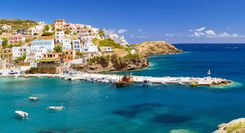
ALÓNISSOS is the largest and only permanently inhabited member of a mini-archipelago at the east end of the Sporades. It’s more rugged and wild than its neighbours, but no less green; pine forest, olive groves and fruit orchards cover the southern half, while a dense maquis of arbutus, heather, kermes oak and lentisc cloaks the north. In part thanks to its marine park status , some of Greece’s cleanest sea surrounds Alónissos – the beaches rarely match those of Skópelos or Skiáthos for sand or scenery, but the white pebbles on most of them further enhance the impression of gin-clear water. Remoteness and limited ferry connections mean that Alónissos attracts fewer visitors than its neighbours. There is, however, a significant British and Italian presence (the latter mostly in all-inclusive hotels), while Greeks descend in force all summer.
The National Marine Park of Alónissos-Northern Sporades
Founded in 1992, the National Marine Park protects monk seals, dolphins, wild goats and rare seabirds in an area encompassing Alónissos plus a dozen islets speckling the Aegean to the east. None of these (save one) has any permanent population, but a few can be visited by excursion boats, weather permitting. Pipéri islet forms the core zone of the park – an off-limits seabird and monk-seal refuge, approachable only by government-authorized scientists. Peristéra, opposite Alónissos, is uninhabited, though some Alonissans cross to tend olive groves in the south; it’s little visited by excursion craft except for a brief swim-stop at the end of a cruise. Well-watered Kyrá Panayiá, the next islet out, has a tenth-century monastery whose old bakery and wine/olive presses, restored in the 1990s, are maintained by one farmer-monk. Nearby Yioúra has a stalactite cave which mythically sheltered Homer’s Cyclops, plus the main wild-goat population, but you won’t see either as kaïkia must keep 400m clear of the shore. Tiny, northernmost Psathoúra is dominated by its powerful lighthouse, the tallest in the Aegean; some excursions stop for a swim at a pristine, white-sand beach.
Hiking on Alónissos
Although its often harsh, rugged landscape might suggest otherwise, of all the Sporades Alónissos caters best to hikers. Fifteen routes have been surveyed, numbered and admirably signposted: many provide just short walks from a beach to a village or the main road, but some can be combined to make meaty circular treks. The best of these are trail #11 from Áyios Dhimítrios, up the Kastanórema and then back along the coast on #15 (2hr 30min), or trails #13 plus #12, Melegákia to Áyios Konstandínos and Áyios Yeóryios (just over 2hr, including some road-walking to return to start). Island resident Chris Browne’s comprehensive walking guide, Alonnisos Through the Souls of Your Feet, is available locally; he also leads guided treks (alonnisoswalks.co.uk).
The Mediterranean monk seal
The Mediterranean monk seal (Monachus monachus) has the dubious distinction of being the most endangered European mammal – fewer than 600 survive, almost half of them here, the rest elsewhere in the Aegean or around islands off the coast of West Africa.
Females have one pup about every two years, which can live for 45 years, attaining 2m in length and over 200kg as adults. Formerly pups were reared in the open, but disturbance by man led to whelping seals retreating to isolated sea caves with partly submerged entrances. Without spending weeks on a local boat, your chances of seeing a seal are slim (marine-park cruises are far more likely to spot dolphins); if seals are spotted (usually dozing on the shore or swimming in the open sea), keep a deferential distance.
Monk seals can swim 200km a day in search of food – and compete with fishermen in the overfished Aegean, often destroying nets. Until recently fishermen routinely killed seals; this occasionally still happens, but the establishment of the National Marine Park of Alónissos-Northern Sporades has helped by banning September–November fishing northeast of Alónissos and prohibiting it altogether within 1.5 nautical miles of Pipéri. These measures have won local support through the efforts of the Hellenic Society for the Protection of the Monk Seal (mom.gr; see Patitíri and around), even among Sporadean fishermen, who realize that the restrictions should help restore local fish stocks. The society has reared several abandoned seal pups (bad weather often separates them from their mothers), subsequently released in the sea around Alónissos.
Évvia
The second largest of the Greek islands after Crete, ÉVVIA (Euboea) – separated only by a narrow gulf from central Greece – often feels more like an extension of the mainland than an entity in its own right. At Halkídha, the old drawbridge spans a mere 40m channel where Évvia was mythically split from Attica and Thessaly by a blow from Poseidon’s trident. Easy access from Athens means that in summer Évvia can seem merely a beach annexe for Athens and the mainland towns across the Gulf.
Nevertheless, Évvia is an island, often a very beautiful one, and in many ways its problems – long distances to cover, poor communications, few concessions to tourism – are also its greatest attractions, ensuring that it has remained out of the mainstream of tourism. Exceptionally fertile, Évvia has always been a quietly prosperous place that would manage pretty well even without visitors. The classical name, Euboea, means “rich in cattle”, and throughout history it has been much coveted. Today agriculture still thrives, with plenty of local goat and lamb on the menu, along with highly rated local retsina.
Évvia divides naturally into three sections, with just a single road connecting the northern and southern parts to the centre. The south is mountainous, barren and rocky; highlights are low-key Kárystos and hiking the nearby mountains and gorges. The centre, with the sprawling island capital at Halkídha, is green, wealthy and busy with both industry and agriculture, but for visitors mainly a gateway, with the bridges at Halkídha and onward transport to Skýros from the easterly port of Kými. In the north, grain fields, olive groves and pine forest are surrounded by the bulk of the island’s resorts, most dominated by Greek holiday homes.
Southern Évvia
So narrow that you sometimes spot the sea on both sides, mountainous southern Évvia is often barren, bleak and windswept. The single road from the north is winding and tortuous – most people who come here arrive by ferry, and though Greeks have holiday homes in numerous coastal spots there’s really just one attractive resort, at Kárystos.
Heading south by road you’ll pass what maps mark as Lake Dhýstos; these days it has been largely reclaimed as farmland, and there’s barely any water. Atop conical Kastrí hill on the east shore are sparse fifth-century BC ruins of ancient Dystos and a medieval citadel. At STÝRA, 35km from Lépoura, three dhrakóspita (“dragon houses”) are signposted and reachable by track. So named because only dragons were thought capable of installing the enormous masonry blocks, their origins and purpose remain obscure. The shore annexe of NÉA STÝRA, 3.5km downhill, is a dull, Greek-frequented resort, worth knowing about only for its handy ferry connection to Ayía Marína. Much the same is true of MARMÁRI, 20km south, except here the link is with Rafína. Both have plenty of food and accommodation should you be stuck waiting for a bus or ferry.
Northern Évvia
Leaving Halkídha to the north, the main road snakes steeply over a forested ridge, with spectacular views back over the city and the narrow strait, and then down through the Dhervéni Gorge, gateway to Évvia’s northwest.
Northern Évvia’s north and west coasts are home to most of the island’s resorts – none, however, that is particularly attractive or sees many foreign visitors. On the whole they consist of long, exposed pebble beaches, backed by scrappy hamlets of second homes and small hotels. Heading clockwise from Loutrá Edhipsoú, you come first to AYIÓKAMBOS, with regular ferry connections to Glýfa on the mainland. OREÍ and NÉOS PÝRGOS, next up, pretty much merge together into a single resort; the former with good restaurants around its harbour, the latter quieter, but with only a tiny beach. PÉFKI is another small, pleasant resort with extensive beaches either side. At Psaropoúli, steeply below the town of VASILIKÁ, there’s a vast, barely developed bay of grey sand and pebbles. PARALÍA AYÍA ÁNNA, by contrast, is a substantial resort on a couple of kilometres of brownish sand, with showers and loungers at the resort end, and plenty of empty space beyond. Finally, at the tiny hamlet of KRÝA VRÝSSI, there’s a lovely brown-sand beach with the ruins of ancient Kirinthos at its southern end.