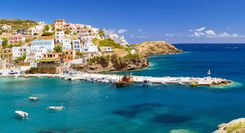
Itháki, Odysseus’s rugged capital, is protected from a tourist influx by an absence of sand. The island makes for good hikes, with rocky cliffs for climbing. Residents admire it's lack of tourism, although despise that the island is officially considered a subsection of Kefalonia.
What To Do On The Ionian Islands
The Ionian Islands are similar in their scenery and activities, the key differences are the levels of tourism on each Island. Other than that, the contrasts are minimal. On much of the larger beaches, you will be spoilt for watersport choices. Everything from banana boats to jet skiing. For more extreme watersports such as sailing and kite-surfing, Vasiliki and Myli Beach on the Island of Lefkada are ideal with winds that are good enough whilst the waves are relatively safe.
For those who prefer to stay out of the water, there are well-marked trails through mountainous and coastal areas for walking and cycling. There are many beautiful waterfalls to be seen, and if you love nature the wetlands are perfect for birdwatching. Marine parks make a nice day out, where you can see Loggerhead Turtles and Monk Seals.
On the island of Corfu, you will find one of the biggest golf courses in Europe, a fun and challenging course at Ermones in Ropa Valley.
Food On the Ionian Islands
As with many Islands, seafood is a delicacy on the Ionian Islands. Freshly caught fish is mastered in culinary experience to produce traditional dishes such as Bianco (fish in a yummy white sauce) and Bourdeto (piquant fish stew).
In Corfu, ginger beer and kumquat liquor are favoured by locals and of course, the famous Ouzo liquor is also recommended to try on the island (or in Greece in general). Ouzo is a popular drink associated with Greece and is made using the aromatic anise seed. Most often, restaurants provide a mandatory shot of Ouzo to customers after their meals.
Brief History of the Ionian Islands
The Ionian islands were the Homeric realm of Odysseus, centred on Ithaca (modern Itháki), and here alone of all modern Greek territory the Ottomans never held sway – except on Lefkádha. After the fall of Byzantium, possession passed to the Venetians, and the islands became a keystone in Venice’s maritime empire from 1386 until its collapse in 1797. Most of the population remained immune to the establishment of Italian as the official language and the arrival of Roman Catholicism, but Venetian influence remains evident in the architecture of the island capitals, despite damage from a series of earthquakes.
On Corfu, the Venetian legacy is mixed with that of the British, who imposed a military “protectorate” over the Ionian islands at the close of the Napoleonic Wars, before ceding the archipelago to Greece in 1864. There is, however, no question of the Islanders’ essential Greekness: the poet Dhionyssios Solomos, author of the national anthem, hailed from the Ionians, as did Nikos Mantzelos, who provided the music, and the first Greek president, Ioannis Kapodhistrias.
Top Image: Zakynthos, Greece © Simon Bradfield