Límnos
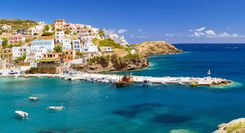
Bucolic Límnos is a sizeable agricultural and military island that has become positively trendy of late: there are upscale souvenir shops, old village houses restored by mainlanders as seasonal retreats and music bars during summer at nearly every beach. For all that, the island’s remoteness and peculiar ferry schedules protected it until the mid-1990s from most aspects of the holiday trade, and conventional tourism was late in coming because hoteliers lived primarily off the visiting relatives of the numerous soldiers stationed here. Most summer visitors are still Greek, particularly from Thessaloníki, though some Brits and other Europeans now arrive by charter flights.
The island has often been the focus of disputes between the Greek and Turkish governments, with frequent posturing over invaded airspace, although the détente of recent years has seen such incidences cease. As a result, Límnos’s garrison of 25,000 soldiers – at the nadir of Greco-Turkish relations during the 1970s and 1980s – is now down to about 6000, and set to fall further if, as expected, the remaining bases close.
The bays of Bourniá and Moúdhros, the latter one of the largest natural harbours in the Aegean, divide Límnos almost in two. The west of the island is dramatically hilly, with abundant basalt put to good use as street cobbles and house masonry. The east is low-lying and speckled with seasonal salt marshes where it’s not occupied by cattle, combine harvesters and vast corn fields. There are numerous sandy beaches around the coast – mostly gently shelving – and it’s easy to find a stretch to yourself.
Like most volcanic islands, Límnos produces excellent wine – good dry white, rosé and retsina – plus ouzo. The Limnians proudly tout an abundance of natural food products, including thyme honey and sheep’s cheese, and indeed the population is almost self-sufficient in foodstuffs.
Western Límnos
Nearly all the tourist amenities are concentrated in the western third of the island, mostly in and around the coastal stretch between Mýrina and the vast Moúdhros Bay. This area includes many of the best beaches and most picturesque inland villages.
Coast north of Mýrina
Beyond Mýrina’s respectable town beaches, the closest good sand lies 3km north at Avlónas, unspoilt except for the local power plant a short way inland. Just beyond, the road splits: the right-hand turning wends its way through Káspakas, its north-facing houses in neat tiers and a potable spring on its platía, before plunging down to Áyios Ioánnis, also reached directly by the left-hand bypass from the capital. The furthest of its three beaches is the most pleasant, a curved cove punctuated by a tiny fishing harbour and offshore islet named Vampire Island.
Thérma and around
- Daily 10am–2pm & 5–9pm
w
thermaspa.gr
Six kilometres northeast of Mýrina, the old Ottoman baths at Thérma, complete with calligraphic plaques, have been restored as an eye-wateringly expensive contemporary health spa, with all conceivable treatments available – or you can just have a hydromassage soak (€12). Unusually for a hot spring, the water is non-sulphurous and is the tastiest on the island, so there is always a knot of cars parked nearby under the trees while their owners fill jerry cans with warm water from a public fountain, which has a bilingual Greek/Ottoman Turkish inscription.
Just south of Thérma is the iconic poster image of Límnos: the chapel of Panayía Kakaviótissa, tucked into a volcanic cave on the flank of Mt Kákavos (360m).
Sardhés
Some 7km north of Thérma, SARDHÉS is the highest village on the island, with wonderfully broody sunsets and a celebrated central taverna. The handsome local houses are typical of mountain villages on Límnos in having an external staircase up to the first floor, as the ground floor was used for animals.
Gomáti
Beyond Sardhés and 5km below Katálakkos lies the spectacular, well-signposted dune environment at Gomáti, one of the largest such in Greece. There are two zones, reached by separate dirt tracks: one at a river mouth, with a bird-rich marsh, and the other to the northwest, with a beach bar and sunbeds. The latter portion especially is a popular outing.
Platý
Thános and its beaches
Kondiás and around
Eleven kilometres east of Mýrina,
KONDIÁS is the island’s third-largest settlement, cradled between hills tufted with Límnos’s biggest pine forest. Stone-built, often elaborate houses combine with the setting to make Kondiás an attractive inland village, a fact not lost on the Greeks and foreigners restoring those houses with varying degrees of taste. Cultural interest is lent by the central
Balkan Art Gallery (daily except Fri 10am–2pm & 7.30–9.30pm; €2), featuring works by prominent painters from across the Balkans – especially Bulgarian Svetlin Russev.
Tsimándhria, 2.5km further east, has better dining options.
Samothráki
SAMOTHRÁKI (Samothrace) has one of the most dramatic profiles of all the Greek islands, second only to Thíra (Santorini): its dark mass of granite rises abruptly from the sea, culminating in the 1611m Mount Fengári. Seafarers have always been guided by its imposing outline, clearly visible from the mainland, and its summit provided a vantage point for Poseidon to watch over the siege of Troy. Landing is subject to the notoriously unpredictable weather, but that did not deter pilgrims who, for hundreds of years in antiquity, journeyed to the island to visit the Sanctuary of the Great Gods and were initiated into its mysteries. The sanctuary remains the main archeological attraction of the island, which, too remote for most tourists, combines earthy simplicity with natural grandeur. The tourist season is relatively short – essentially (late) July and August – but you will find some facilities open as early as Easter and one or two all year round.
The Sanctuary of the Great Gods
Hidden in a stony but thickly wooded ravine between the tiny hamlet of PALEÓPOLI – 6km northeast from Kamariótissa, and 3km directly north from Hóra – and the plunging northwestern ridge of Mount Fengári, lie the remains of the Sanctuary of the Great Gods. From the late Bronze Age (around the eighth century BC) until the early Byzantine era (fifth century AD), the mysteries and sacrifices of the cult of the Great Gods (see box, p.658) were performed on Samothráki, in ancient Thracian, until the second century BC. Little is known of this dialect except that it was a very old Indo-European tongue, related to and eventually replaced by ancient Greek. The spiritual focus of the northern Aegean, the importance of the island’s rituals was second only to the Mysteries of Eleusis in all the ancient world. The well-labelled site strongly evokes its proud past while commanding views of the mountains and the sea.
Thássos
Just 12km from the mainland, Thássos has long been a popular resort island for northern Greeks, and since the early 1990s has also attracted a cosmopolitan mix of tourists, particularly Germans and Scandinavians on packages, as well as an increasing number of people from eastern Europe. They are all entertained by vast numbers of bouzoúkia (music halls) and music tavernas, while nature-lovers can find some areas of outstanding beauty, especially inland. Moreover, the island’s traditional industries have managed to survive the onslaught of modernity. The elite of Thássos still make a substantial living from the pure-white marble that constitutes two-thirds of the landmass, found only here and quarried at dozens of sites in the hills between Liménas and Panayía. Olives, especially the oil, honey, nuts and fruit (often sold candied) are also important products. The spirit tsípouro, rather than wine, is the main local tipple; pear extract, onions or spices like cinnamon and anise are added to home-made batches.