Lesser Cyclades
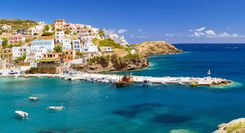
Four of the six small islands in the patch of the Aegean between Náxos and Amorgós have slid from obscurity into fashion in recent years. Inhabited since prehistoric times, the group is known commonly as the Lesser Cyclades and includes Irakliá, Skhinoússa, Áno Koufoníssi and Dhonoússa. The islands’ popularity has hastened the development of better facilities and higher prices, but, with only limited ferry services, they’ve managed to avoid mass tourism.
Irakliá
Irakliá, the westernmost of the Lesser Cyclades, and with the least spoilt scenery, has just over 150 permanent residents. As the first stop on the ferry service from Náxos, the island is hardly undiscovered by tourists, but with fewer amenities than some of its neighbours, it retains the feel of a more secluded retreat.
The port of Áyios Yeóryios is a small but sprawling settlement behind a sandy tamarisk-backed beach that gets quite crowded in August. Livádhi, a big, shallow beach, is 2km southeast of the port and its crystal-clear waters are the main tourist attraction of the island. The asphalted road continues 3km on to the tiny capital Panayía (Hóra), which has no lodgings to speak of. In season, a local boat sails from the port at 11am to make a tour of the island, stopping at the small sandy beach at Alimiá and the nearby pebble beach of Karvounólakos.
Skhinoússa
A little to the northeast of Irakliá, the island of Skhinoússa is just beginning to awaken to its tourist potential. Its indented outline, sweeping valleys and partly submerged headlands – such as the sinuous, snake-like islet Ofidhoúsa (Fidoú) – provide some of the most dramatic views in the group.
An asphalted road leads up from the port of Mersíni to the capital, Hóra (also called Panayía), for 1.2km. From Hóra you can reach no fewer than sixteen beaches dotted around the island, accessible by a network of dirt tracks. Tsigoúri is a ten-minute track walk downhill from northwest Hóra and gradually being developed. The locals’ preferred choice of beaches are Alygariá to the south, Psilí Ámmos to the northeast, and Almyrós, half an hour southeast.
Áno Koufoníssi
ÁNO KOUFONÍSSI (usually referred to simply as Koufoníssi) is the flattest, most developed and most densely inhabited island of the group. With some of the least-spoilt beaches in the Cyclades, the island is attracting increasing numbers of Greek and foreign holidaymakers and as it’s small enough to walk round in a day, it can feel overcrowded in July and August. The best views are not of Koufoníssi itself, but out across the water to mountainous Kéros island.
The old pedestrian street of HÓRA, crossing a low hill behind the ferry harbour, has been engulfed by new room and hotel development, but the town still retains its affable, small-island atmosphere. All the good beaches are in the southeast of the island, improving as you go east along a road that skirts the gradually developing coastline along the edge of low cliffs. Fínikas, a fifteen-minute walk from town, is the first of four wide coves with gently shelving golden sand. The next beach, Fanós, is the youngsters’ favourite, because of the beach bar that dominates the stretch of sand. Next is Platiá Poúnda, where caves have been hollowed out of the cliffs. Further east, the path rounds a rocky headland to Porí, a much longer and wilder beach, backed by dunes and set in a deep bay. It can be reached more easily from the town by following a dirt road heading inland through the scrub-covered hills.
Dhonoússa
Dhonoússa is a little out on a limb compared with the other Lesser Cyclades, and ferries call less frequently. Island life centres on the pleasant port settlement of Stavrós, spread out behind the harbour and the village beach. Most sunbathers head for Kéndros, a long and attractive stretch of shadeless sand twenty minutes over the ridge to the east; a World War II wreck can be easily spotted by snorkellers. The village of Mersíni is an hour’s walk from Stavrós, while a nearby path leads down to Livádhi, an idyllic white-sand beach with tamarisks for shade. In high season a beach-boat runs from the port to all beaches, many of which are nudist; the locals don’t seem to mind.
Amorgós
AMORGÓS, with its dramatic mountain scenery and laidback atmosphere, is attracting visitors in increasing numbers. The island can get extremely crowded in midsummer, the numbers swollen by film buffs paying their respects to the film location of Luc Besson’s The Big Blue, although fewer venture out to Líveros at the island’s western end to see the wreck of the Olympia which figures so prominently in the film. In general it’s a low-key, escapist clientele, happy to have found a relatively large, interesting, uncommercialized and hospitable island with excellent walking. Families tend to stay around Katápola, while younger tourists prefer Aigiáli.
This is the island to try rakómelo – a kind of fermented grappa with honey, herbs and spices, drunk in shots as an aperitif.
Síkinos
SÍKINOS has so small a population – around 240 – that the mule ride or walk from the port up to the capital was only replaced by a bus in the late 1980s. At roughly the same time the new jetty was completed; until then Síkinos was the last major Greek island where ferry passengers were still taken ashore in launches. With no dramatic characteristics and no nightlife to speak of, few foreigners make the short trip over here from neighbouring Folégandhros or Íos. The end result, however, is the most unspoilt rural countryside in the Cyclades where the clichéd image of a priest riding a donkey can suddenly materialize from over a hill.
Folégandhros
The sheer cliffs of FOLÉGANDHROS rise 300m from the sea in places, and until the early 1980s they were as effective a deterrent to tourists as they had historically been to pirates. Folégandhros was used now and then as an island of political exile from Roman times right up until 1969, and life in the high, barren interior was only eased in 1974 by the arrival of electricity and the subsequent construction of a road running from the harbour to Hóra and beyond. Development has been given further impetus by the recent increase in tourism and the ensuing commercialization. The island is becoming so trendy that Greek journalists speak of a new Mýkonos in the making, a fact that is reflected in its swish jewellery and clothes shops. Yet away from showcase Hóra and the beaches, the countryside remains mostly pristine. Donkeys are also still very much in evidence, since the terrain on much of the island is too steep for vehicles.
Hóra
The island’s real character and appeal are rooted in the spectacular HÓRA, perched on a cliff-edge plateau, a steep 3km from the port. Locals and foreigners mingle at the cafés and tavernas under the trees of the five adjacent squares, passing the time undisturbed by traffic, which is banned from the village centre. Towards the northern cliff-edge and entered through two arcades, the defensive core of the medieval kástro neighbourhood is marked by ranks of two-storey residential houses, with almost identical stairways and slightly recessed doors.
From the cliff-edge Poúnda square, where the bus stops, a path zigzags up – with views along the northern coastline – to the wedding-cake church of Kímisis tis Theotókou, whose unusual design includes two little fake chapels mounted astride the roof. The church, formerly part of a nunnery, is on the gentlest slope of a pyramidal hill with 360m cliffs dropping to the sea on the northwest side and is a favourite spot for watching some of the Aegean’s most spectacular sunsets. Beyond and below it hides the Khryssospiliá, a large cave with stalactites and ancient inscriptions, centre of a strange ancient youth cult, but closed to the public for archeological excavations. However, a minor, lower grotto can still be visited by excursion boat from the port. Towards the top of the hill are a few fragments of the ancient Paleókastro.
Hóra is inevitably beginning to sprawl at the edges, and the burgeoning nightlife – a few dance bars along with a number of music pubs and ouzerís – is to the south, away from most accommodation.