Salamína
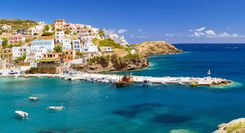
SALAMÍNA is the quickest possible island-hop from Pireás, and indeed much of its population commutes to the city to work. The island itself, however, is highly developed, has few tourist facilities, and is close enough to the Athenian dockyards to make swimming unappealing. The island’s port is at Paloúkia, facing the mainland, just a short hop across a narrow, built-up isthmus to Salamína Town on the west coast. Five kilometres or so beyond Salamína Town, Eándio has the island’s cleanest and most attractive beaches. A similar distance from Salamína Town to the north, the monastery of Faneroméni (daily 8.30am–12.30pm & 4pm–sunset) is a working nunnery with impressive frescoes, beautifully sited amid pine woods overlooking the mainland.
The Battle of Salamis
Perhaps the main reason for heading to Salamína is for the boat trip itself, through an extraordinary industrial seascape of docks and shipworks. The waters you cross were the site of one of the most significant sea battles of ancient times; some would say of all time, given that this was a decisive blow in preventing a Persian invasion and allowing the development of Classical Athens, and with it modern Western culture.
In 480 BC, the Greeks were in full retreat from the vast Persian army under Xerxes, following the defeat of the Spartans at Thermopylae. Many Greek cities, including Athens, had been sacked and burned by the invaders – indeed smoke from the ruins on the Acropolis probably formed a backdrop to the Battle of Salamis. The Greeks had roughly 370 triremes supplied by around twenty cities, the bulk from Athens, Corinth and Aegina; the Persian fleet was twice the size, with heavier ships, but even more diverse, with many from subject nations whose loyalty was questionable.
Through false information and strategic retreats, the Greeks managed first to tire many of the Persian crews – who rowed all night to cut off a non-existent escape attempt – and then to lure them into the narrow strait off Salamína. Crowded in and unable to manoeuvre, and with the wind in the wrong direction, the Persians found themselves at the mercy of the more nimble Greek triremes, and the battle eventually became a rout. Some two hundred Persian ships were sunk, against forty-odd on the Greek side, and few of their heavily armoured crews or marines survived.
Angístri
ANGÍSTRI, fifteen minutes by fast boat from Égina, is a tiny island, obscure enough to be overlooked by most island-hoppers, though the visitors it does have are a diverse mix: Athenian weekenders, retirees who bought and restored property here years ago, plus a few British and Scandinavian package holidaymakers. There’s a small, not terribly attractive strip of development on the north coast facing Égina, but the rest of the island is pine-covered, timeless and beautiful – albeit with very few beaches. It’s also strangely schizophrenic: holiday weekends can see hordes of young Greeks camping out on otherwise empty beaches, while in Skála a few small, classy hotels are juxtaposed with cafés serving English breakfasts to the package-trippers.
Égina
A substantial and attractive island with a proud history, less than an hour from Pireás, ÉGINA (Aegina) is not surprisingly a popular weekend escape from Athens. Despite the holiday homes, though, it retains a laidback, island atmosphere, especially if you visit midweek or out of season. Famous for its pistachio orchards – the nuts are hawked from stalls all around the harbour – the island can also boast substantial ancient remains, the finest of which is the beautiful fifth-century BC Temple of Aphaea, commanding superb views towards Athens from high above the northeast coast.
Égina Town
ÉGINA TOWN, the island’s capital, makes an attractive base, with some grand old buildings around a large, busy harbour. The Neoclassical architecture is matched by a sophisticated ethos: by island standards this is a large town, with plenty of shopping and no shortage of tempting places to eat and drink. Life revolves around the waterfront, where ferries come and go, yachts moor, fishermen tend their nets and kaïkia tie up to sell produce from the mainland.
The Markellos tower
The restored Pýrgos Markéllou, or Markellos Tower, is an extraordinary miniature castle which was the seat of the first Greek government after independence. Despite appearances, it was built only around 1800 by members of the Friendly Society and the local politician Spýros Márkellos. You can’t go inside except during the occasional special exhibition, but walking here, through the cramped inland streets, is enjoyable in itself.
Folklore Museum
Égina’s Folklore Museum is a lovely example of its type, housed in a nineteenth-century mansion. Its upper rooms are packed with fine old furniture, traditional costumes, and many of the trappings of island life a century ago, along with a small local historical archive. Downstairs are rooms devoted to fishing, with model boats and fishing gear, and to agricultural life, with a collection of the basics of village life.
Ancient Aegina
The site of Ancient Aegina lies north of the centre on a promontory known as Kolóna, after the lone column that stands there. The extensive remains, centring on a Temple of Apollo at the highest point, are well signed, and some reconstruction makes it easier to make out the various layers of settlement from different eras. Near the entrance, a small but worthwhile archeological museum houses finds from the site, along with information on the island’s ancient history. Highlights of the display include a room of Minoan-influenced Middle Bronze Age pottery, rescued from a nearby building site.
The beaches
On the north edge of town, between the port and Kolóna, there’s a tiny but popular beach with remarkably shallow water. This was the site of the ancient city’s harbour, of which various underwater remains are clearly visible. You can swim south of town, too, but there are more enticing spots further north – immediately beyond Kolóna there’s an attractive bay with a small, sandy beach, while other small coves lie off the road heading further out of town in this direction. Just a couple have any facilities, with loungers and beach bars; Kamares Paradise is among the more attractive.