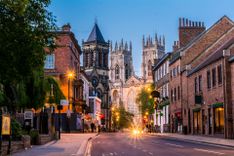
Newcastle upon Tyne
Vibrant and handsome, NEWCASTLE UPON TYNE has emerged from its industrial heyday and its post-industrial difficulties with barely a smut on its face. Its reputation for lively nightlife is just the tip of the iceberg; with its collection of top-class art galleries, museums and flourishing theatre scene – not to mention the shopping – the city is up there among the most exciting in Britain.
The de facto capital of the area between Yorkshire and Scotland, the city was named for its “new castle” founded in 1080 and hit the limelight during the Industrial Revolution – Grainger Town in the city’s centre is lined with elegant, listed classical buildings, indicating its past wealth and importance as one of Britain’s biggest and most important exporters of coal, iron and machinery. The decline of industry damaged Newcastle badly, signalling decades of poverty and hardship – a period recalled by Antony Gormley’s mighty statue the Angel of the North, which, since its appearance in 1998, has become both a poignant eulogy for the days of industry and a symbol of resurgence and regeneration.
Accommodation
Budget hotel chains offer plenty of good-value rooms in the city centre and down by the Quayside, while the biggest concentration of small hotels and guesthouses – and the YHA hostel – lies a mile north of the centre in popular, student-filled Jesmond, along and off Osborne Road.
Drinking
Newcastle’s boisterous pubs, bars and clubs are concentrated in several areas: in the Bigg Market (between Grey St and Grainger St), around the Quayside and in the developing Ouseburn area, where bars tend to be quirkier and more sophisticated; in Jesmond, with its thriving student-filled strip of café/bars; and in the mainstream leisure-and-cinema complex known as The Gate (Newgate St). The gay area, known as the “Pink Triangle”, focuses on the Centre for Life, spreading out to Waterloo Street and Westmorland and Scotswood roads. Top drinking brew is Newcastle Brown – an ale known locally as “Dog” – produced in this city since 1927.
Eating
Newcastle has a great variety of places to eat, from expensive, top-quality restaurants showcasing the talents of young and creative chefs, to fun, relaxed cafés and budget-friendly Chinese restaurants (mostly around Stowell Street in Chinatown). The popular chain restaurants are down by the Quayside.
Newcastle orientation
Visitors are encouraged to think of the city as Newcastle Gateshead, an amalgamation of the two conurbations straddling the Tyne. On Gateshead Quays are the BALTIC contemporary arts centre and Norman Foster’s Sage music centre, and on the opposite side, Newcastle’s Quayside is scene of much of the city’s contemporary nightlife. The city splits into several distinct areas, though it’s only a matter of minutes to walk between them. The castle and cathedral occupy the heights immediately above the River Tyne, while north of here lies the city centre, Grainger Town. Chinatown and the two big draws of the Discovery Museum and the Life Science Centre are west of the centre, while east is the renowned Laing Gallery. In the north of the city, on the university campus, is the Great North Museum: Hancock and even further north, through the landscaped Exhibition Park, is the Town Moor, 1200 acres of common land where freemen of the city – including Jimmy Carter, Nelson Mandela and Bob Geldof – are entitled to graze their cattle. The old industrial Ouseburn Valley, home to an alternative cultural scene, interesting galleries, the excellent Seven Stories children’s museum and some popular bars, is a short walk east along the river from the city centre.
Nightlife
Newcastle’s biggest club night is Shindig, taking place on Saturdays and switching locations around the city. Gigs, club nights and the gay scene are reviewed exhaustively in The Crack, available in shops, pubs and bars.
The Northumberland coast
Stretching 64 miles north of Newcastle up to the Scottish border, the low-lying Northumberland coast is the region’s shining star, stunningly beautiful and packed with impressive sights. Here you’ll find the mighty fortresses at Warkworth, Alnwick and Bamburgh and the magnificent Elizabethan ramparts surrounding Berwick-upon-Tweed, while in between there are glorious sandy beaches as well as the site of the Lindisfarne monastery on Holy Island and the seabird and nature reserve of the Farne Islands, reached by boat from Seahouses.
Alnwick
The appealing market town of ALNWICK (pronounced “Annick”), thirty miles north of Newcastle and four miles inland from Alnmouth, is renowned for its castle and gardens – seat of the dukes of Northumberland – which overlook the River Aln. It’s worth spending a couple of days here, exploring the medieval maze of streets, the elegant gatehouses on Pottergatea and Bondgate and the best bookshop in the north.
Alnwick Castle
The Percys – who were raised to the dukedom of Northumberland in 1750 – have owned Alnwick Castle since 1309. In the eighteenth century, the first duke had the interior refurbished by Robert Adam in an extravagant Gothic style – which in turn was supplanted by the gaudy Italianate decoration preferred by the fourth duke in the 1850s. There’s plenty to see inside, though the interior can be crowded at times – not least with families on the Harry Potter trail, since the castle doubled as Hogwarts School in the first two films.
Alnwick Garden
The grounds of the castle are taken up by the huge and beautiful Alnwick Garden, designed by an innovative Belgian team and full of quirky features such as a bamboo labyrinth maze, a serpent garden involving topiary snakes, and the popular Poison Garden, filled with the world’s deadliest plants. The heart of the garden is the computerized Grand Cascade, which shoots water jets in a regular synchronized display, while to the west is Europe’s largest treehouse with a restaurant within.
Bamburgh
One-time capital of Northumbria, the little village of BAMBURGH, just three miles from Seahouses, lies in the lee of its magnificent castle. Attractive stone cottages – holding the village shop, a café, pubs and B&Bs – flank each side of the triangular green, and at the top of the village on Radcliffe Road is the diminutive Grace Darling Museum. From behind the castle it’s a brisk, five-minute walk to two splendid sandy beaches, backed by rolling, tufted dunes.
Bamburgh Castle
Solid and chunky, Bamburgh Castle is a spectacular sight, its elongated battlements crowning a formidable basalt crag high above the beach. Its origins lie in Anglo-Saxon times, but it suffered a centuries-long decline – rotted by sea spray and buffeted by winter storms, the castle was bought by Lord Armstrong (of Rothbury’s Cragside) in 1894, who demolished most of the structure to replace it with a hybrid castle-mansion. Inside there’s plenty to explore, including the sturdy keep that houses an unnerving armoury packed with vicious-looking pikes, halberds, helmets and muskets; the King’s Hall, with its marvellous teak ceiling that was imported from Siam (Thailand) and carved in Victorian times; and a medieval kitchen complete with original jugs, pots and pans.
Berwick-upon-Tweed
Before the union of the English and Scottish crowns in 1603, BERWICK-UPON-TWEED, twelve miles north of Holy Island, was the quintessential frontier town, changing hands no fewer than fourteen times between 1174 and 1482, when the Scots finally ceded the stronghold to the English. Interminable cross-border warfare ruined Berwick’s economy, turning the prosperous Scottish port of the thirteenth century into an impoverished English garrison town. By the late sixteenth century, Berwick’s fortifications were in a dreadful state and Elizabeth I, fearing the resurgent alliance between France and Scotland, had the place rebuilt in line with the latest principles of military architecture. Berwick was reborn as an important seaport between 1750 and 1820, and is still peppered with elegant Georgian mansions dating from that period.
Berwick’s walls – one and a half miles long and still in pristine condition – are no more than 20ft high but incredibly thick. They are now the town’s major attraction; it’s possible to walk the mile-long circuit (1hr) round them, allowing for wonderful views out to sea, across the Tweed and over the orange-tiled rooftops of the town. Protected by ditches on three sides and the Tweed on the fourth, the walls are strengthened by immense bastions.
Holy Island
It’s a dramatic approach to HOLY ISLAND (Lindisfarne), past the barnacle-encrusted marker poles that line the three-mile-long causeway. Topped with a stumpy castle, the island is small (just 1.5 miles by one), sandy and bare, and in winter it can be bleak, but come summer day-trippers clog the car parks as soon as the causeway is open. Even then, though, Lindisfarne has a distinctive and isolated atmosphere. Give the place time and, if you can, stay overnight, when you’ll be able to see the historic remains without hundreds of others cluttering the views. The island’s surrounding tidal mud flats, salt marshes and dunes have been designated a nature reserve.
Brief history
It was on Lindisfarne (as the island was once known) that St Aidan of Iona founded a monastery at the invitation of King Oswald of Northumbria in 634. The monks quickly established a reputation for scholarship and artistry, the latter exemplified by the Lindisfarne Gospels, the apotheosis of Celtic religious art, now kept in the British Library. The monastery had sixteen bishops in all, the most celebrated being the reluctant St Cuthbert, who never settled here – within two years, he was back in his hermit’s cell on the Farne Islands, where he died in 687. His colleagues rowed the body back to Lindisfarne, which became a place of pilgrimage until 875, when the monks abandoned the island in fear of marauding Vikings, taking Cuthbert’s remains with them.
Seahouses and around
Around ten miles north from Craster, beyond the small village of Beadnell, lies the fishing port SEAHOUSES, the only place on the local coast that could remotely be described as a resort. It’s the embarkation point for boat trips out to the windswept Farne Islands, a rocky archipelago lying a few miles offshore.
The Farne Islands
Owned by the National Trust and maintained as a nature reserve, the Farne Islands are the summer home of hundreds of thousands of migrating sea birds, notably puffins, guillemots, terns, eider ducks and kittiwakes, and home to the only grey seal colony on the English coastline. A number of boat trips potter around the islands – the largest of which is Inner Farne – offering birdwatching tours, grey seal-watching tours and the Grace Darling tour, which takes visitors to the lighthouse on Longstone Island, where the famed local heroine lived.
Northumberland National Park
Northwest Northumberland, the great triangular chunk of land between Hadrian’s Wall and the coastal plain, is dominated by the wide-skied landscapes of Northumberland National Park, whose four hundred windswept square miles rise to the Cheviot Hills on the Scottish border. The bulk of the Park is taken up by Kielder Water and Forest nature reserve, a superb destination for watersports and outdoor activities; the small town of Bellingham makes a good base for the reserve, as do Rothbury and Wooler, both of which also provide easy access to some superb walking in the craggy Cheviot Hills.
Kielder Water and Forest
Surrounded by 250 acres of dense, pine forest, Kielder Water is the largest reservoir in England. The road from Bellingham follows the North Tyne River west and skirts the forested edge of the lake, passing an assortment of visitor centres, waterside parks, picnic areas and anchorages that fringe its southern shore. Mountain biking, hiking, horseriding and fishing are some of the land-based activities on offer, and watersports like waterskiing, sailing, kayaking and windsurfing are hugely popular, too. The mass of woodlands and wetlands mean that wildlife is abundant – you might spot badgers, deer, otters, ospreys and red squirrels. Leaplish Waterside Park, on the western flank of the reservoir, is the best place to head if you’re visiting for the first time and need to get your bearings.
The Tees Valley
Admittedly not much of a tourist hotspot in comparison to Northumberland or County Durham, the TEES VALLEY – once an industrial powerhouse and birthplace of one of the greatest developments in Britain, the public steam railway – nevertheless has some enjoyable attractions. Darlington, with its strong railway heritage, is a pleasant place to spend a day, while Middlesbrough’s MIMA and Hartlepool’s Maritime Experience are extremely worthwhile, the latter particularly if you have children to entertain.