The Department of San Marcos
Leaving Quetzaltenango you can head west to the little-visited department of San Marcos – home of the country’s highest volcano, Tajumulco, and some magnificent highland scenery. The route passes through Ostuncalco and then the twin towns of San Marcos and San Pedro Sacatepéquez (these form the main population centre in these parts but hold little interest for visitors).
Northwest of here there’s some magnificent high country, and a paved road that fringes the Tajumulco and Tacaná volcanoes. Continuing along this remote route you pass through the isolated villages of Tectitán and Cuilco, and can eventually loop up to the Carretera Interamericana.
El Quiché
At the heart of the western highlands, the department of El Quiché encompasses the full range of Guatemalan scenery. The south is fertile and heavily populated while to the north the landscape becomes increasingly dramatic, rising to the massive, rain-soaked peaks of the Cuchumatanes. For the traveller, El Quiché has a lot to offer, including Chichicastenango, the scene of a vast, twice-weekly market and still a pivotal centre of Maya religion. Beyond here are the ruins of K’umarkaaj and, further to the north, the extraordinary scale of the mountain scenery is exhilarating. Isolated villages set in superb highland bowls sustain a wealth of indigenous culture and occupy a misty, mysterious world of their own – above all in the land of the Ixil.
Brief history
The department takes its name from the greatest of the pre-conquest tribal groups, the K’iche’, who overran much of the highlands by 1450 from their capital at K’umarkaaj. With little in the way of plunder, this remote, mountainous terrain remained an unimportant backwater for the Spanish. The region became a centre of intense guerrilla activity in the late 1970s and was the scene of unrivalled repression, as tens of thousands of villagers were wiped out by the military. Today these highlands remain a stronghold of Maya culture, and El Quiché, dotted with small villages and mountain towns, is the scene of some superb fiestas and markets.
Chichicastenango
North from Los Encuentros junction, the road drops down through dense pine forests into a deep ravine before beginning a tortuous ascent around a seemingly endless series of switchbacks until reaching CHICHICASTENANGO. Dubbed Guatemala’s “Mecca del Turismo”, Chichi is a compact and traditional town of cobbled streets, though the charming old adobe houses are now outnumbered by modern concrete structures. Twice a week the town’s highland calm is shattered by the Sunday and Thursday markets, which attract many tourists, traders and Maya weavers from throughout the central highlands.
The market is by no means all that sets Chichicastenango apart, for it’s an important centre of culture and religion. Over the years, Maya traditions and folk Catholicism have been treated with a rare degree of respect. Today the town has an important collection of Maya artefacts, parallel indigenous and ladino governments and two churches that make no effort to disguise their acceptance of unconventional pagan worship.
Locals adhere to the ways of traditional weaving, the women wearing superb huipiles with flower motifs. The men’s costume of short trousers and jackets of black wool embroidered with silk is highly distinguished, although it’s very expensive to make and these days almost all men opt for Western dress. For Sundays and fiestas, however, a handful of cofradres (elders of the religious hierarchy) still wear the traje clothing and parade through the streets bearing spectacular silver processional crosses and antique incense-burners.
Chichicastenango’s market
There’s been a market at Chichicastenango for hundreds, if not thousands, of years and despite the touristy side of the event, local people continue to come twice a week to trade their wares. On Sundays and Thursdays, Chichicastenango’s streets are lined with stalls and packed with buyers, and the choice is overwhelming, ranging from superb-quality Ixil huipiles to wooden dance-masks and everything in between, including pottery, gourds, belts and blankets, plus a gaudy selection of fabrics. You can still pick up some authentic weaving, but you need to be prepared to wade through a lot of very average material – and haggle hard. Your chances of getting a good deal are better before the tourist buses arrive at 10am or in the late afternoon once things have started to quiet down. Prices are pretty competitive, but for a real bargain you need to head further into the highlands – or to Panajachel, which is a better bet for típica clothing.
For a brilliant vantage point over the vegetable market, head for the indoor balcony on the upper floor of the Centro Comercial building on the north side of the plaza. You’ll be able to gawk at the villagers below (as well as take photographs without fear of being intrusive) as they haggle and chat over bunches of carrots and onions. It’s possible to pick out costumes from all over the highlands, including huipiles from the Atitlán villages, and even from as far away as Chajul; the “space cowboy” shirts and pants are worn by men from the neighbouring Sololá area.
Fiesta time in Chichicastenango
Chichicastenango’s appetite for religious fervour is especially evident during the fiesta of Santo Tomás, from December 14 to 21. It’s a spectacular occasion, with attractions including the Palo Volador, in which men dangle by ropes from a 20m pole, a live band or two, a massive procession, traditional dances, clouds of incense, gallons of chicha and deafening fireworks. On the final day, all babies born in the previous year are brought to the church for christening. Easter is also celebrated with tremendous energy and piety.
The Ixil region
High up in the Cuchumatanes, in a landscape of steep hills, bowl-shaped valleys and gushing rivers, is the Ixil region. Here Nebaj, Chajul and Cotzal, three remote and extremely traditional towns, share a language spoken nowhere else in the country. These lush, rain-drenched highlands are hard to reach and have proved notoriously difficult to control, and today’s relaxed atmosphere of highland Maya colour and customs conceals a bitter history of protracted conflict.
The beauty of the landscape and the strength of indigenous culture in the Ixil are both overwhelming. When church leaders moved into the area in the 1970s, they found very strong communities in which the people were reluctant to accept new authority for fear that it would disrupt traditional structures, and where women were included in decision-making. Counterbalancing these strengths are the horrors of the human rights abuses that took place here during the civil war, which must rate as some of the worst anywhere in Central America. Despite this terrible legacy, however, the fresh green hills are some of the most beautiful in the country, and the towns are friendly and accommodating, with a relaxed and distinctive atmosphere in a misty world of their own.
Brief history
Before the arrival of the Spanish, Nebaj was a sizeable centre, producing large quantities of jade. The Conquest was particularly brutal in these parts, however. After several setbacks, the Spaniards finally managed to take Nebaj in 1530, by which time they were so enraged that the settlement was burnt to the ground and the survivors enslaved as punishment. Things didn’t improve with the coming of independence: the Ixil people were regarded as a source of cheap labour and forced to work on the coastal plantations. Many never returned, and even today large numbers of local people still migrate to the coast, Guatemala City and the US in search of work.
In the late 1970s and 1980s, the area was hit by waves of horrific violence as it became the main theatre of operation for the Guerrilla Army of the Poor. Since the 1996 peace accords, normality steadily returned to the area, as villagers have returned to their ancestral settlements and rebuilt their homes.
Guerrilla warfare in the Ixil
The bitter civil war of the 1970s and 1980s ravaged the western highlands, and left the Ixil devastated by the conflict between the Guatemalan army and the insurgent Ejército Guerrillero de los Pobres (the EGP, or Guerrilla Army of the Poor). By 1996, when the guerrilla war officially ended, nearly all of the region’s smaller villages had been destroyed and fifteen thousand to twenty thousand people had been killed, with thousands more displaced. Most of the victims were villagers, dying not because of their political beliefs but because they had been caught between the army and the EGP, who saw the creation of a liberated zone in the Ixil as the springboard to national revolution. Investigations later found the Guatemalan military responisble for of over ninety per cent of civilian deaths in the Ixil.
The 1970s: the rise of the EGP
The EGP first entered the area in 1972, when a small group of guerrilla fighters crossed the Mexican border and began building links with locals, impressing some villagers with plans for political and social revolution. The guerrillas opened their military campaign in 1975 with the assassination of Luis Arenas, a finca owner from near Chajul, who employed hundreds of labourers under a system of debt bondage. The EGP shot Arenas in front of hundreds of his employees as he was counting the payroll. According to the group, workers joined them with cries of “Long live the poor, death to the rich”. But other accounts describe how people walked for days to pay their last respects to Arenas.
These actions prompted a huge response from the armed forces, who began killing, kidnapping and torturing suspected guerrillas and sympathizers. The EGP was already well entrenched, however, and by late 1978 was regularly occupying villages, holding open meetings and tearing down debtors’ jails. In January 1979 they killed another local landowner, Enrique Brol, of Finca San Francisco near Cotzal. On the same day, the EGP also briefly took control of Nebaj itself, summoning the whole of the town’s population, as well as Western travellers, to the central plaza, where they denounced the barbaric inequalities of life in the Ixil.
The 1980s
The army responded with a wave of horrific attacks on the civilian population. Army units swept through the area, committing atrocities, burning villages and massacring thousands. Nevertheless, the strength of the guerrillas continued to grow, and in 1981 they again launched an attack on Nebaj, by then a garrison town. Shortly afterwards the army chief of staff, Benedicto Lucas García (the president’s brother), flew into Nebaj to threaten locals that if they didn’t “clean up their act” he’d bring five thousand men “and finish off the entire population”.
The army changed its tactics under new president Ríos Montt, using anti-Communist propaganda and conscripted civilian patrols (PACs) to ensure the loyalty of the people. Villagers were given ancient rifles and told to protect their communities from guerrillas. The army swept through the Ixil, razed fifty villages to the ground and settled the displaced in new “model” communities. With the EGP retreating to more remote terrain, Ixil people began to adapt to the army’s newfound dominance, many opting to reject contact with the guerrillas.
Hit hard, the EGP responded with desperate acts. On June 6, 1982, guerrillas stopped a bus near Cotzal and executed thirteen civil patrol leaders and their wives; eleven days later a guerrilla column entered the village of Chacalté, where the civil patrol had been particularly active, and killed a hundred people.
The army’s offer of amnesty soon drew refugees out of the mountains: between 1982 and 1984 some 42,000 people turned themselves in, fleeing a harsh existence under guerrilla protection. Others returned after years spent living like nomads, hunting animals in the jungles of the Ixcán to the north. By 1985 the guerrillas had been driven back into a handful of mountain strongholds.
Peace accords
Skirmishes continued until the mid-1990s, but ceased with the signing of peace accords. Since then, ex-guerrillas and former civil patrollers have resettled the old village sites and communities have been rebuilt.
K’umarkaaj (Utatlán)
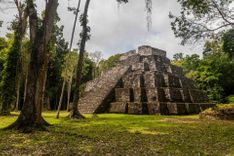
Early in the fifteenth century, riding on a wave of successful conquest, the K’iche’ king Gucumatz (Feathered Serpent) founded a new capital, K’umarkaaj. A hundred years later the Spanish arrived, renamed the city Utatlán, and then destroyed it, leaving the ruins that can be visited today.
K’umarkaaj is nowhere near as grand as the large ruins of Petén, but its dramatic setting, surrounded by deep ravines and pine forests, is impressive, and its historical significance intriguing. Little restoration has taken place and once-grand temples and palaces are today just grassy mounds. The small museum has a scale model of what the original city may once have looked like.
Brief history
The splendour of the city, once containing 23 palaces, signified the strength of the K’iche’ empire, which at its height boasted a population of around a million.
By the time of the Conquest, however, the K’iche’ empire was fractured. Their first encounter with the Spanish was a heavy defeat near Quetzaltenango, resulting in the loss of their leader Tecún Umán. The K’iche’ then invited the Spanish to their capital, but on seeing the fortified city, the conquistador feared a trap and captured K’iche’ leaders Oxib-Queh and Beleheb-Tzy. His next step was characteristically straightforward: “As I knew them to have such a bad disposition to service of his Majesty, and to ensure the good and peace of this land, I burnt them, and sent [soldiers] to burn the town and destroy it.”
The Popol Vuh
Written in K’umarkaaj shortly after the arrival of the Spanish, the more than nine thousand lines of the Popol Vuh detail the cosmology, mythology and traditional history of the K’iche’. The first of the two parts of this sacred poem is an account of the K’iche’s creation by their god, who is known as Heart of Sky. According to the Popol Vuh, at first there was only water and sky; the creator then formed earth and mountains, plants and trees. Heart of Sky turned his attention to animals, and created creatures of the forest including deer, birds and jaguars. Unsatisfied with these animals, the creator fashioned humans from corn paste after twice failing to make man from mud and wood. The Popol Vuh then recounts the adventures of the ancestors of mankind, the hero twins (or wizard twins) Hunahpú and Xbalanqué, which culminate in an epic struggle with the death lords of Xibalbá, the Maya underworld. The twins ultimately triumph, and the cycle of creation is born.
The Popol Vuh’s second half describes the wanderings of the K’iche’ ancestors as they migrate south from the Toltec area of Mexico and settle in the highlands of Guatemala. Evidence gathered by archeologists and epigraphers strongly supports the accuracy of this part of the epic. The book concludes with a history of K’iche’ royalty, and suggests a shared lineage with these kings and their gods. Dennis Tedlock’s translation of the Popol Vuh (see Wildlife and the environment) is regarded as the definitive text.
Huehuetenango and around
At the foot of the mighty Cuchumatanes, HUEHUETENANGO is a departmental capital and the focus of trade and transport for a vast area of northwest Guatemala. Its atmosphere is provincial and pretty relaxed, though heavy traffic, much of which thunders through the town centre, reduces this appeal somewhat.
Before the arrival of the Spanish it was the site of one of the residential suburbs that surrounded the Mam capital of Zaculeu (the ruins of this site, just a few kilometres from town, are worth a visit). Under colonial rule it was a small regional centre with little to offer beyond a steady trickle of silver and a stretch or two of grazing land. Today the department is famous for its rich, complex high-quality coffee – which you’ll have ample opportunity to sample in the town’s cafés.
Zaculeu
A few kilometres to the west of Huehuetenango are the ruins of ZACULEU, capital of the Mam, who were one of the principal pre-conquest highland tribes. The site includes several large temples, plazas and a ball court, but unfortunately it was restored pretty unsubtly by a latter-day colonial power, the United Fruit Company, in 1946 and 1947. The walls and surfaces were levelled off with a layer of thick white plaster, leaving them stark and undecorated. There are no roof-combs, carvings or stucco mouldings, and only in a few places does the original stonework show through. Even so, the site has a peculiar atmosphere of its own and is worth a look; surrounded by trees and neatly mown grass, with fantastic views of the mountains, it’s also an excellent spot for a picnic.
There’s a small museum on site with examples of some of the burial techniques used – bodies were crammed into great urns, interred in vaults and also cremated – and some interesting ceramics.
Brief history
The site of Zaculeu, first occupied in the fifth century, is thought to have been a religious and administrative centre for the Mam, and the home to its elite; the bulk of the population most likely lived in small surrounding settlements. After a period of subjugation under the rival K’iche’ tribe in the fifteenth century, the Mam reasserted their independence, only for another expansionist empire, the Spanish – a yet more brutal alternative – to arrive. Following a massacre by the Spanish of five thousand Mam warriors to the south, Mam chief Kaibal Balam withdrew to the safety of Zaculeu, which was protected by ravines and walls. The Spanish army prepared for a lengthy siege, giving the Maya a choice: become Christians “peacefully” or face “death and destruction”.
Attracted by neither option, the Mam struggled to hold out against the invading force, but after about six weeks under siege, his army starving to death, Kaibal Balam surrendered. With the bitterest of ironies a bastardized version of his name has been adopted by one of Guatemala’s crack army regiments – the “Kaibiles”, who were responsible for numerous massacres during the 1970s and early 1980s.
Market days
Make an effort to catch as many market days as possible – they’re second only to local fiestas in offering a rich perspective of Maya life. These are some of the best:
Monday
San Juan Atitán; Zunil.
Tuesday
Chajul; Comalapa; Olintepeque; Sololá; Totonicapán.
Wednesday
Almolonga; Colotenango; Cotzal; Momostenango; Sacapulas.
Thursday
Aguacatán; Chichicastenango; Jacaltenango; Nebaj; Panajachel; Sacapulas; San Juan Atitán; San Mateo Ixtatán; San Rafael La Independencia; Soloma; Tajumulco; Uspantán; Zacualpa.
Friday
Chajul; San Francisco el Alto; San Martín; Santiago Atitlán; Sololá.
Saturday
Almolonga; Cotzal; Todos Santos Cuchumatán; Totonicapán.
Sunday
Aguacatán; Chichicastenango; Jacaltenango; Joyabaj; Momostenango; Nahualá; Nebaj; Ostuncalco; Panajachel; Sacapulas; San Juan Comalapa; San Martín Jilotepeque; San Mateo Ixtatán; Santa Eulalia; Soloma; Uspantán; Zacualpa.