Discover more places in Thailand

written by
Rough Guides Editors
Just a few hours from Bangkok, the east-coast resorts draw a mix of weekending Bangkokians and leisure-seeking tourists. Transport connections are excellent, and for overland travelers, several Cambodian border crossings are within easy reach.
But Thailand trip planning for this region isn’t just about beautiful beaches. The east coast is also a hub of Thailand’s industrial economy, with natural gas fields and deep-sea ports driving major development along the first 200km of coastline — an area known as the Eastern Seaboard.
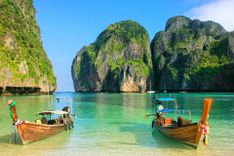
Don’t let the initial sprawl of refineries and depots put you off. Offshore, you’ll find beaches as stunning as Thailand’s famous southern retreats, along with secluded havens perfect for kicking back in a hammock.
The first worthwhile stop comes 100km east of Bangkok at the town of Si Racha, which is the point of access for tiny Ko Si Chang, whose dramatically rugged coastlines and low-key atmosphere make it a restful retreat. In complete contrast, nearby Pattaya is Thailand’s number one package-tour destination, its customers predominantly middle-aged European men enticed by the resort’s sex-market reputation and undeterred by its lacklustre beach. Things soon look up, though, as the coast veers sharply eastwards towards Ban Phe, revealing the island of Ko Samet, the prettiest of the beach resorts within comfortable bus-ride range of Bangkok.
East of Ban Phe, the landscape becomes lusher and hillier around Chanthaburi, the dynamo of Thailand’s gem trade and one of only two eastern provincial capitals worth visiting. The other is Trat, 68km further along the highway, and an important hub both for transport into Cambodia via Hat Lek – one of this region’s two main border points, the other being Aranyaprathet – and for the forty islands of the Ko Chang archipelago. The most popular of this island group is large, forested Ko Chang itself, whose long, fine beaches have made it Thailand’s latest resort destination. A host of smaller, less-developed islands fill the sea between Ko Chang and the Cambodian coast, most notably temptingly diverse Ko Mak and Ko Kood.
Highway 3 extends almost the entire length of the east coast, beginning in Bangkok as Thanon Sukhumvit, and known as such when it cuts through towns, and hundreds of buses ply the route, connecting all major mainland destinations. It’s also possible to travel between the east coast and the northeast and north without doubling back through the capital: the most direct routes into Isaan start from Pattaya, Rayong and Chanthaburi. Bangkok’s Suvarnabhumi Airport is less than 50km from Si Racha, and there are two domestic airports along the east coast itself: at U-Tapao naval base, southeast of Pattaya, and just west of Trat. Though a rail line connects Bangkok with Si Racha and Pattaya, it is served by just one slow train a day in each direction; a branch line makes two journeys a day to Aranyaprathet near the Cambodian border.
The most commonly used overland crossing into Cambodia from Thailand is at Poipet, which lies just across the border from the Thai town of Aranyaprathet, 210km due east of Bangkok. It’s best to arm yourself in advance with an e-visa for Cambodia and to make the journey by regular public transport, but it’s also possible to buy a package all the way through to Siem Reap and to get a thirty-day visa on arrival at the border, though both of the latter options are more likely to open you up to possible scams, including a fake “Cambodian Consulate” in Aranyaprathet and rip-off currency exchange (it’s not compulsory to buy riel before entering Cambodia, despite what some touts may say). For further details, see wthaivisa.com for its visa-run forum; and wtalesofasia.com/cambodia-overland.htm for a very detailed description of the crossing and for advice on onward transport into Cambodia. Once you’ve walked across the border and entered Cambodia, it’s about two hours in a taxi or bus to reach Siem Reap, 150km away. If you have the deep misfortune of getting stuck in dusty, dirty Aranyaprathet, where local transport comes in the form of tuk-tuks, try the comfortable fan and a/c rooms at Inter Hotel at 108/7 Thanon Chatasingh.
From Bangkok, you can travel to Aranyaprathet Station, 4km from the border post, by train; you’ll need to catch the 5.55am if you want to get across the border the same day. Return trains depart Aranyaprathet at 6.35am and 1.35pm. Alternatively, take a bus from Bangkok’s Northern (Mo Chit) Bus Terminal to Aranyaprathet, or a faster, more expensive a/c minibus from Victory Monument. To reach Aranyaprathet from east-coast towns, the easiest route is to take a bus from Chanthaburi to the town of Sa Kaew, 130km to the northeast, and then change to one of the frequent buses for the 55km ride east to Aranyaprathet.
It’s also possible to buy a through ticket to Siem Reap from Trat and Ko Chang, or from Thanon Khao San in Bangkok, but this option is dogged by scams (including a visa “service charge”), takes much longer than doing it independently, and nearly always uses clapped-out buses or even pick-ups on the Cambodian side, despite the promised “luxury bus”.
The eastbound journey out of Bangkok is not at all scenic, dominated initially by traffic-choked suburban sprawl and then by the industrial landscape of the petrochemical and shipping industries that power Thailand’s Eastern Seaboard. The first major population centre is the provincial capital of Chonburi, whose only notable attraction is its annual October bout of buffalo-racing. Twenty kilometres on, you reach the fast-growing town of SI RACHA, a prosperous residential and administrative hub for the Eastern Seaboard’s industries and home to a sizeable population of expat families. The town is best known though as the source of nam phrik Si Racha, the chilli-laced ketchup found on every kitchen table in Thailand, and as the departure point for the island of Ko Si Chang. Si Racha’s only sight is the Sino–Thai “island temple” of Wat Ko Loy, a gaudy hexagon presided over by a statue of the Chinese Goddess of Mercy, Kuan Im, and located on an islet at the end of a 1500m causeway, adjacent to the pier for boats to Ko Si Chang.
The unhurried pace and absence of consumer pressures make small, dry, rocky KO SI CHANG an engaging place to get away from it all for a day or two. Unlike most other east-coast destinations, it offers no real beach life – it’s a populous, working island with a deep-sea port, rather than a tropical idyll – and there’s little to do here but explore the craggy coastline by kayak or ramble up and down its steep, scrubby contours on foot or by motorbike. The island is famous as the location of one of Rama V’s summer palaces, a few parts of which have been restored, and of a popular Chinese pilgrimage temple, as well as for its rare white squirrels, which live in the wooded patches inland.
Ko Si Chang celebrates three particularly interesting festivals. Songkhran is marked from April 17 to 19 with sandcastle-building, greasy-pole-climbing and an exorcism ritual for any islanders who have suffered unpleasant deaths over the previous year. At Visakha Puja, the full-moon day in May when Buddha’s birth, death and enlightenment are honoured, islanders process to the old palace with hand-crafted Chinese lanterns. And on September 20, Ko Si Chang honours its royal patron King Chulalongkorn’s birthday with a son et lumière in the palace grounds and a beauty contest staged entirely in costumes from the Chulalongkorn era.
Small, slow-paced, peaceful KO MAK (sometimes spelt “Maak”) makes an idyllic, low-key alternative to Ko Chang, 20km to the northwest. Measuring just sixteen square kilometres, it’s home to little more than four hundred people, divided into five main clans, who work together to keep the island free of hostess bars, jet skis, banana boats and the like, and on initiatives such as mountain-bike trails. A couple of narrow concrete roads traverse the island, which is dominated by coconut and rubber plantations; elsewhere a network of red-earth tracks cuts through the trees. Ko Mak is shaped like a star, with fine white-sand beaches along the northwest coast at Ao Suan Yai and the southwest coast at Ao Kao, where most of the island’s (predominantly mid-range and upper-bracket) tourist accommodation is concentrated; the principal village, Ban Ao Nid, is on the southeast coast and there’s another village at Ban Laem Son on the east coast. The main beaches are just about within walking distance of each other, and other parts of the island are also fairly easy to explore on foot, or by mountain bike, motorbike or kayak – the best way to discover the empty undeveloped beaches hidden along the north and eastern coasts. The reefs of Ko Rang are also less than an hour’s boat ride away so snorkelling and diving trips are quite popular. There is as yet no major commercial development on the island and no bank or ATM, but bungalows on both beaches will change money. There’s a small clinic off the Ao Nid road, though for anything serious a speedboat will whisk you back to the mainland.
During the rainy season (early June–Sept), choppy seas mean that boat services to Ko Mak are much reduced. Most Ko Mak accommodation stays open – and offers tempting discounts – but the smaller places often don’t bother to staff their restaurants. Islanders say that it can be very pleasant during this “green season”, though you may be unlucky and hit a relentlessly wet few days.
The mediocre reefs of Ko Rang, part of the Ko Chang National Marine Park, are less than an hour’s boat ride west of Ko Mak and are the island’s main diving and snorkelling destination; they’re the main focus of Ko Chang dive and snorkel boats too, so you won’t be alone. You can also join a cookery class.
The fourth-largest island in Thailand, forested KO KOOD (also spelt Ko Kut and Ko Kud) is still a wild and largely uncommercialized island. Though it’s known for its sparkling white sand and exceptionally clear turquoise water, particularly along the west coast, Ko Kood is as much a nature-lover’s destination as a beach-bum’s. Swathes of its shoreline are fringed by scrub and mangrove rather than broad sandy beaches and those parts of the island not still covered in virgin tropical rainforest are filled with palm groves and rubber plantations. Most of the 25km-long island is penetrated only by sandy tracks and, in places, by navigable khlongs, if at all. All of this makes Ko Kood a surprisingly pleasant place to explore on foot (or kayak), especially as the cool season brings refreshing breezes most days. The interior is also graced with several waterfalls, the most famous of which is Nam Tok Khlong Chao, inland from Ao Khlong Chao and the focus of occasional day-trips from Ko Chang and Ko Mak.
Because of its lack of roads, Ko Kood has to date been the almost exclusive province of package-tourists, but things are becoming much easier for independent travellers, with a choice of scheduled boat services from the mainland, as well as from Ko Chang and Ko Mak, and the emergence of some budget-minded guesthouses. The island is still pretty much a one-season destination, though, as rough seas mean that nearly all the boat services only operate from November through May. An increasing number of places are staying open year-round, however, and offer tempting discounts to those willing to chance the rains and the off-season quiet. There is some malaria on the island so be especially assiduous with repellent and nets if you are not taking prophylactics; there’s a malaria-testing station in Ban Khlong Hin Dam.
Most of Ko Kood’s fifteen hundred residents make their living from fishing and growing coconut palms and rubber trees. Many have Khmer blood in them, as the island population mushroomed at the turn of the twentieth century when Thais and Cambodians resident in nearby Cambodian territory fled French control.
The main settlements are Ban Khlong Hin Dam, just inland from the main Nam Leuk (Hin Dam) pier, Ban Khlong Mat, a natural harbour-inlet a few kilometres further north up the coast, the stilted fishing village of Ban Ao Salat across on the northeast coast and the fishing community of Ban Ao Yai on the southeast coast. On the southwest coast, several of the main beaches also have small villages. Of these, the obvious choices for budget travellers are Ao Khlong Chao and Ao Ngamkho, which both have a choice of accommodation and eating options and are within walking distance of each other; Ao Bang Bao also has cheapish bungalows and is the longer and arguably better beach but has no village and is more isolated. Seclusion is the thing on all the other west-coast beaches, most of which are the province of just one or two upmarket resorts.
Ko Kood’s three dive operators charge around B3000 for two dives, with snorkellers paying B1000, and B14,500 for the four-day Openwater Diver course. You might prefer to opt for a local Ko Kood dive as the usual sites around Ko Rang are always packed with dive boats from Ko Chang and Ko Mak.
Opposite Away Resort at the north end of Ao Khlong Chao t082 220 6002, wbbdivers.com.
Next to Siam Beach Resort at Ao Bang Bao t085 698 4122, wkohkooddivers.com.
Headquarters at Ko Kood Beach Resort at Ao Khlong Mat, with another desk at Happy Days on Ao Ngamkho t087 144 5945, wkohkood-paradisedivers.com.
Thinking of travelling to Thailand? Start planning by learning about how to get to Thailand.
Top image © Punnawit Suwattananun/Shutterstock