Things To Do In Galle
For a dose of culture, the previously mentioned UNESCO listed Galle Fort is a landmark that is not to be missed whilst in the area and is often seen as the main attraction of the town. The Reformed Dutch Protestant Church is worth a visit solely for its extraordinary interior and dates back to 1755, a great spot for a history lesson on the islands European influences.
If you are a true foodie, then Galle might be your haven. Seafood is a delicacy here, for obvious reasons. Be sure to try the fresh catches of the day, and the grilled Calamari and seared Yellowfin Tuna is sure to do your taste buds some good. On Sundays, the Galle Fort Market takes place that involves many food stalls and pop-up cafes offering little delights to snack on whilst you wonder listening to the live music and gaining an insight into local life.
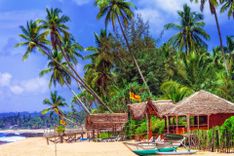
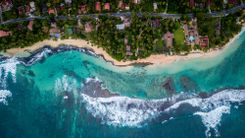
Just a short ride from Galle, Unawatuna beach brings an easy coastal break to a Sri Lankan family adventure trip. Here, palm trees lean over the sand below rose-tinted sunsets and beside turquoise waters.
The waves at Unawatuna are gentle and frequent, making them well-suited to beginner surfing. In the right season, whale watching trips head out into the deeper waters, where you may see whales and dolphins moving through the waves close to the boats.
If you're planning a trip to Sri Lanka, don't miss our Sri Lanka itineraries and information on how to get there.
Brief history of Galle
Galle is thought to have been the Biblical Tarshish, from whence King Solomon obtained gold, spices, ivory, apes and peacocks, and the combination of its fine natural harbour and strategic position on the sea routes between Arabia, India and Southeast Asia made the town an important trading emporium long before the arrival of the Europeans. In 1589, the Portuguese established a presence here, constructing a small fort named Santa Cruz, which they later extended with a series of bastions and walls. The Dutch captured Galle in 1640 after a four-day siege, and in 1663 expanded the original Portuguese fortifications to enclose the whole of Galle’s sea-facing promontory, establishing the street plan and system of bastions which survive to this day, as well as introducing marvels of European engineering such as an intricate subterranean sewer system which was flushed out daily by the tide and is still in use today.
The British took Galle in 1796 during the islandwide transfer of power following Dutch defeat in the Napoleonic Wars – ironically, after all the ingenuity and labour they had invested in the town’s defences, Galle was finally surrendered with hardly a shot being fired. The city continued to serve as Ceylon’s principal harbour for much of the nineteenth century but Colombo’s growing commercial importance and improvements to its harbour gradually eroded Galle’s trade. By the early twentieth century, Galle had become an economic backwater, lapsing into a tranquil decline which happily, if fortuitously, allowed the old colonial townscape of the Fort to survive almost completely intact.
Independence and revival
In the years since independence, Galle has recovered some of its lost dynamism. Despite playing second fiddle to Colombo, Galle’s port still receives significant quantities of shipping and there are usually a few enormous container ships parked offshore waiting to dock. Most significant, however, has been the dramatic revival in the Fort’s fortunes over the past decade, as expats (mainly British) and members of the Colombo elite have bought up and renovated many of the area’s historic properties. This remarkable influx of foreigners and cash has transformed the formerly sleepy and slightly scruffy old town into Sri Lanka’s most cosmopolitan enclave, home to a sizeable foreign population and now awash with boutique hotels, cute cafes and chic shops – a fitting turn of events for Sri Lanka’s most European settlement.
Galle festivals
Proof of Galle’s burgeoning cultural credentials is provided by the string of new festivals which have been held here over the past few years. Pride of place goes to the Galle Literary Festival, founded in 2007, which has established itself as a major item on the global literati circuit – the 2012 festival attracted a string of luminaries ranging from Tom Stoppard and Joanna Trollope through to Simon Sebag Montefiore and Richard Dawkins. The other big event in town is the recently launched Galle Music Festival, a three-day music event alternating between Galle (even-numbered years) and Jaffna and showcasing local and international folk musicians, dancers and other performers.
Dutch Burghers
Many of the tombstones which cover the floor and fill the small churchyard of the Dutch Reformed Church bear Dutch names – Jansz, De Kretser, Van Langenberg and the like – dating from the colonial period right up to modern times. These commemorate the families of Sri Lanka’s smallest, and oddest, minority: the Dutch Burghers – Sri Lankans of Dutch or Portuguese descent.
At the time of Independence the Burgher community numbered around fifty thousand, based mainly in Colombo. Burghers had held major government posts under the British as well as running many of the island’s trading companies, although their numbers declined significantly in the 1950s, when as many as half the country’s Burgher families, disillusioned by Sinhalese nationalist laws based on language and religion, left for Australia, Canada or Britain.
Despite their Dutch (or Portuguese) ancestry, the Burghers have for centuries spoken English as their first language. Burgher culture preserves strong Dutch elements, however, and they would be horrified to be confused with the British, despite a certain amount of intermarriage over the years (not only with the British, but also with the Sinhalese and Tamils). Not that there is really such a thing as a single Burgher culture or community. Many of the wealthier Burghers arrived in Ceylon as employees of the Dutch East India Company, while working-class Burghers, more often from Portugal, came to help build the railways and settled largely on the coast between Colombo and Negombo. And to make things a little more confused, there are thousands of Sri Lankans with Dutch or Portuguese names, adopted during the years of occupation, yet who have no connection at all with Europe.
Over the past five decades, the Burghers have particularly made their mark in the arts, both in Sri Lanka and beyond. Geoffrey Bawa, arguably Asia’s greatest twentieth-century architect, belonged to the community (though his family, in typical Burgher style, also claimed Malay descent). George Keyt (1901–93), Sri Lanka’s foremost modern painter, was also a Burgher, as are two of Sri Lanka’s leading contemporary artists, Barbara Sansoni, founder of the Barefoot company in Colombo, and designer Ena de Silva. Overseas, the best-known Burgher is Canada-based novelist Michael Ondaatje, whose memoir of island life, Running in the Family, gives a wonderful picture of Burgher life in the years before Independence.