Eating in Negombo
Negombo has one of Sri Lanka’s better selections of places to eat, making it a useful early or final stop on a Sri Lanka food tour.
Disappointingly, most restaurants are strung out along the main road, rather than on the beach itself, and the majority are identikit tourist dives with largely undistinguished cooking and ambience. The town’s proximity to the Negombo lagoon, source of some of the island’s finest prawns and crabs, also makes it a good place for seafood.
Negombo drinking and nightlife
During the season, Negombo is usually the liveliest of the west coast resorts, with most action concentrated along the northern end of the strip around the Rodeo bar and Pub Sherry – about as rowdy as Sri Lanka gets, which isn’t very.
Around Negombo
There are a number of low-key attractions scattered around Negombo including the fine wetlands of Muthurajawela, the Henerathgoda Botanical Gardens and a couple of temples, any of which make for a pleasant half-day excursion.
If you're planning a trip to Sri Lanka, don't miss our Sri Lanka itineraries and information on how to get there.
North of Negombo
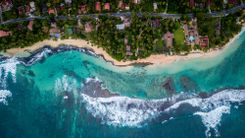
North of Negombo, the coastline becomes increasingly rocky and wild, with narrow beaches and crashing waves that make swimming impossible for most of the year. Not surprisingly, the area remains largely undeveloped, although there are a cluster of appealing places to stay just north of Negombo in peaceful Waikkal. Heading north brings you to the bustling fishing town of Chilaw and the interesting Munnesvaram Temple, one of the island’s most important Hindu shrines, while further up the coast the idyllic Kalpitiya Peninsula is home to the island’s best dolphin-watching and a superb cluster of small-scale eco-resorts on beautiful Alankuda Beach – which also provide a convenient jumping-off point for the nearby Wilpattu National Park.
Wilpattu National Park
Occupying a vast swathe of land stretching all the way up to the border of the Northern Province, Wilpattu National Park is the largest in Sri Lanka, and was formerly the most popular until the onset of the civil war, when its position straddling the frontline between Sinhalese and Tamil areas led to the widespread destruction of local infrastructure and killing of wildlife. The park finally reopened in 2009 and its wildlife is now gradually recovering, although the effects of long-term poaching mean that the overall density of wildlife remains significantly lower than in parks such as Yala, Uda Walawe and Minneriya, although there’s a small but significant chance of spotting the leopards and sloth bears for which the park was once famous, not to mention elephants, deer, and many types of bird. Equally, the lack of visitors and the size of the area open to visitors (around eight times larger than that at Yala, for instance) means that it’s also supremely peaceful compared to many other parks.
An unusual feature of Wilpattu’s topography are its numerous villus. These look like lakes (indeed the park’s name derives from villu-pattu, “Land of Lakes”), though they’re actually just depressions filled with rainwater which expand and contract with the seasons, attracting a range of water-birds and wildlife.
Rama, Shiva and Munnesvaram
According to legend, Munnesvaram temple was established by none other than Rama himself, after he defeated and killed Rawana, as related in the Ramayana. Following the final battle with Rawana, Rama was returning to India in his air chariot (the Dandu Monara, or “Wooden Peacock” – often claimed to be the earliest flying machine in world literature – whose stylized image formerly adorned the tailfins of all Air Lanka planes) when he was overcome by a sudden sense of guilt at the bloodshed occasioned by his war with Ravana. Seeing a temple below he descended and began to pray, whereupon Shiva and Parvati appeared and ordered him to enshrine lingams (symbolic of Shiva’s creative powers) in three new temples: at Konesvaram in Trincomalee, Thirukethesvaram in Mannar, and at Munnesvaram.
The belief that these three temples were thus established by Rama – an incarnation of the great Hindu god Vishnu – lends each an additional aura of sanctity, though the fact that they were created to enshrine a trio of lingams serves as a subtle piece of propaganda asserting the superiority of Shiva over his greatest rival in the Hindu pantheon. The paradox is that, despite Sri Lanka’s close association with Vishnu in his incarnation as Rama, almost all the island’s Hindu temples are dedicated to Shiva, or to deities closely related to him, and hardly any to Vishnu himself.
Want to learn even more useful information for your upcoming trip to Sri Lanka? Read our travel tips for travelling to Sri Lanka.