Andong and around
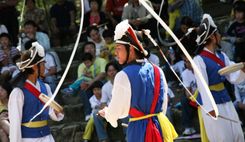
Surrounded by picturesque countryside and magical sights, ANDONG (안동) is deservedly one of the most popular draws in the region for foreign travellers. Whatever the Korean tourist booklets say about its history, don’t go expecting a mini-Gyeongju – such a comparison is unfair and misguided, as there’s little in the city itself. However, the wonderful sights on Andong’s periphery mean that it has enough to be respected on its own terms. The centre is small, pleasant and unhurried, with the main sights located well out of town – Dosan Seowon to the north is a stunning Confucian academy dating from Joseon times, while to the west is Hahoe Folk Village, a rustic approximation of traditional Korean life. A similar village can be found nearer the centre, next to a rather absorbing folklore museum.
Dosan Seowon
Dosan Seowon (도산 서원) is a Confucian academy, surrounded by some of the most gorgeous countryside that the area can offer. The academy was established in 1574, in honour of Yi Hwang, a well-respected Confucian scholar also known as Toegye. It no longer functions as a place of study, but a refurbishment in the 1970s gave back the tranquillity of its original raison d’être: this was a highly important study place during the Joseon era, and the only one outside Seoul, for those who wished to pass the notoriously hard tests necessary for governmental officials. Opposite the main entrance, you may notice a little man-made hill topped by a traditional-style shelter; the stele underneath once marked an important spot for the government exams, with the original location somewhere towards the bottom of the lake that you pass on the bus in. As you enter the complex, beyond the flower gardens and up the steps are two libraries whose nameplates are said to have been carved by Toegye himself; the buildings were built on stilts to keep humidity to a minimum. Further on are structures that were used as living quarters, the main lecture hall, and a shrine to Toegye, though this last one is usually closed off. Passing back down under a cloak of maple – which flames roaring red in late autumn – you’ll find an exhibition hall detailing the great man’s life and times, as well as an astrolabe for measuring the movements of celestial bodies.
Toegye, neo-Confucianist
Poet, scholar, all-round good guy and bearded star of the thousand-won note, Toegye (퇴계; 1501–70) is one of Korea’s most revered historical characters. Born Yi Hwang, but better known by his pen name (pronounced Twegg-yeah), he exerted a major influence on the politics and social structure of his time. The country was then ruled by the Joseon dynasty, one of the most staunchly Confucian societies the world has ever known – each person was born with a predefined limit as to what they could aspire to in life, forever restricted by their genetics. The aristocracy oversaw a caste-like system that dictated what clothes people could wear, who they could marry, and what position they could hold, among other things.
Toegye was lucky enough to be born into privileged society. He excelled in his studies from a young age, and eventually passed the notoriously difficult governmental exams necessary for advancement to the higher official posts. Once there, he refused to rest on his laurels – he hunted down those he thought to be corrupt, and as a reward for his integrity was exiled, several times, from the capital. However, his intelligence made him a force to be reckoned with, and he set about introducing neo-Confucian thought, much of it borrowed from the Song dynasty in China; he advocated, for example, advancement based on achievement rather than heredity. After his death, the Confucian academy Dosan Seowon was built in his honour; it retains the contemplative spirit of the time, and of Toegye himself.
Hahoe Folk Village
Korea has made many efforts to keep alive its pastoral traditions in the face of rapid economic growth; one particularly interesting example is its preserved folk villages. While some exist purely for show, others are functioning communities where life dawdles on at an intentionally slow pace, the residents surviving on a curious mix of home-grown vegetables, government subsidy and tourist-generated income. Hahoe Folk Village (하회 마을) is one of the best and most popular in the country, a charming mesh of over a hundred traditional countryside houses nestling in the gentle embrace of an idle river. This charming mix of mud walls, thatched roofs and dusty trails is no mere tourist construct, but a village with a history stretching back centuries, and you’ll be able to eat up at least a couple of hours exploring the paths, inspecting the buildings and relaxing by the river. The village’s past is told on information boards outside the most important structures – seek out the Yangjin residence, for example, the oldest in the village, and built in a blend of Goryeo- and Joseon-era styles. The village can sometimes get a little busy with visitors, but it’s easy to escape and find space – try the riverside at the far end of the village, past the church.
Around Gyeongju
An almost overwhelming number of sights litter the countryside around Gyeongju – those listed here make up just a fraction of the possibilities, so be sure to scour local maps and pamphlets for things that might be of particular interest to you. Transport to sights is not always regular – you may need to spend some time waiting for buses, so if possible, try to get the latest timetable from one of Gyeongju’s tourist offices. While hitchhiking is never totally safe and can’t be wholeheartedly recommended, you’ll rarely get a better chance than on the run east to the Underwater Tomb of King Munmu, where the road is lightly trafficked and everyone is heading to or from Gyeongju. To the north of Gyeongju are Oksan Seowon, one of the country’s best examples of a Joseon-era Confucian academy, and Yangdong Folk Village, a collection of traditional housing. To the west of the city and within cycling range are yet more regal tombs.
Golgulsa and Girimsa
On the way to see King Munmu and his watery grave, and easily combined as part of a day-trip, you’ll pass a rural spur road leading to two out-of-the-way temples that inhabit a wonderfully unspoilt valley east of Gyeongju. Golgulsa (골굴사) is the nearer of the two, and famed as a centre of seonmudo, a Zen-based martial art. From the bus stop near the village of Andong-ni (#150, the same bus that heads to Munmu), it’s just under 1km to the temple turn-off on the left. It’s all uphill from here, with the track heading past a teahouse before rising into the small complex, from where it becomes even steeper. Backing the complex is a sixth-century Buddha, carved into a cliff navigable on some short but precipitous paths. Though now protected by a monstrous modern structure, a clamber up to the Buddha is essential for the picture-perfect view alone; there are barriers to stop you from going over the edge. Those of an even steelier disposition may like to stay at the temple for some martial arts practice; visit www.golgulsa.com for more information.
Five kilometres further down the spur road is Girimsa (기림사), a temple that receives few visitors on account of its location. There are sometimes direct buses from Gyeongju – ask at the tourist office – but it’s quite possible to make the long walk here from Golgulsa: allow at least an hour each way. The road sees little traffic, and the journey is its own reward, with farmland-backed views and the occasional man walking his pet bird of prey while the surrounding rice paddies reverberate to the sound of thousands of frogs. After such majestic countryside, the slightly drab grounds of the temple itself may come as something of a letdown, but it’s a quiet place rarely overrun with visitors. Notable are a couple of statues of the Goddess of Mercy, and a centuries-old Bodhi tree.
The Underwater Tomb of King Munmu
Just off the coast east of Gyeongju is the Underwater Tomb of King Munmu (문무대왕 수중릉). Though the name befits a good novel, and it’s popular with Korean tourists, the actual signature of rocky crags may come as an anticlimax; it’s worth the trip, however, not only to see the beauty of the surrounding countryside but also to feast on delicious fresh seafood.
The king’s final resting place lies literally a stone’s throw from the coast. In his lifetime, Munmu achieved the first unification of the Korean peninsula, reasoning that the power of his united forces would better repel any invasion from the Japanese. On his deathbed, and still clearly concerned by the Nipponese threat, he asked to have his ashes scattered on the offshore rocks, believing that he would then become a sea dragon, offering eternal protection to the country’s coast. Just 1km inland you’ll be able to make out two giant stone pagodas, 13m high, which mark the former site of Gameunsa (감은사), a temple built on the orders of Munmu’s son, Sinmun, in order to provide his sea-dragon father an inland retreat along the now-dry canal.
You may be lucky enough to witness one of the banana-heavy shamanist ceremonies that occasionally take place on the beach, honouring spirits of the local seas.
Daegu and around
DAEGU (대구) is Korea’s fourth largest city by population, and a major centre of business. The core of town is effectively one large shopping mall, the department stores supplemented by a lattice of streets devoted to particular products. Herbal Medicine Street is the best known, as the city has for centuries been a centre of herbal medicine, but you could also head to Steamed Rib Meat Street or Rice Cake Street if you’re hungry, Shoe Street or Sock Street if your feet need clothing, or Washing Machine Appliance Street if, well, your washing machine needs maintenance.
For all this, it has to be said that Daegu as a city is not particularly attractive. However, in a country obsessed with appearance, it’s hard to talk to a Korean about Daegu without being told how beautiful its women are; the city is based in a geological bowl, which makes for very hot summers, very cold winters and very delicious apples – this fruit that pops out of the surrounding countryside is said to keep the skin pimple-free, as well as providing the blanching effect that Korean girls crave. There are few notable sights in central Daegu, but it’s a pleasant place to shop, or to catch up on your partying if you’ve been trawling the Gyeongsang countryside. Outside the city boundaries Palgongsan is a wonderful park to the north of town, while Haeinsa is one of Korea’s best-known temples, and just a bus ride to the west.
The Daegu subway fire
On February 18, 2003, a calamitous event took place under Daegu’s downtown streets, one that was to have a heavy impact on the Korean psyche, and a terrible comedown after the spectacular success of the previous year’s World Cup. The simple facts – around two hundred killed in a subway fire – do not even begin to tell the story, with failings before, during and after the event bringing about a national sense of shame, and a level of introspection previously unseen in a country accustomed to looking abroad for excuses.
A few months before the fire, a man named Kim Dae-han had suffered a stroke that left him partially paralysed. Ostracized by his family and friends, and losing his sanity, he decided to take his frustrations out on society. During a Tuesday morning rush-hour, he wandered into a subway train armed with gasoline-filled containers, which caught fire as the train pulled into Jungangno station. The fire spread rapidly through the carriages, owing to the lack of any fire-extinguishing apparatus on board; both the seats and the flooring produced toxic smoke as they burned. Kim managed to escape, along with many passengers from his train, but the poor safety procedures on the line meant that the driver arriving in the opposite direction was not informed of the problem, and pulled in to a plume of thick, toxic smoke. At this point the fire detection system kicked in and shut off power on the line, leaving both trains stranded. The driver of the second train told passengers to remain seated while he attempted to contact the station manager, and when finally put through was told to leave the train immediately. He duly scurried upstairs, but in his haste had removed the train’s key, shutting off power to the doors, and effectively sealing the remaining passengers inside – death on a large scale was inevitable. The total count has never been fully established, as some bodies were burnt beyond all recognition.
The families of the victims, and the country as a whole, needed someone to blame. The arsonist was sentenced to life in prison, avoiding the death penalty on the grounds of mental instability; he died in jail soon afterwards. The incident raised some serious questions, primarily about safety being compromised by a thirst for profit, and the treatment of the disabled in Korean society – a baptism of fire for incoming president Roh Moo-hyun. Safety on Daegu’s subway has since been significantly improved, and facilities for the disabled have improved across Korea. At least some good may be coming out of one of Korea’s biggest modern-day disasters.