The Baekje capitals
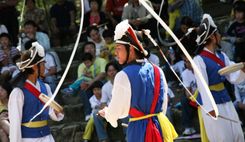
Gongju and Bueyo are two small settlements in Chungnam that were, for a time, capitals of the Baekje dynasty which controlled much of the Korean peninsula’s southwestern area during the Three Kingdoms period. Once known as Ungjin, Gongju became the second capital of the realm in 475, when it was moved from Wiryeseong (now known as Seoul), but held the seat of power for only 63 years before it was passed to Buyeo, a day’s march to the southwest. Buyeo (then named Sabi) lasted a little longer until the dynasty was choked off in 660 by the powerful Silla empire to the east, which went on to unify the peninsula. Today, these three cities form an uneven historical triangle, weighed down on one side by Gyeongju’s incomparable wealth of riches. Although the old Silla capital sees by far the most foreign tourists, the Baekje pair’s less heralded sights can easily fill a weekend. Many of these echo those of the Silla capital – green grassy mounds where royalty were buried, imposing fortresses, lofty pavilions and ornate regal jewellery. Unabashedly excessive, yet at the same time achieving an ornate simplicity, Baekje jewellery attained an international reputation and went on to exert an influence on the Japanese craft of jewellery-making; some well-preserved examples in both cities can be found at their museums, which are two of Korea’s best. Additionally, the Baekje Culture Festival takes place each September, with colourful parades and traditional performances in both Buyeo and Gongju; see wwww.baekje.org for more information.
The two cities remain off the radar of most international travellers, and most who visit do so on day-trips from Seoul. Much of this can be attributed to the fact that there’s next to no higher-end accommodation in either city, though a resort has recently opened up just outside Buyeo. Though unheralded even by Koreans, the cities’ unassuming restaurants are a different story altogether – though extremely earthy, the food on offer here is some of the best and most traditional in the land, and an extremely well-preserved secret.
The Baekje dynasty
The Baekje dynasty was one of Korea’s famed Three Kingdoms – Goguryeo and Silla being the other two – and controlled much of southwestern Korea for almost seven hundred years. The Samguk Sagi, Korea’s only real historical account of the peninsula in these times, claims that Baekje was a product of sibling rivalry – it was founded in 18 BC by Onjo, whose father had kick-started the Goguryeo dynasty less than twenty years beforehand, in present-day North Korea; seeing the reins of power passed on to his elder brother Yuri, Onjo promptly moved south and set up his own kingdom.
Strangely, given its position facing China on the western side of the Korean peninsula, Baekje was more closely allied with the kingdom of Wa in Japan – at least one Baekje king was born across the East Sea – and it became a conduit for art, religion and customs from the Asian mainland. This fact is perhaps best embodied by the Baekje artefacts displayed in the museums in Buyeo and Gongju, which contain lacquer boxes, pottery and folding screens not dissimilar to the craftwork that Japan is now famed for.
Though the exact location of the first Baekje capitals is unclear, it’s certain that Gongju and Buyeo were its last two seats of power. Gongju, then known as Ungjin, was capital from 475 to 538; during this period the aforementioned Three Kingdoms were jostling for power, and while Baekje leaders formed an uneasy alliance with their Silla counterparts the large fortress of Gongsanseong was built to protect the city from Goguryeo attacks. The capital was transferred to Sabi – present-day Buyeo – which also received a fortress-shaped upgrade. However, it was here that the Baekje kingdom finally ground to a halt in 660, succumbing to the Silla forces that, following their crushing of Goguryeo shortly afterwards, went on to rule the whole peninsula.
Though local rebellions briefly brought Baekje back to power in the years leading up to the disintegration of Unified Silla, it was finally stamped out by the nascent Goryeo dynasty in 935. Despite the many centuries that have elapsed since, much evidence of Baekje times can still be seen today in the form of the regal burial mounds found in Gongju and Buyeo.
Buyeo
The smaller and sleepier of the Baekje duo, BUYEO (부여) is nonetheless worth a visit. The Baekje seat of power was transferred here from Gongju in 538, and saw six kings come and go before the abrupt termination of the dynasty in 660, when General Gyebaek led his five thousand men into one last battle against a Silla-Chinese coalition ten times that size. Knowing that his resistance would prove futile, the general killed his wife and children before heading into combat, preferring to see them dead than condemn them to slavery. Legend has it that thousands of the town’s women threw themselves off a riverside cliff when the battle had been lost, drowning both themselves and the Baekje dynasty. Today, this cliff and the large, verdant fortress surrounding it are the town’s biggest draw, along with an excellent museum.
Gongju
Presided over by the large fortress of Gongsanseong, small, sleepy GONGJU (공주) is one of the most charming cities in the land, and deserving of a little more fame. It’s also the best place in which to see relics from the Baekje dynasty that it ruled as capital in the fifth and sixth centuries: King Muryeong, its most famous inhabitant, lay here undisturbed for over 1400 years, after which his tomb yielded thousands of pieces of jewellery that provided a hitherto unattainable insight into the splendid craft of the Baekje people. Largely devoid of the bustle, clutter and chain stores found in most Korean cities, and with a number of wonderful sights, Gongju is worthy of at least a day of your time.
Cheonan and around
After years in the shadows, Cheonan (천안) is a city on the up: now connected to Seoul by subway and high-speed train, its population has boomed in recent years, both with disaffected office workers from the capital and migrants from Asia who have been brought over to work on one of the many construction projects. The new KTX line has enabled commuters to work in Seoul while living in a cheaper, more manageable city, but despite the flashy new department stores and housing complexes, there’s little here to detain travellers bar the superb Arario Gallery – instead, visitors mainly use Cheonan as a jumping-off point for the largest museum in the country, the fascinating Independence Hall of Korea.
Independence Hall of Korea
Set in a wooded area east of Cheonan, Korea’s largest museum, the Independence Hall of Korea (독립 기념관), is a concrete testament to the country’s continued struggle for independence during its most troubled time, from 1910 to 1945, when it suffered the indignity of being occupied by Japan. Though this was a relatively short period, the effects were devastating, and despite the Korean government’s initial appeal for locals not to be “filled with bitterness or resentment”, the popularity of the place and the size of its seven large exhibition halls – each of which would probably function quite well as individual museums – show that the wounds are still sore. Scarcely an opportunity is missed to insert a derogatory adjective against the Japanese people and policies of the time, but this combination of vitriol and history makes the place an absorbing visit.
Each hall highlights different aspects of the occupation, with the most important displays labelled in English. However, many locals head straight for those detailing Japanese brutality during the colonial period – “Torture done by Japan”, a life-size display featuring some unfortunate mannequins, is one of the most popular exhibits, but there are also numerous photographs. Should you tire of the unrelenting indignation, the “Hall of National Heritage” is filled with less bombastic displays detailing traditional Korean life.
Coastal Chungnam
Within easy reach of Seoul, Chungnam’s coast is a popular place for anyone seeking to escape the capital for a bit of summer fun. Inevitably, the main attractions are the beaches, with the white stretches of Mallipo and Daecheon the most visited; the latter’s annual mud festival is one of the wildest and busiest events on the peninsula. It’s a short ferry trip from the mainland bustle to the more traditional offshore islands, a sleepy crew strung out beyond the horizon and almost entirely dependent on fishing.
Daecheon beach
Long, wide and handsome, DAECHEON BEACH (대천 해수욕장) is by far the most popular on Korea’s western coast, hauling in a predominantly young crowd. In the summer this 3km-long stretch of white sand becomes a sea of people, having fun in the water by day, then drinking and letting off fireworks until the early hours. The revelry reaches its crescendo each July with the Boryeong mud festival, a week-long event that seems to rope in (and sully) almost every expat in the country. Mud, mud and more mud – wrestle or slide around in it, throw it at your friends or smear it all over yourself, then take lots and lots of pictures – this is one of the most enjoyable festivals on the calendar (see wwww.mudfestival.or.kr for more details). At other times you can still sample the brown stuff at the Mud House (머드 하우스), the most distinctive building on the beachfront, where mud massages cost from W25,000. Admission gets you entry to an on-site sauna, at which you can bathe in a mud pool or even paint yourself with the stuff; all manner of mud-based cosmetics are on sale at reception, including mud shampoo, soap and body cream. In summer, rent banana boats, jet-skis and large rubber tubes, or even a quad bike to ride up and down the prom.
Nine kilometres south of the beach is Muchangpo (무창포), a settlement that becomes popular for a few days every month when the tides retreat to reveal a path linking the beach with a small nearby island, an event inevitably termed “Moses’ Miracle”; the sight of a line of people seemingly walking across water is quite something. For advice on the tides phone the tourist information line on t041/1330.
West Sea islands
From Daecheon harbour, a string of tiny islands stretches beyond the horizon into what Koreans term the West Sea, a body of water known internationally as the Yellow Sea. From their distant shores, the mainland is either a lazy murmur on the horizon or altogether out of sight, making this a perfect place to kick back and take it easy. Beaches and seafood restaurants are the main draw, but it’s also a joy to sample the unhurried island lifestyle that remains unaffected by the changes that swept through the mainland on its course to First World status; these islands therefore, provide the truest remnants of pre-industrial Korean life. Fishing boats judder into the docks where the sailors gut and prepare their haul with startling efficiency; it’s sometimes possible to buy fish directly from them. Restaurants on the islands are usually rickety, family-run affairs serving simple Korean staples.
The cure-all root
For centuries, perhaps even millennia, the ginseng root has been used in Asia for its medicinal qualities, particularly its ability to retain or restore the body’s Yin–Yang balance; for a time, it was valued more highly by weight than gold. Even today, Korean ginseng is much sought after on the global market, due to the country’s ideal climatic conditions; known locally as insam (인삼), much of it is grown in the Chungcheong provinces under slanted nets of black plastic. The roots take anything up to six years to mature, and suck up so much nutrition from the soil that, once harvested, no more ginseng can be planted in the same field for over a decade.
The health benefits of ginseng have been much debated in recent years, and most of the evidence in favour of the root is anecdotal rather than scientific. There are, nonetheless, hordes of admirers, and ginseng’s stock rose further when it rode the crest of the “healthy living” wave that swept across Korea just after the turn of the millennium. Today it’s possible to get your fix in pills, capsules, jellies, chewing gum or boiled sweets, as well as the more traditional tea or by eating the root raw. As the purported benefits depend on the dosage and type of ginseng used (red or white), it’s best to consult a practitioner of oriental medicines, but one safe – and delicious – dish is samgyetang (삼계탕), a tasty and extremely healthy soup made with a ginseng-stuffed chicken, available across the land. Or for a slightly quirky drink, try mixing a sachet of ginseng granules and a spoon of brown sugar into hot milk – your very own ginseng latte.