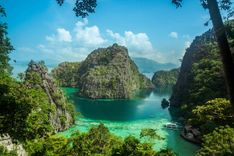
Explore Mindanao
Some of the most accessible (and safest) parts of Mindanao lie along the north coast, starting with the inviting city of Cagayan de Oro. The northwest coast stretching from Iligan to Dipolog is mostly rural and undeveloped, but peppered with alluring port towns and national parks, while the pint-sized island of Camiguin to the northeast is one of the country’s most appealing tourist spots. Northeastern Mindanao is known as Caraga (aka Region XIII), an area generally overlooked by foreign tourists though rich in eco-tourism potential. Highlights include the ancient wooden boat discovered at Butuan, the spell-binding Enchanted River and the surfing hotspot of Surigao.
Read More- Cagayan de Oro
-
Iligan
Iligan
Some 90km west of Cagayan de Oro, the port city of ILIGAN has been working hard to shed its drab industrial image in recent years, rebranding itself as the “city of waterfalls”. Little more than a village in the early 1900s, Iligan boomed as an industrial centre after the creation of a hydroelectric power scheme in the 1950s. With a population of around 300,000 it’s a friendly, laidback place these days, with a peaceful mix of Christian locals and M’ranao Muslims visiting from nearby Marawi, though the biggest draw for visitors lies outside the city proper in the form of those justly famed cascades.
Iligan’s biggest draws are the waterfalls that puncture the surrounding countryside, as there’s little to see inside the city itself; most of Iligan was rebuilt after a devastating fire in 1957. The best cluster lies on the west side on the highway towards Ozamiz and Zamboanga; take any jeepney (P6–12) towards Buru-un and tell them where you want to get off.
The most impressive cascade is the Maria Cristina Falls, 8.5km to the southwest of Iligan, which also serves as the main source of power for much of Mindanao. One hundred metres high, the twin falls (named after two heartbroken girls that are supposed to have jumped from the top), plunge into the torrential Agus River, but are at their best Saturday and Sunday at 11am, when the Agus VI Hydroelectric Plant upstream releases the most water. The falls are located with the NPC Nature Park, which also contains some shabby animal exhibits and a three-stage zip line across the river. From the jeepney stop on the highway it’s around 150m to the park entrance; walking on to the falls from the entrance takes around 20min (800m), or there’s a park shuttle for P10. The falls can only be viewed from a deck inside the power station building – you can’t get up close.
-
Mount Malindang National Park
Little known and little explored, Mount Malindang National Park is a densely forested region that offers some tough trekking and the opportunity to see rare species such as the tarsier and flying lemur.
There are actually four main peaks in Mount Malindang National Park: North Peak, South Peak, Mount Ampiro and Mount Malindang itself, which is the tallest at 2404m. The area was extensively logged before being declared a national park in 1971, so most of the forest growth today is relatively new. There’s a long-established tribal group living in the park, the Subanon, whom you may well encounter at their Lake Duminagat settlement. They consider Mount Malindang their tribal homeland and source of strength. The best time to visit the park is during the months of January to April when the trails are dry.
You need a permit (P200) to enter the park, which is available from the Protected Area Office (t088/531-2184) at the back of the Provincial Capitol Building in Orquieta, a one-hour bus ride north from Ozamiz. A guide is essential and can be arranged here for P1500 a day.
-
Dolphin Island
Dolphin Island
Just thirty minutes drive north along the coast from Ozamiz in the village of Sinacaban, the Misamis Occidental Aquamarine Park (MOAP; P10) is an ambitious eco-tourism project that combines dolphins, fish ponds, mangrove restoration and chalet-style accommodation via the Dolphin Island Resort (t088/586-0292). Rooms range from deluxe suites (P2500–2999) to smaller cottages (P1500–1999), all on stilts overlooking the shallow bay with hot showers and TV. There are also dorm beds from P250.
The real attraction here is Dolphin Island, a series of man-made stilt huts over a sand bar 2km offshore. It’s principally a dolphin rescue centre, with fenced-in seawater pens providing a safe haven for animals trapped or injured by fishermen – after rehabilitation they are released into nearby dolphin communities. At the time of writing the island was home to five spotted dolphins and one green turtle. You can swim with the dolphins here for just P250 – an incredible deal. There’s a basic restaurant on the island that serves fried chicken, pork and rice, and another restaurant onshore at the resort. The fifteen-minute boat ride to the island costs P30 round-trip (every hour, daily 8am–4pm; last boat back 5.30pm), and you can rent snorkelling gear (P50/hr), kayaks (P100/hr) or organize dive trips (from P2300). Tricycles to MOAP from the Ozamiz ferry charge around P200.
- Dapitan
-
Camiguin Island
Camiguin Island
Lying around 20km off the north coast of mainland Mindanao, the pint-sized island of Camiguin (“cam-ee-gin”) is one of the country’s most appealing tourist spots, offering ivory beaches, iridescent lagoons and jagged mountain scenery. There’s no shortage of adventure here either, with reasonable scuba diving and some tremendous trekking and climbing in the rugged interior, especially on volcanic Mount Hibok-Hibok. Another major tourist draw is the annual Lanzones festival, held in the fourth week of October. Revellers dressed only in lanzones leaves stomp and dance in the streets as a tribute to the humble fruit, one of the island’s major sources of income.
The beauty of Camiguin is that it doesn’t really matter where you stay because you can visit all the sights easily from anywhere. The coastal road is almost 70km long, making it feasible to circle the island in a day. If you don’t want to depend on public transport, consider hiring your own private jeepney or tricycle for the trip. Many resorts also offer motorcycle rental.
-
Agusan Marsh Wildlife Sanctuary
About 70km south of Butuan on the road to Davao, the Agusan Marsh Wildlife Sanctuary is a giant maze of interconnecting rivers, channels and lakes, with dramatic areas of swamp forest consisting largely of sago trees and inhabited by parrots, purple herons, serpent eagles and a good number of saltwater and Philippine crocodiles.
The marsh is around 2 hours 30 minutes from Butuan and 3 hour from Davao; whichever direction you’re coming from, you need to get off the bus in the town of Bunawan (only slow non-a/c buses stop here), and then take a tricycle west to the town hall (t910/984-0285) to register. From here you can hire a boat and guide for the three-hour ride along the river to the marsh area itself – be prepared for a full day out and take lots of water and sunblock. Hotels in Butuan can help arrange trips, but a locally arranged day tour in Bunawan costs around P1500 for the boat plus P1000 for the guide. Despite its isolation, the marsh is inhabited by about 2600 people, mainly the Manobo, an animist group that live across much of eastern Mindanao. Their houses are floating wooden structures with thatched roofs and rest on a platform lashed to enormous logs. Whole communities exist like this, their houses tethered to one another in one place, but moveable at any time. There is some very basic accommodation in Bunawan if you get stuck, and some of the floating Manobo villages also offer lodgings – ask at the town hall.
-
The Enchanted River
The Enchanted River
Swimming in the Enchanted River (daily; P10) is one of the highlights of Mindanao. The accessible part of the river is more like a narrow saltwater lagoon that ends at an underwater cave and ravine crammed with all sorts of tropical fish that get fed every day at noon. The colours are mesmerizing; the water glows like liquid sapphire, surrounded by dense jungle and karst outcrops.
The site is managed by the local authorities as a small park (you can wander to a small beach from here), but it’s well off the beaten path and very few foreign tourists make it this far. The park lies at the end of a 12km dirt road, just beyond the fishing village of Talisay – the village is almost as enchanting as the lagoon, with neat, nipa and wood cottages, some with stilts over the water, and plenty of blossomy gardens.
The turning to the river and Talisay is signposted 2km north of Hinatuan on the main coast road, 150km south of Butuan; the main road is served by frequent buses plying between Butuan and Mangagoy; without your own transport it’s a very long walk or habal-habal ride from Hinatuan.
- Siargao Island
-
The Mindanao problem
Despite its volatile political situation and advice from Western governments to avoid travelling to all of Mindanao, much of the island is safe for foreign travellers. However, you should always check the current situation before travelling and read our advice on trouble spots. Politically the situation is fluid and confusing, with a number of factions and splinter groups calling for varying degrees of autonomy from Manila.
The thorniest issue involves Mindanao’s Muslims (also known as Moros), who are seeking self-determination. The Moro National Liberation Front (MNLF) started a war for independence in the 1970s that dragged on until 1987, when it signed an agreement accepting the government’s offer of autonomy. As a result, the Autonomous Region in Muslim Mindanao, or ARMM, was created in 1990, covering the provinces of Basilan, Lanao del Sur, Maguindanao, Sulu and Tawi-Tawi, plus Marawi City. The more radical Moro Islamic Liberation Front (MILF) splintered from the MNLF in 1981 and refused to accept the 1987 accord. It has since continued fighting and making uneasy truces, broken many times. In 2008 MILF broke the latest ceasefire after the Supreme Court ruled that a government deal offering them large areas of the south went against the constitution. At the height of the fighting, more than 750,000 people were displaced, and about 400 people killed. At the time of writing things appeared to have calmed; President Benigno Aquino had reopened negotiations with the MILF, proposing a wider Muslim ancestral homeland in Mindanao.
Mindanao’s problems don’t end with the MILF, however. One disaffected group of fighters formed Abu Sayyaf, whose centre of operations is largely Basilan Island, off Mindanao’s south coast. Abu Sayyaf, whose name means “Bearer of the Sword”, is said to have ties to a number of Islamic fundamentalist organizations including al-Qaeda. The group finances its operations mainly through robbery, piracy and kidnappings. They are believed to have been responsible for the bombing of Superferry 14 in February 2004, which sank off the coast of Manila with the loss of 116 lives. In 2006 the group’s leader, Khadaffy Janjalani, was shot dead in an encounter with government troops. However, kidnapping remains a threat.
And then there’s the communist rebels (aka New People’s Army), who have also been fighting since 1969 for the establishment of a communist state in Mindanao; they remain active in remote parts of the island.
Finally, much of the ARMM remains dangerous territory thanks to private armies aligned to corrupt local politicians. In 2009, 57 men and women (including 34 journalists) were tortured and brutally murdered in what was dubbed the Maguindanao Massacre, apparently for attempting to register a rival candidate for the upcoming elections; the perpetrators were a private militia controlled by the powerful Ampatuan clan (who were arrested and tried in 2010).