Paksan and Pakkading
Route 13 passes through PAKSAN, capital of Bolikhamxai province and the northernmost major settlement on the narrow neck of Laos, but few travellers actually stop over in this small and sleepy Mekong town, and the ferry crossing to and from Beung Kan in Thailand is still little used, despite being open to foreigners. After years of planning, workers have finally moved in to fix the terrible road between Paksan and Phonsavan, which would make it possible for northbound travellers from Savannakhet to head straight to the Plain of Jars without having to make a detour through Vientiane. Reports say the project, which could knock five hours off the current eight-hour slog, should be finished soon. By that time, the increased through-traffic and ensuing facilities should
make spending a night in Paksan a more tempting option than it is at present.
Pakkading
Forty kilometres southeast of Paksan, Nam Kading NBCA is Bolikhamxai province’s largest conservation area and a place of dramatic scenic beauty. Running parallel to the Mekong and encompassing 1740 square kilometres, the park has a chain of mountains down its length, the highest peak being the 1588-metre Mount Pha Pet, which can clearly be viewed as you travel Route 13. Unfortunately, this is likely to be as intimate a glimpse as you’ll get, as there are no roads into the reserve, and no facilities for visitors whatsoever.
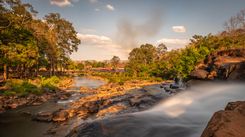
Behind the ridge on the eastern boundary of the NBCA, the Nam Mouan and Nam Theun rivers converge to form the Nam Kading, so named because the waterfalls where the Nam Theun spills off the plateau are said to make a “kading” sound – the sound of a water buffalo’s bell. The Nam Kading flows out through a gap in the mountains to join the Mekong at the village of PAKKADING. There are a number of good fish restaurants along the highway here, making it a favourite lunch spot for truckers and travellers plying Route 13.
To the east of Pakkading, the highway crosses a Russian-built bridge and heads south out of town. Drivers often pause to light a cigarette before crossing the bridge, and then respectfully toss the lit cigarette into the swift waters below, an offering to appease the feisty water serpent believed to live at the river’s mouth. Every year a buffalo is sacrificed to the water serpent, though the offerings weren’t enough to spare the lives of a Russian engineer and several Lao workers who died during construction of the bridge.
East to Xepon and the Vietnam border
From Savannakhet, Route 9 heads east through a series of drab and dusty towns, passing Muang Phin and then Xepon, where it begins its climb up into the Annamite Mountains. The road ends its Lao journey at the Lao Bao pass, before crossing into Vietnam and continuing down to Dong Ha, where it joins Highway 1. The French completed the road in 1930, as part of an Indochinese road network intended to link Mekong towns with the Vietnamese coast, bringing in Vietnamese migrants and trucking out Lao produce. Today, the Thais, too, have an interest in Route 9 as a trade corridor, linking their relatively poor northeastern provinces with the port of Da Nang in Vietnam.
While most travellers barrel through here on direct buses to and from Vietnam, the frontier is not without sites of interest. As you approach Muang Phin, Route 9 begins to cross the north–south arteries of the Ho Chi Minh Trail, a network of dirt paths and roads that spread throughout southeastern Laos, running from the Mu Gia Pass in Bolikhamxai province south through Attapeu and into Cambodia. While much of the debris from the war lies off the beaten track, some of these war relics are easily accessible. Another place worth stopping in to explore the surrounding area is the recently rebuilt market town of Xepon which, along with neighbouring towns, is populated predominantly by Phu Tai people, a lowland Lao group.
Xepon
A picturesque village in the foothills of the Annamite Mountains, 40km from the Vietnamese border, XEPON is a pleasant rural stopover for those in transit on the route to Vietnam or Savannakhet. The original town of Xepon was destroyed during the war – along with every house of the district’s two hundred villages – and was later rebuilt here 6km west of its original location, on the opposite bank of the Xe Banghiang River. The old city (written as “Tchepone” on some old maps) had been captured by communist forces in 1960 and became an important outpost on the Ho Chi Minh Trail. As such, it was the target of a joint South Vietnamese and American invasion in 1971, aimed at disrupting the flow of troops and supplies headed for communist forces in South Vietnam.
Vietnamese influence
Ties between Muang Phin and Vietnam go back a long way. During much of the eighteenth and nineteenth centuries, the area’s Phu Tai inhabitants paid tribute to the court in Hué. In the middle of the nineteenth century, the Vietnamese rulers, having just wrapped up a war with Siam, were content to exact a light tribute of wax and elephant tusks from the Phu Tai, preferring to leave the Tai minority’s territory as a loose buffer zone between regional powers. By this point, Vietnamese merchants, following the traditional trading route across the Lao Bao pass, were already arriving in Muang Phin with cooking pans, iron, salt and fish sauce, and returning east with cows and water buffaloes in tow. A story told by an early French visitor to the town attests to the business acumen of one of these merchants. Upon arriving in town, the merchant found prices too high, but was reluctant to return home without making a good profit. With a quick conversion to Buddhism the merchant’s problem was solved: he shaved his head and shacked up in the local temple where he could defray his expenses until prices dropped, at which point the merchant donned a wig, bought up a few buffalo and hightailed it back to Hué.