Some history
Knowledge of Luang Prabang’s early history is sketchy, at best. The earliest Lao settlers made their way down the Nam Ou Valley sometime after the tenth century, absorbing the territory on which the city lies. At the time, the area was known as Muang Sawa, a settlement thought to have been peopled by the Austroasiatic ancestors of the Lao Theung. According to folklore, this migration of the Lao to Luang Prabang was led by Khoun Lo, who claimed the area for his people and called the settlement Xieng Dong Xieng Thong. By the end of the thirteenth century, Xieng Dong Xieng Thong had emerged as one of the chief centres of Lao life in the Upper Mekong region, a principality significant enough to be a vassal state of the great Siamese kingdom of Sukhothai.
However, it wasn’t until the legendary Lao warrior Fa Ngum swept down the Nam Ou with a Khmer army in 1353 and captured Xieng Dong Xieng Thong that the town emerged as the heart of a thriving, independent kingdom in its own right. Claiming the throne of his grandfather, Fa Ngum founded the kingdom of Lane Xang Hom Khao – the Land of a Million Elephants and the White Parasol – and established the line of kings that was to rule Laos for six centuries.
With Fa Ngum came monks, artisans and learned men from the Khmer court and, according to histories written a century and a half later, a legal code and Theravada Buddhism. Yet Fa Ngum was still very much the fourteenth-century warrior. After his ministers grew weary of his military campaigns and his rather uncivilized habit of taking his subject’s wives and daughters as concubines, he was exiled and replaced on the throne by his son, Oun Heuan, during whose peaceful reign the city flourished.
The sacking of the city in 1478 by the Vietnamese proved a catalyst for the ushering in of the city’s golden age: striking temples, including the sim of Wat Xieng Thong, were built, epic poems composed and sacred texts were copied. In 1512, King Visoun brought the Pha Bang, a sacred Buddha image, to Xieng Dong Xieng Thong, a distinguishing event for the identity of the Lao people and the city itself, and a sign that Theravada Buddhism was flourishing.
Wary of encroaching Burmese, King Setthathilat, Visoun’s grandson, moved the capital to Vientiane in 1563, leaving the Pha Bang behind and renaming the city after the revered image. The Pha Bang may have been known for its protective properties, but they were no match for the might of the Burmese, and Luang Prabang was engulfed by the chaos of successive Burmese invasions.
From then on, the city had a roller-coaster ride. With the disintegration of Lane Xang at the turn of the eighteenth century, Kingkitsalat became the first king of an independent Luang Prabang. When French explorers Doudart de Lagrée and Francis Garnier arrived in 1867, they found a busy market and port town of wooden homes, a town that Garnier called “the most eminent Laotian centre in Indochina”. With Luang Prabang firmly in Siam’s orbit, the explorers’ suggestion that the kingdom would be better off French was scoffed at by King Oun Kham, but the explorers were proved right two decades later when the Siamese left the town virtually undefended and the city was set ablaze by a group of marauding Haw. During the siege, French vice-consul Auguste Pavie plucked the ageing Lao king from his burning palace and brought him downriver to safety. From that moment, the king offered tribute to France.
Almost everything was lost during the sacking of the city, but the event provided Pavie with the ammunition he needed to “conquer the hearts” of the Lao and usher in Luang Prabang’s French period. The town was quickly rebuilt, with the French counting ten thousand people and more than a thousand homes a year after the town’s destruction. Within time, the French hired Vietnamese workers to build the homes that lend the city its classic French–Indochinese character, a trend quickly followed by Lao nobility. The city remained remote however: even in 1930 it took longer to travel by river from Saigon to Luang Prabang than it did to travel from Saigon to France.
During the two Indochina wars, Luang Prabang fared better than most towns in Laos, though while the city itself remained intact during the fighting that consumed the country over the next two decades, the Second Indochina War ultimately took its toll on Luang Prabang’s ceremonial life, which lost its regal heart when the Pathet Lao ended the royal line by forcing King Sisavang Vatthana to abdicate in 1975. Two years later, Luang Prabang and Laos lost the king himself, as the new communist government, fearful that he might become a rallying point for a rebellion, allegedly exiled him to a Hoa Phan cave, a journey from which he and his family never returned.
In 1995, the city was designated an UNESCO World Heritage Site, in recognition of it’s unique mix of traditional Lao architecture and old colonial buildings.
Luang Prabang's Old City
The old city is concentrated on a long finger of land, approximately 1km long by 300m wide. The thicker southern end of the peninsula is dominated by a steep, forested hill, Phousi, crowned by a Buddhist stupa that can be seen for miles around. As the city grew it expanded outwards from the peninsula to the south and east, and continues to do so to this day.
Just four parallel streets run the length of the peninsula, but there are enough cross streets, lanes and dead ends to keep things interesting. Amazingly, each area seems to exude its own distinct personality. Although it is possible to knock off all the attractions in the old city in a couple of days, it’s far more enjoyable to explore it a little at a time, and really soak up the atmosphere; the many temples and monasteries are certainly too charming be rushed through.
Alms-giving
The daily dawn procession of monks through the streets of the old city has become one of the quintessential images of Luang Prabang and is one of its biggest tourist “attractions”. As a result, however, it can feel a little zoo-like, as tourists line up to watch the monks pass, cameras madly clicking to get the best shot.
There’s no denying the serene beauty of the alms-giving ceremony (Tak Bat) as kneeled locals place sticky rice into the baskets of the passing saffron-robed monks. However, if you do wish to see it, it’s important to behave properly – in particular, dress appropriately and modestly, don’t make physical contact with the monks, and keep a respectful distance from them. It is possible to join the alms-giving, but locals request that you only do so if it would be meaningful to you. If you do so, buy sticky rice from the morning market beforehand rather than the street vendors that congregate along Sisavangvong Road as the rice can be of dubious quality.
Big Brother Mouse
Set up to promote literacy in Laos, Big Brother Mouse (Phayaluangmeungchan Rd; t071/254937, wwww.bigbrothermouse.com) is an excellent scheme that publishes books in Lao and enables young people to gain new skills in reading, writing and computing. Books are still a rare commodity in Laos, so the work that Big Brother Mouse does is vital in helping young Lao people develop new skills and enhance their prospects.
The organization, which is non-profit and Lao-owned, encourages visitors to buy books to take on treks, rather than giving sweets or pens to village children. In addition, tourists can sponsor a book party ($300–400), help young adults practise their English (Mon–Sat 9am; 2hr) or volunteer in the office and shop (vacancies are regularly posted outside the shop). You are welcome to visit the shop and speak to the staff in more detail about their work and what you can do – look for the big cut-out of a mouse outside.
Phousi
Phousi (Sacred Hill) is the geographical as well as spiritual centre of the city. Believed to have once harboured a powerful naga who dwelt in its bowels, the hill is also seen as a miniature Mount Meru, the Mount Olympus of Hindu-Buddhist cosmology. Though there is nothing to see on the hill itself, save for an ancient-looking sim at its foot, Phousi is striking from a distance. Indeed, the golden spires of That Chomsi at its summit are the first glimpse of the city that visitors get if they are arriving by boat or plane. Likewise, the peak affords a stunning panorama of the city it crowns, and the shimmering rivers and jungle-clad mountains beyond are mesmerizing. Viewing the setting sun from the summit of Phousi has become a kind of tourist ritual, so don’t expect to enjoy the moment alone – indeed, early morning is a better time to come, when the city and the hill are more peaceful. A quieter spot from which to watch the sunset is Santi Chedi on a hill due east of Phousi, which affords a marvellous view back towards Phousi, without the crowds.
There are three approaches to the summit. The first and most straightforward is via the stairway directly opposite the main gate of the Royal Palace Museum. The second approach, on the other side of the hill, is up a zigzag stairway flanked by whitewashed naga, and can be used for descending to Phousi Road. The third and most rambling approach is via Wat Pha Phoutthabat near Phousi’s northern foot (across from the Saynamkhan Riverview Hotel).
Most people choose the first ascent, which allows you to first stop at the adjacent Wat Pa Houak. This fine little temple, overlooking Sisavangvong Road and the Royal Palace Museum, has a charmingly weathered facade, but is mainly of interest of its interior murals. Though the French art historian Henri Parmentier once describing them as “ridiculous”, they are in fact fascinating, and appear to depict Luang Prabang as a celestial city. Besides Lao characters in classical costumes, there are Chinese, Persians and Europeans in the city, but it is not clear whether they have come as visitors or invaders. After soaking up the murals it’s a steep climb through a tunnel of shady plumeria trees to the peak.
The Royal Palace (Royal Palace Museum)
Occupying a fittingly central location in the old city, between Phousi Hill and the Mekong River, the former Royal Palace is now home to the Royal Palace Museum, preserving the trappings and paraphernalia of Laos’s recently extinguished monarchy. The palace, at the end of a long drive lined with stately palms, was constructed in 1904 by the French and replaced an older, smaller palace of teak and rosewood. The new palace was supposed to be crowned by a European-style steeple, but King Sisavang Vong insisted on modifications, and the graceful stupa-like spire that you see today was substituted, resulting in a tasteful fusion of European and Lao design. Another striking feature is the pediment over the main entrance adorned with a gilt rendition of the symbol of the Lao monarchy: Airavata, the three-headed elephant, being sheltered by the sacred white parasol. This is surrounded by the intertwining bodies of the fifteen guardian naga of Luang Prabang.
The king’s reception room, to the right of the entrance hall, is full of huge Gauguinesque canvases portraying what appears to be “a day in the life of old Luang Prabang”, with scenes of the city as it appeared in the early twentieth century. The paintings, executed by Alex de Fautereau in 1930, are meant to be viewed at different hours of the day when the light from outside is supposed to illuminate the panels depicting the corresponding time of day.
More impressive is the Throne Hall, just beyond the entry hall. Its high walls spangled with mosaics of multicoloured mirrors set in a crimson background, the throne hall dazzles even in the dim light. These mosaics, along with others at Wat Xieng Thong, were created in the mid-Fifties to commemorate the 2500th anniversary of the historic Buddha’s passing into Nirvana. On display in this room are rare articles of royal regalia: swords with hilts and scabbards of hammered silver and gold, an elaborately decorated fly-whisk and even the king’s own howdah (elephant saddle). Also on show is a cache of small crystal, silver and bronze Buddha images taken from the inner chamber of the “Watermelon Stupa” at Wat Visoun. Somehow these treasures escaped the plundering gangs of “Black Flag” Chinese who, led by a White Tai warlord, sacked Luang Prabang in 1887. The stupa was destroyed, rebuilt in 1898, but collapsed in 1914. It was then that the Buddhas were discovered inside.
Leaving the Throne Hall via the door on the right, you come to the royal library, which is almost exclusively made up of official archives of the Ming and Ching dynasties, a gift from China during the Cultural Revolution. The corridors that surround the rooms at the rear are decorated with sixteen pictures that illustrate the legend of Prince Wetsantara, considered an important epic by Lao Buddhists.
King Sisavang Vong’s bedchamber, located at the very back of the palace, is surprisingly modest. The only thing that looks especially regal is the massive hardwood bed, the headboard of which sports the king’s initials and a carved Buddha sheltered by a seven-headed naga. The footboard bears a rendition of the royal emblem of Laos, this time with a two-tiered parasol.
Of the two final rooms, the near room houses diplomatic gifts presented to the people of Laos by a handful of nations, as well as the rather tatty-looking flag of the Kingdom of Laos that was given a symbolic ride up into space and back on one of the Apollo missions. Not long afterwards, the Kingdom of Laos ceased to exist. In the far room hang larger-than-life portraits of King Sisavang Vattana, his wife Queen Kham Phoui and their son Prince Vong Savang. These are the only officially displayed portraits of the last members of the 600-year-old dynasty anywhere in Laos. Had they not been painted by a Soviet artist they almost certainly would not have survived the years following the revolution. The same goes for the bronze sculpture of King Sisavang Vong in the museum grounds near the front gate. This statue may look familiar if you have already passed through Vientiane, where a larger version stands in the park adjacent to Wat Simuang.
Turn left immediately upon exiting the museum to reach the small room that currently houses the Pha Bang, the most sacred Buddha image in Laos. Flanking the Pha Bang are numerous other Buddha images, including ancient Khmer stone images and several pairs of mounted elephant tusks. One pair, deeply incised with rows of Buddhas, was noted by Francis Garnier on the altar of Wat Visoun in the 1860s. Displayed nearby in richly carved wooden frames are silk panels embroidered with gold and silver thread that depict yet more images of the Buddha.
The Pha Bang
Much more than an ancient image of the Buddha, the Pha Bang is the palladium of Laos. The pursuit and enshrining of palladial images has a long history in Southeast Asia, full of intrigue and Byzantine plotting. Like Thailand’s “Phra Kaew” and Burma’s “Mahamuni” Buddha images, the Pha Bang is believed to possess miraculous powers that safeguard the country in which it is enshrined. Formerly, palladial images were thought to legitimize the sovereignty of a king who had one in his possession. Only a pious king with sufficient religious merit could hope to hold onto such an image, and losing it was thought to be proof that a kingdom and its ruler did not deserve to possess it. Thus the histories of certain palladia read like the itinerary of some much coveted sacred sword or holy grail.
According to Lao legend, the Pha Bang image was cast of gold, silver, copper, iron and precious stones. Overseen by the god Indra, who donated gold for its creation, the image was crafted in the heavens above the Himalayas and then delivered to the capital of Sri Lanka. From there the image made its way to Cambodia and then to the city of Xieng Dong Xieng Thong, later renamed Luang Prabang (the Great Pha Bang) in honour of the image. In the early eighteenth century, the Pha Bang was moved to Vientiane, now the capital. Twice the Siamese invaded Vientiane, capturing the image, and twice they returned it to the Lao, believing that the Pha Bang was bad luck for Siam.
Since 1867, the Pha Bang has been kept in Luang Prabang, where to this day it is considered the most sacred Buddha image in Laos and centrepiece of the Lao New Year festival. At least, that’s the official story. Persistent rumours have circulated since the revolution that the authentic Pha Bang was removed from its ornate pedestal and given to the Soviets in return for assistance to the Pathet Lao during the war. The image on display is said to be a copy, while the real Pha Bang is locked away in some vault in Moscow, its powers no longer serving as a talisman for Laos.
Outside Luang Prabang's Old City
The old city may have the highest concentration of monasteries and old buildings, but there is plenty of interest on and beyond Setthathilat Road including an excellent museum, over twenty temples, several markets, and a choice of scenic walks. The most historically important of the temples are Wat Hosian Voravihane, Wat Visoun and Wat Aham, although a trip to the opposite banks of the Mekong and Nam Khan rivers will reward you with many other venerable riverside temples, as well as a relaxed rural ambience and good views back over the old city.
Traditional Arts and Ethonology Centre (TAEC)
Tucked up a steep unpaved road off Setthathilat Road, the Traditional Arts and Ethnology Centre provides an excellent introduction to Laos’s ethnic groups. The small exhibition displays beautiful clothing, household objects and religious artefacts to illustrate the history and way of life for the Akha, Hmong and Khmu people, among others. All of the items are attributed to their makers, and the information that runs alongside the displays is insightful and interesting. Particularly fascinating is the short documentary on Taoist ordination ceremonies, complemented by some beautiful ceremonial masks made from tissue-thin mulberry paper, which are worn on the top of the head in order that they can be seen by the gods. A small shop attached to the museum sells reasonably priced handicrafts, and the charming café is a good place to stop for a cup of Lao coffee.
River town
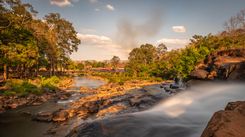
Surrounded by rivers on three sides, Luang Prabang not surprisingly feels almost waterborne, and the ship-like contour of the peninsula enhances this impression. Numerous stairways, flanked with whimsical guardian images, link palaces, monasteries and homes with nearby rivers, and are a statement of the importance of the Mekong and the Nam Khan in the lives of Luang Prabang’s population. The banks along the Mekong side are the more lively, but the Nam Khan side is more evocative of old Luang Prabang, and on either side the show is a never-ending affair.
When the French arrived in Luang Prabang they noted a “floating suburb” anchored in the shallows on the Mekong’s banks. Francis Garnier described how arriving boats and rafts would slowly poke among the houseboats looking for a place to land and discharge their passengers and cargo. With paved roads conveying much of the traffic into Luang Prabang, life along the river is less of a circus now, but sights and sounds of riparian commerce linger, and ferries between both sides of the Mekong usually groan under the weight of produce (and villagers) being taken to and from the city. On the Nam Khan side, groups of residents tend tidy riverside gardens and make their way down to the river to bathe during dusk’s waning light. It is scenes like these, all but vanished and forgotten in more developed countries, that make Luang Prabang such a fascinating place.