The Shikoku pilgrimage
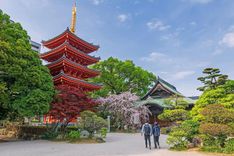
Wherever you are in Shikoku, you’ll seldom be far from Japan’s longest and most famous pilgrimage, established by disciples of the Buddhist saint Kōbō Daishi, founder of Shingon Buddhism ( for more on Daishi). It usually takes over two months to walk the 1400km between the 88 temples on the prescribed route, and plenty of pilgrims, known as henro-san, still complete the journey this way, though far more follow the route by car, train or on bus tours. The number of temples represents the 88 evils that, according to Shingon Buddhism, bedevil human life.
Henro-san are easy to spot, since they usually dress in traditional short white cotton coats, coloured shoulder bands and broad-rimmed straw hats, and generally clutch rosaries, brass bells and long wooden staffs – for support on the steep ascents to many of the temples. The characters on their robes and staffs translate as “Daishi and I go together”. Most pilgrims are past retirement age, as few younger Japanese have the inclination or the vacation time needed for such a pilgrimage.
The present-day headquarters of the Shingon sect is Kōya-san, in Wakayama-ken, and this is the traditional start of the pilgrimage. The first temple visited on Shikoku is Ryōzen-ji, near Naruto in Tokushima-ken. Pilgrims then follow a circular route that winds its way clockwise around the island, stopping at all the temples en route to the 88th, Ōkubo-ji, in Kagawa-ken.
Several books in English describe the 88-temple hike, including Oliver Statler’s classic Japanese Pilgrimage. For more up-to-date details, check out shikokuhenrotrail.com, created by the American henro David Turkington.
Takamatsu
Even before the Seto Ōhashi connected Shikoku’s rail network with Honshū, the port of TAKAMATSU (高松), capital of Kagawa-ken, was a major gateway into the island. Warlord Chikamasa Ikoma built his castle here in 1588, but the city and surrounding area’s history go back a long way before that. The priest and mystic Kōbō Daishi was born in the prefecture, the banished Emperor Sutoku was murdered here in 1164 and, 21 years later, the Taira and Minamoto clans clashed at nearby Yashima. In air raids during World War II, Chikamasa’s castle was virtually destroyed, along with most of the city.
Today, Takamatsu is a sprawling but fairly attractive cosmopolitan city of 420,000 inhabitants, peppered with covered shopping arcades and designer stores. As twenty-first-century as all this is, the city’s star attraction remains Ritsurin-kōen, one of Japan’s most classical, spacious and beautifully designed gardens. The gardens are easily accessible on a day-trip from Honshū, but it’s well worth staying overnight so you can also take in Shikoku Mura, the open-air museum of traditional houses at Yashima, or Kotohira-gū, the ancient shrine an hour’s train ride west of the city. Takamatsu is also a gateway to two of the most appealing islands in the Inland Sea: Shōdo-shima, a mini-Shikoku with its own temple circuit and scenic attractions; and delightful Naoshima, a must for contemporary art and architecture fans with several outstanding galleries designed by Andō Tadao.
Naoshima
The living canvas for a dynamic ongoing art project, idyllic NAOSHIMA (直島) is home to three stunning Andō Tadao-designed galleries as well as several large-scale installations and outdoor sculptures from major international and Japanese talent. In the island’s main town and ferry port, Miyanoura (宮浦), is an amazing bathhouse, while around the southern Gotanji area there are sheltered beaches with glorious Inland Sea views – all making Naoshima a blissful escape.
Ritsurin-kōen
Takamatsu’s one must-see sight, Ritsurin-kōen (栗林公園), is 2.5km south down Chūō-dōri from the JR station. The formal garden, Japan’s largest at 750,000 square metres, lies at the foot of Mount Shuin. Its construction began in the early seventeenth century and took several feudal lords over one hundred years to complete. The gardens were designed to present magnificent vistas throughout the seasons, from an arched red bridge amid a snowy landscape in winter, to ponds full of purple and white irises in early summer.
The East Gate is the garden’s main entrance but JR trains stop at least once an hour at Ritsurin-kōen Kita-guchi, close by the North Gate. At either entrance you can pick up a free English map of the gardens and buy tickets that combine entrance with tea in the Kikugetsu-tei Pavilion. From the East Gate you can either follow a route through the Nantei (South Garden) to the left or Hokutei (North Garden) to the right. The more stylized Nantei garden has paths around three lakes, dotted with islands with carefully pruned pine trees. The highlight here is the delightful Kikugetsu-tei, or “Scooping the Moon”, teahouse overlooking the South Lake. Dating from around 1640 and named after a Tang-dynasty Chinese poem, the teahouse exudes tranquillity, with its screens pulled back to reveal perfect garden views. Viewed from across the lake it’s just as impressive, swaddled in trees that cast a shimmering reflection over the water. The Nantei also has the less elaborate but more secluded Higurashi-tei teahouse, set in a shady grove.
Hokutei has a more natural appearance, and is based around two ponds – Fuyosho-ike, dotted with lotus flowers, and Gunochi-ike, where feudal lords once hunted ducks and which now blooms with irises in June. Keep an eye out for the Tsuru Kame no Matsu, just to the left of the main park building, a black pine tree shaped like a crane spreading its wings and considered to be the most beautiful of the 29,190 trees in the gardens. Behind this is a line of pines called the “Byōbu-matsu”, after the folding-screen painting (byōbu) they are supposed to resemble.
Shōdo-shima
It may not have quite the same idyllic appeal as its smaller Inland Sea neighbour Naoshima, but thanks to its splendid natural scenery and a collection of worthwhile sights Shōdo-shima (小豆島) should still be high on any list of places to visit in Shikoku. The mountainous, forested island styles itself as a Mediterranean retreat, and has a whitewashed windmill and mock-Grecian ruins strategically placed in its terraced olive groves. But native culture also gets a look-in, since Shōdo-shima – which translates as “island of small beans” – promotes its own version of Shikoku’s 88-temple pilgrimage and its connection with the classic Japanese book and film Nijūshi-no-Hitomi (24 Eyes). This tear-jerking tale of a teacher and her twelve young charges, set on Shōdo-shima between the 1920s and 1950s, was written by local author Tsuboi Sakae. A trip to the island also offers a rare opportunity to visit a centuries-old soy sauce factory (see Naoshima), where traditional methods are still employed.
Tokushima
Built on the delta of the Yoshino-gawa – Shikoku’s longest river – and bisected by the Shinmachi-gawa, TOKUSHIMA (徳島), the capital of Tokushima-ken, is known across Japan for its fantastic summer dance festival, the Awa Odori, which is attended every year by over one million people (see The dancing fools). If you’re not among them then don’t worry, as Tokushima does its best to provide a flavour of the Awa Odori experience year-round at the Awa Odori Kaikan, at the foot of Mount Bizan, a parkland area providing sweeping views of the city.
Home to the first temple of the Shikoku pilgrimage, Tokushima has a long history of welcoming visitors and you’ll find it a noticeably friendly and relaxed place, as well as a good base to explore the rest of the prefecture. North of the city are the whirlpools of Naruto, while heading south there’s the pretty coastal village of Hiwasa, where turtles lay their eggs on the beach each summer, popular surf beaches, and, across the border in Kōchi-ken, the jagged cape at Muroto. Inland, the best place to head is the spectacular Iya Valley, including the river gorge at Ōboke.
Awa Odori Kaikan
At the base of the 280m-high Mount Bizan (眉山), is the Awa Odori Kaikan (阿波踊り会館). The complex houses a good gift shop on the ground floor, a ropeway on the fifth floor that goes to the top of Mount Bizan, a museum on the third floor, and the Awa Odori Hall where there are at least four live performances daily of the city’s famous dance, including one slightly more expensive evening performance from 8pm ; audience participation is encouraged at all performances, so don’t be surprised if you end up on stage.
The dancing fools
Every year in mid-August many Japanese return to their family homes for Obon (Festival of the Dead), which is as much a celebration as a remembrance of the deceased. Towns all over the country hold bon dances, but none can compare to Tokushima’s Awa Odori – the “Great Dance of Awa” – a four-day festival that runs every year from August 12 to 15. Over a million spectators come to watch the eighty thousand participants, dressed in colourful yukata (summer kimono) and half-moon-shaped straw hats, who parade through the city, waving their hands and shuffling their feet to an insistent two-beat rhythm, played on taiko drums, flutes and shamisen (traditional stringed instruments). With plenty of street parties and sideshows, this is as close as Japan gets to Rio’s Mardi Gras, and there’s plenty of fun to be had mingling with the dancers, who famously chant, “The dancing fool and the watching fool are equally foolish. So why not dance?”
If you plan to attend the festival, book accommodation well in advance or arrange to stay in one of the nearby towns and travel in for the dances, which start at 6pm and finish at 10.30pm (street parties continue well into the night). To take part as a dancer, contact the Tokushima International Association, which organizes a dance group on one of the festival nights.
Hiwasa
Picturesque HIWASA (日和佐), 55km south of Tokushima, is worth pausing at for its intriguing temple, quaint harbour and pretty beach. Yakuō-ji (薬王寺), the 23rd temple on the Shikoku pilgrimage, is on the hillside as you pull into the train station; the temple’s base is surrounded by hotels and gift shops catering to the hordes of pilgrims who regularly pass through. Climbing the steps to the main temple, you can’t fail to notice lots of ¥1 coins on the ground: some pilgrims place a coin on each step for luck as they head up. At the top of the steps is the main temple area, whose buildings date from 815 AD and where there’s a striking statue of a goddess carrying a basket of fish and flanked by lotus blooms. Off to the right is a more recently built single-storey pagoda. There’s a good view of Hiwasa’s harbour from the platform, but the highlight here is to descend into the pagoda’s darkened basement, where for ¥100 you can fumble your way around a pitch-black circular corridor to a central gallery containing Brueghel-like painted depictions of all the tortures of hell. In a second gallery is a long scroll showing the steady decay of a beautiful, but dead, young woman.
About 1km south of the harbour, the reconstructed castle Hiwasa-jō (日和佐城) is only worth visiting for its impressive view of the town. The better option is to head directly to Ōhama beach, north of the harbour, where turtles lay their eggs between May and August. During this time, the beach is roped off and spectators must watch the action from a distance. For a closer look at the turtles, make your way to the Sea Turtle Museum at Umigame Hakubutsukan Karetta (うみがめ博物館カレッタ), beside the beach. The displays are mainly in Japanese, but are very visual, with step-by-step photos of turtles laying eggs; you can also see some turtles swimming in indoor and outdoor pools.
The popular surfing spot of KAIFU (海部), 26km south of Hiwasa, is where the JR train line ends and is replaced with the private Asa Kaigan railway. You’ll nearly always have to change trains here to continue toward the southern cape (simply cross over to the opposite platform). Even if you don’t, you’ll have to pay ¥270 extra to travel the remaining two stops – the first is SHISHIKUI (宍喰), Tokushima’s top surf beach, where there’s a good range of accommodation including the reasonable Kokuminshukusha Mitoko-sō (国民宿舎みとこ荘). The end of the line is KANNOURA (甲浦), a sleepy village with a pleasant stretch of gravelly sand framed with rocky outcrops.
Inland to the Ōboke Gorge
From Awa Ikeda the road and railway enter the spectacular Ōboke Gorge (大歩危), cut through by the sparkling Yoshino-gawa. The vertiginous mountains here and in the adjacent Iya Valley can be coated in snow during the winter, while less than one hour south, the palms of Kōchi sway in the sunshine. This remoteness from the rest of the island made the gorge an ideal bolt-hole for the Taira clan after their defeat at Yashima in 1185. Here the warriors traded their swords for farm implements and built distinctive thatched-roof cottages on the mountainsides. Few of these remain in their original form, their thatched roofs now covered in rusty tin and their wooden walls in plastic sheeting, but one that does is Chiiori (ちいおり), a 300-year-old house in the village of Tsurui (釣井). This delightfully rustic building is the base for The Chiiori Project, which fosters community-based tourism in the Iya Valley and has established a small organic farm. Regular volunteer weekends and workshops on traditional crafts are hosted here, and it’s also possible to stay overnight (Fri–Mon), a communal experience where guests and staff cook, eat and wash up together, and everyone shares a dorm. The suggested rates are ¥7000 for the first night and ¥4000 per subsequent night; rates may be reduced if you’re involved in one of their volunteer projects.
Even more picturesque are the Oku Iya Kazura-bashi (奥祖谷かずら橋), a pair of vine bridges also known as the “Fufu-bashi” (husband and wife bridges), some 30km further into the Iya Valley from Nishi Iya and en route to Tsurugi-san (剣山) – at 1955m, Shikoku’s second-highest mountain. A four-hour round-trip climb starts at Minokoshi (見ノ越), from where there’s a ropeway part of the way up the mountain, if you want to save time and effort.
With thrilling rapids and spectacular rocky scenery, a boat trip down the Yoshino-gawa is the best way to view the Ōboke Gorge. Also check out the whitewater rafting trips on offer.
Naruto
The 88-temple pilgrimage first reaches Shikoku at NARUTO (鳴門), around 13km north of Tokushima. However, the town is more famous for the whirlpools that form as the tides change and water is forced through the narrow straits between Shikoku and Awaji-shima. This is one of Tokushima’s most heavily hyped attractions, but it’s not a consistently reliable phenomenon. The whirlpools are at their most dramatic on days of the full and new moon; to avoid a wasted journey, check first on the tidal schedule with tourist information in Tokushima. To see the whirlpools up close you can either hop on one of the tourist cruise boats, or traverse the Uzu-no-Michi (渦の道), a walkway under Naruto-Ōhashi bridge, which puts you 45m directly above the maelstrom. The cheaper alternative is a bird’s-eye view from Naruto-kōen, the park on Oge Island, just to the north of Naruto town.
Uchiko
A trip to Ōzu can easily be combined with one to the appealing small town of UCHIKO (内子), ten minutes by express train north along the Yosan line. Uchiko was once an important centre for the production of Japanese wax (moku-rō), made from the crushed berries of the sumac tree. The wax is still used in candles, polishes, crayons, cosmetics, food and even computer disks. The wealth generated by the industry has left Uchiko with many fine houses preserved in the picturesque Yōkaichi (八日市) district of the town, where craftsmen can still be seen making candles by hand.
The best place to start your tour of Uchiko – which is easily explored on foot – is at the handsomely restored kabuki theatre Uchiko-za (内子座; Tues–Sun 9am–4.30pm; ¥300), which lies around 500m northeast of the train station. Performances are held once or twice a week at the theatre, which was built in 1916 to celebrate the accession of the Emperor Taisho; during the day you can wander around the auditorium and stage.
Closer to Yōkaichi, at Akinai-to-Kurashi Hakubutsukan, is the Museum of Commercial and Domestic Life (商いと暮らし博物館; daily 9am–4.30pm; ¥200), set in a charmingly converted merchant’s house, and with mechanical talking dummies that help show the daily life of a shopkeeper during the Taishō era (1912–26). The mannequins, which are electronically activated to start speaking, include a moaning pharmacist in the upstairs storeroom.
Just before heading northwest uphill into the Yōkaichi district, take a detour towards the Oda-gawa to admire the venerable Takahashi Residence (高橋邸; daily except Tues 9am–4.30pm; free), the birthplace of Takahashi Ryutaro, a politician and founder of the Asahi Beer company. The elegant two-storey building with castle-like stone walls has a lovely garden, which you can admire from the café inside.
Return to Yōkaichi, walking uphill past touristy shops selling souvenirs and tea, to reach the Machiya Shiryōkan (町家資料館; daily 9am–4.30pm; free), dating from 1793 and restored as a typical merchant’s townhouse. Further along, on the left after the kink in the road, are two of Uchiko’s most photographed buildings: the Ōmura Residence (大村家), the Edo-era home of a dyehouse merchant, and neighbouring Hon-Haga Residence (本芳我邸; daily except Thurs 9am–4.30pm; free), home of the main family behind Uchiko’s wax industry. This is more elaborate than the other houses, with ornate gables, a facade decorated with intricate plaster sculptures, and a small, attractive garden. Next on the right is another grand house once belonging to the Hon-Haga family, the Kami Haga Residence (上芳我邸; daily 9am–4.30pm; ¥400). Its size and elegant interior decoration give a good indication of how wealthy they must have been. Unlike most of the other buildings along the street, the plaster walls are a golden sand colour, and there’s a spacious courtyard surrounded by exhibition halls. If you plan to enter all the buildings and museums around town, a small saving can be made by purchasing the ¥700 combination ticket from Uchiko-za, the Kami Haga Residence or the Museum of Commercial and Domestic Life.
Uchiko Practicalities
By the fastest trains Uchiko is one hour from Uwajima and 25min from Matsuyama. JR offers a handy ¥2700 day-pass ticket covering Matsuyama, Uchiko and Ōzu. Several buses a day run from Matsuyama, Ōzu and Uwajima, stopping a couple of hundred metres to the east of Yōkaichi. Bicycle rental is available at the train station (daily 9.30am–5pm; ¥300/hr). There’s also an old-fashioned bus that shuttles back and forth from the station to Yōkaichi (Fri–Sun; ¥800 for round-trip ticket).
Although there’s no need to stay overnight in Uchiko, there are some colourful ryokan and minshuku in and around town. Matsunoya (松乃屋; ¥10,001−15,000, ¥20,001−30,000 with two meals,) is a pleasant, traditional ryokan on the main road leading up to Yōkaichi. Some 2km north of Yōkaichi, Farm Inn Raum Kokuriko (ファームインRAUM古久里来; ¥15,001−20,000 with two meals) is a rather cultured farmhouse-minshuku where you can help the owners cultivate rice and harvest from various fruit orchards. For alternatives, contact Uchiko Tourist Association or the International Association on the third floor of Uchiko Town Hall (内子市役所; Mon–Fri 8.30am–5pm).
For food, be aware that many of the restaurants along Yōkaichi are overpriced tourist traps; one exception is Komachi (こまち; daily except Wed 9am–5pm & 6pm–midnight), a charming teahouse serving green tea and snacks such as sweet bean cake. It’s also a gift shop and turns into a bar at night. Down on the island in the river there is also Karari (からり), a modern restaurant, fresh-produce market and ice-cream parlour. Uchiko’s twin-town links with Germany are celebrated here with a menu heavy on sausages, and at lunchtime they also run a small udon restaurant and a hamburger bar on the island.