Around Nara
Even before Nara was founded, the surrounding plains were sprinkled with burial mounds, palaces and temples. A few of these still survive, of which the most remarkable is Hōryū-ji, an historic temple about 10km southwest of Nara in Ikaruga district, which also includes the Chūgū-ji nunnery. Closer to Nara, the two temples of Nishinokyō district, Yakushi-ji and Tōshōdai-ji, continue the story of the transition from Chinese to Japanese art and architecture. The route described below starts at Hōryū-ji and then works back towards Nara. All of these temples are served by the same buses (routes #52 and #97) from Nara’s JR and Kintetsu stations.
Hōryū-ji
As you walk round the UNESCO World Heritage Site of Hōryū-ji (法隆寺), completed in 607 AD, it’s worth bearing in mind that Buddhism had only really got going in Japan some fifty years earlier. The confident scale of Hōryū-ji and its superb array of Buddhist statues amply illustrate how quickly this imported faith took hold. One of its strongest proponents was Prince Shōtoku (574–622), the then-regent, who founded Hōryū-ji in accordance with the dying wish of his father, Emperor Yōmei. Though the complex burnt down in 670, it was soon rebuilt, making this Japan’s oldest-surviving Buddhist temple.
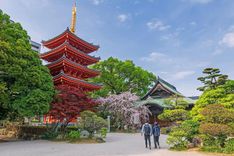
The main approach to Hōryū-ji is from the south, which takes you past the helpful information centre (). Walk north from here along a wide, tree-lined avenue to Nandai-mon (Great South Gate), which marks the outer enclosure. Inside lies a second, walled compound known as the Sai-in Garan, or Western Precinct. Within the Sai-in Garan’s cloister-gallery, the Five-Storey Pagoda will inevitably catch your eye first. This is Japan’s oldest five-tier pagoda, and inside you can see the early eighth-century clay images of Buddha entering nirvana. However, it’s actually the right-hand building, the Kon-dō (Golden Hall), which is Hōryū-ji’s star attraction. This is the world’s oldest wooden structure, dating from the late seventh century, and although it’s not very large, the building’s multi-layered roofs and sweeping eaves are extremely striking.
Entering the Kon-dō’s east door, you’re greeted by a bronze image of Shaka Nyorai (Historical Buddha) flanked by two Bodhisattvas still bearing a few touches of original gold leaf that they were once covered in; this Shaka triad was cast in 623 AD in memory of Prince Shōtoku, who died the previous year. To its right stands Yakushi Nyorai, the Buddha of Healing, to which Hōryū-ji was dedicated, and to the left a twelfth-century Amida Buddha commemorating the Prince’s mother.
Exiting the Sai-in compound, walk east past two long, narrow halls, to the Daihōzō-den (Gallery of Temple Treasures), which houses Hōryū-ji’s priceless temple treasures in two halls. Look out for the bronze Yume-chigae Kannon. This “Dream-Changing” Kannon is credited with turning bad dreams into good, and has a soft, secretive smile. Connecting the two museum halls is the Kudara Kannon Dōi, which houses the wooden Kudara Kannon statue, thought to date from the seventh century. Nothing is known about this unusually tall, willowy figure, but it has long been recognized as one of the finest Buddhist works of art in Japan.
The Hidden Buddha of Hōryū-ji
Tō-in Garan is the eastern precinct of Hōryū-ji, which was added in 739. At its centrepiece is the octagonal Yume-dono (Hall of Dreams), with its magnificent statue, the Kuze Kannon. Until the late nineteenth century, this gilded wooden figure, said to be the same height as Prince Shōtoku (perhaps even modelled on him in the early seventh century), was a hibutsu, a hidden image, which no one had seen for centuries. Somewhat surprisingly, it was an American art historian, Ernest Fenellosa, who in the 1880s was given permission by the Meiji government, against the wishes of the temple, to unwrap the Kannon from the bundle of white cloth in which it had been kept. He revealed a dazzling statue in an almost perfect state of repair, carrying a sacred jewel and wearing an elaborate crown, with the famous enigmatic smile of the Kon-dō’s Shaka Nyorai on its youthful lips. Unfortunately, the Kannon is still kept hidden for most of the year, except for brief spells in spring and autumn (April 11–May 15 & Oct 22–Nov 22).
Tōshōdai-ji
The weathered, wooden halls in Tōshōdai-ji's (唐招提寺) shady compound are superb examples of late eighth-century architecture. The temple was founded in 759 by the eminent Chinese monk Ganjin – he of Nara’s Kaidan-in – when he was granted permission to move from the city to somewhere more peaceful.
The first thing you’ll see on entering the south gate is the stately Chinese-style Kon-dō (main Hall), which has recently been restored. Craftsmen who accompanied Ganjin from the mainland are responsible for the three superb dry-lacquer statues displayed here. The Kō-dō (Lecture Hall) behind the Kon-dō also dates from the late eighth century, and is more Japanese in styling. During the Nara period, this hall was a major centre of learning and religious training. On the compound’s east side is the concrete Shin-Hōzō, where, each spring and autumn, Tōshōdai-ji’s treasures go on display. Again, these are mostly statues, of which the most celebrated is a headless Buddha known as the “Venus of the Orient”. Just once a year – on June 6, the anniversary of Ganjin’s death – the doors of the Miei-dō (Founder’s Hall), in the northern section of the compound, are opened to reveal a lacquered image which was carved just before he died in 763 at the grand age of 76. He’s buried next door, in the far northeast corner of the compound, in a simple grave within a clay-walled enclosure.
Yakushi-ji
Six kilometres northwest of Hōryū-ji, the Nishinokyō area is home to two great temples that are again famed for their age and wealth of statuary – Yakushi-ji and Tōshōdai-ji.
The older of the pair is southerly Yakushi-ji (薬師寺). Emperor Tenmu first ordered its construction sometime around 680 AD when his wife was seriously ill. Although she recovered, Tenmu himself died eight years later, leaving the empress to dedicate Yakushi-ji herself in 697. Over the centuries, fires have destroyed all but one of the original buildings, though the statues themselves have fared better.
The only building of historical note in Yakushi-ji’s inner compound is the three-storey East Pagoda, which was famously described as “frozen music” by Ernest Fenellosa. He was referring to the rhythmical progression of the smaller double roofs that punctuate the pagoda’s upward flow. It’s the sole surviving remnant of the original temple and contrasts strongly with the spanking red lacquer of the new West Pagoda, the Daikō-do (Great Lecture Hall) and the Kon-dō (Golden Hall), all of which have been rebuilt during the last thirty years. However, inside the Kon-dō the temple’s original seventh-century bronze Yakushi triad sits unperturbed. Past fires have removed most of the gold and given the statues a rich black sheen, but otherwise they are in remarkably fine condition.
Continuing through the outer compound you come to a long, low wooden hall on your left, the Tōin-dō. Rebuilt around 1285, the hall houses a bronze image of Shō-Kannon, an incarnation of the goddess of mercy, which dates from the early Nara period. This graceful, erect statue, framed against a golden aureole, shows distinctly Indian influences in its diaphanous robes, double necklace and strands of hair falling over its shoulders.
The last building, in the compound’s northeast corner, is the Daihōzō-den, a modern treasure hall. It’s only open for three short periods each year, and during two of those periods a rare, Nara-period painting of Kissho-ten, the Buddhist goddess of peace, happiness and beauty, is the prime attraction. She is portrayed as a voluptuous figure with cherry-red, butterfly lips, and dressed in an intricately patterned fabric whose colours are still remarkably clear.