





Explore Kyoto & Nara
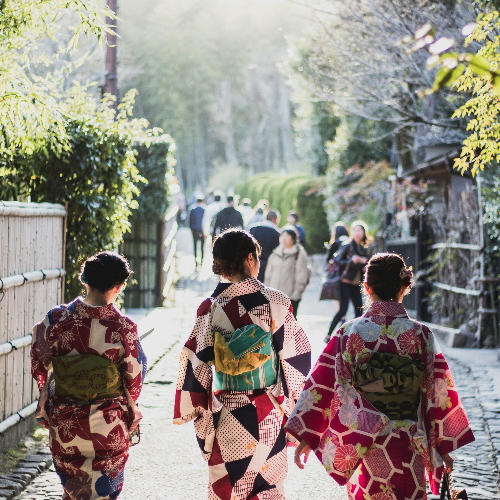
There’s so much to see in Kyoto itself that most people don’t explore the surrounding area. First priority should probably go to Arashiyama, to the west side of Kyoto, which is famous for its gardens and temples, as well as the Hozu-gawa gorge boat ride and the monkey park. Uji, to the south of Kyoto, is another quiet pocket of history and home to the magnificent Byōdō-in, whose graceful Phoenix Hall is a masterpiece of Japanese architecture, as well as the tea fields which support Kyoto’s cultural traditions. In the northeast of Kyoto is Hiei-zan, atop a mountain overlooking the city, where age-old cedars shelter the venerable temples of Enryaku-ji. Below Hiei-zan, Ōhara contains a scattering of beguiling temples in an attractive valley.
Slightly further afield, but definitely worth the effort, are Amanohashidate, the “Bridge to Heaven”, on the northern coast of Kyoto prefecture and one of the trio of top scenic views in Japan; the attractive castle town of Hikone on Biwa-ko, Japan’s largest lake; and the architecturally stunning Miho Museum, nestled in the Shigaraki mountains.
Read More-
Arashiyama
Arashiyama
Western Kyoto ends in the pleasant, leafy suburb of ARASHIYAMA (嵐山). Set beside the Hozu-gawa, Arashiyama was originally a place for imperial relaxation, away from the main court in central Kyoto, where aristocrats indulged in pursuits such as poetry-writing and hunting, but the palaces were later converted into Buddhist temples and monasteries. The most famous of these is Tenryū-ji, noted for its garden, while the smaller, quieter temples have a more intimate appeal. In contrast with Tenryū-ji’s somewhat introspective garden, that of Ōkōchi Sansō – the home of a 1920s movie actor – is by turns secretive and dramatic, with winding paths and sudden views over Kyoto. For a break from temples and gardens, take the Torokko train up the scenic Hozu valley to Kameoka, from where boats ferry you back down the fairly gentle Hozu rapids.
A good way to explore the area is to rent a bike and spend a day pottering around the lanes and through magnificent bamboo forests; alternatively, it is possible to see some of the main sights by jinrikisha. If you’re pushed for time, you could consider combining Arashiyama with the sights of western Kyoto.
- Uji
-
Hiei-zan
Hiei-zan
Protecting Kyoto’s northeastern flank (traditionally considered the source of evil spirits threatening the capital), the sacred mountain of Hiei-zan (比叡山) is the home of Tendai Buddhism, the headquarters of which are housed in an atmospheric collection of buildings, Enryaku-ji. Also on top of the mountain is the kitsch Garden Museum Hiei, an outdoor museum devoted to re-creating garden scenes from famous paintings by Monet and Renoir. Away from the commercialization, Enryaku-ji is still a pleasant place to meander along ancient paths through cedar forests. Though there are several ways of getting to Enryaku-ji, the easiest route is by bus from Kyoto, wriggling up the mountainside and then following a ridge road north. On a clear day you’ll be rewarded with huge views west over Biwa-ko, Japan’s largest lake and the second-oldest freshwater lake in the world after Lake Baikal in Siberia.
-
Ohara
Ohara
Though only a short bus ride north from Kyoto, the collection of temples that make up ŌHARA (大原) is almost in a different world. All are sub-temples of Enryaku-ji, but the atmosphere here is quite different: instead of stately cedar forests, these little temples are surrounded by maples and flower-filled gardens, fed by tumbling streams. The sights are divided into two sections: the easterly Sanzen-in and the melancholy Jakkō-in across the rice fields.
-
Amanohashidate
Amanohashidate
At the northern tip of Kyoto-fu (Kyoto prefecture), the stubby peninsula of Tango-hantō (丹後半島) leans protectively over Wakasa Bay, shielding the sand spit of Amanohashidate (天橋立), the “Bridge to Heaven”. As one of the trio of top scenic views in Japan (the other two are Matsushima and Miyajima), Amanohashidate has a lot to live up to. The “bridge” is actually a 3.6km ribbon of white sand and pine trees slinking its way between the touristy villages of Monju and Fuchū across the bay.
On Mount Nariai above Fuchū, the splendidly atmospheric Nariai-ji is one of the 33 temples on the Saigoku Kannon pilgrimage route, while closer to the summit there is a fantastic view of the bay and coast as far away as the Noto-hantō, some 500km northeast. East along the Tango-hantō lies the picturesque fishing hamlet of Ine, while across the bay in Monju is another attractive wooden temple, Chion-ji, standing on the brink of the sandbar – a lovely area for a quiet stroll or cycle ride, or simply lazing on the beach.
-
Hikone
Hikone
On the northeastern shore of Biwa-ko, Japan’s largest lake, lies the stately castle town of HIKONE (彦根). Often overlooked by international visitors, Hikone (not to be confused with Hakone, the resort town near Mount Fuji) is an easy day-trip from Kyoto or Ōsaka. This attractive town not unreasonably claims that it has retained the look and feel of the Edo period more than any other place in the country. The town’s castle is one of the few in Japan to have remained intact since the early 17th century. With Himeji-jō’s donjon under renovation till sometime in 2016, it’s well worth a visit. Hikone is also known for its butsudan (Buddhist altar) industry and the town has an abundance of shops with elaborate altars on display. Hikone’s main attractions can all be seen on foot and, except during the cherry blossom season when the castle is engulfed by hordes of tourists, the town can be enjoyed at a leisurely and crowd-free pace.
-
Miho Museum
Miho Museum
The I.M. Pei-designed Miho Museum (ミホミュージアム) is one of the architectural highlights of the Kansai region, although it’s only open for a few months every year – exact dates vary; check the website for details. Located in a rural, mountainous part of Shiga Prefecture, which is best known for its Shigaraki pottery, the museum provides an unlikely setting for an incredible collection of artworks belonging to Koyama Mihoko and her daughter Hiroko. Koyama is the head of one of Japan’s so-called “new religions”, Shinki Shumeikai, founded in 1970, which has an estimated 300,000 followers worldwide, hundreds of whom live and work here at the museum. The central tenet of Shinki Shumeikai’s philosophy is that spiritual fulfilment lies in art and nature, hence the setting.
From the entrance and restaurant (serving excellent, if pricey, organic vegetarian cuisine), access to the museum proper is on an electric shuttle bus through a tunnel that opens onto a beautiful valley spanned by a 120m-high bridge; alternatively, you can walk – it takes about fifteen minutes on foot. Opposite is a series of tetrahedrons, which is all that can be seen of the museum, as most of it is actually built inside the mountainside due to planning restrictions. Inside, a continually shifting pattern of light and shadow is created by the innovative use of skylights, pyramid-shaped wall lights and ever-so-slightly uneven corridors which look out – through windows fitted with aluminium screens – onto bamboo gardens and tranquil green landscapes.
The museum has two wings. The north wing houses Japanese art, including priceless porcelain, scrolls, screens and Buddhist relics; the south wing has antiquities from the rest of the world, including jewellery, frescoes, textiles and statues produced by a range of civilizations, from ancient Egyptian to classical Chinese. Among the numerous treasures are a three-thousand-year-old silver-and-gold cult figure of a falcon-headed deity from Egypt’s 19th dynasty, a limestone Assyrian relief unearthed in Nimrud and the splendid Sanguszko Carpet from Iran. Each artwork is labelled in English and Japanese and there are explanatory leaflets in some of the galleries, but the overall effect is one of art that is meant to be experienced for its intrinsic beauty rather than its historical or cultural import.
There are tours available to the museum but it is better (and very much cheaper) to get there by yourself. From JR Kyoto Station, take a local train on the JR Biwako line (for Nagahama or Maibara) two stops to JR Ishiyama Station (every 10–15min; 13min; ¥230). Buses (50min; ¥800), run by the Teisan Bus Company, leave for the museum from outside Ishiyama Station’s south exit. On weekdays, buses leave at ten minutes past the hour between 9.10am and 1.10pm. If you miss the last bus, you’ll have to take a taxi, which is quite expensive (¥6000). On Saturdays, Sundays and national holidays, the weekday timetable is supplemented by buses at 9.50am and 2.55pm.
-
Marathon monks
Marathon monks
Followers of the Buddhist Tendai sect believe that the route to enlightenment lies through chanting, esoteric ritual and extreme physical endurance. The most rigorous of these practices is the “thousand-day ascetic mountain pilgrimage”, in which marathon monks, as they’re popularly known, are required to walk 40,000km through the mountains and streets of Kyoto in a thousand days – the equivalent of nearly a thousand marathons. The thousand days are split into hundred-day periods over seven years; during each period the monk has to go out every day in all weathers, regardless of his physical condition. He must adhere to a strict vegetarian diet and, at one point during the seven years, go on a week-long fast with no food, water or sleep, just for good measure.
Not surprisingly, many monks don’t make it – in the old days they were expected to commit ritual suicide if they had to give up. Those that do finish (nowadays, about one person every five years) are rewarded with enlightenment and become “living Buddhas”. Apparently, the advice of modern marathon monks is much sought after by national baseball coaches and others involved in endurance training.


