Kawagoe
Saitama-ken is home to the interesting old castle town of Kawagoe (川越), just 40km north of Tokyo. Although it doesn’t look promising on arrival, Kawagoe’s compact area of sights, around 1km north of the main station, is aptly described as a “Little Edo”, and once you’ve browsed the many traditional craft shops and paused to sample the town’s culinary delights, you’ll probably find the day has flown by. This would certainly be the case on the third Saturday and Sunday of October, when Kawagoe’s grand matsuri is held, one of the most lively festivals in the Tokyo area, involving some 25 ornate floats (called dashi) and hundreds of costumed celebrants.
Kawagoe’s fortunes owe everything to its strategic position on the Shingashi River and Kawagoe-kaidō, the ancient highway to the capital. If you wanted to get goods to Tokyo – then called Edo – they more than likely had to go via Kawagoe, and the town’s merchants prospered as a result, accumulating the cash to build fireproof kurazukuri, the black, two-storey shophouses for which the town is now famous. At one time there were over two hundred of these houses, but their earthen walls didn’t prove quite so effective against fire as hoped (nor were they much use in the face of Japan’s headlong rush to modernization). Even so, some thirty remain, with sixteen prime examples clustered together along Chūō-dōri, around 1km north of the JR and Tōbu stations.
Kita-in
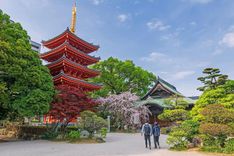
Kawagoe’s other major highlight, around 500m east of Hon-Kawagoe station, is Kita-in (喜多院), the main temple complex of the Tendai Buddhist sect. There’s been a temple on these grounds since 830, and it gained fame when the first Tōkugawa shogun, Ieyasu, declared the head priest Tenkai Sōjō a “living Buddha”. Such was the reverence in which the priests here were held that, when the temple burnt down in 1638, the third shogun, Iemitsu, donated a secondary palace from Edo Castle (on the site of Tokyo’s present-day Imperial Palace) as a replacement building. This was dismantled and moved here piece by piece, and is now the only remaining structure from Edo Castle which survives anywhere.
You have to pay an entry fee to view the palace part of the temple but it’s well worth it. The room with a painted floral ceiling is believed to be where Iemitsu was born. Serene gardens surround the palace and a covered wooden bridge leads across into the temple’s inner sanctum, decorated with a dazzling golden chandelier. The entry fee also includes access to the Gohyaku Rakan, a remarkable grove of stone statues. Although the name translates as “500 Rakans”, there are actually 540 of these enigmatic dwarf disciples of Buddha, and no two are alike. Should you know your Chinese birth sign, it’s fun to search the ranks for it, as twelve of the statues include the zodiac symbols of animals and mythical beasts. Kita-in also has its own mini Tōshō-gū, which, like its famous cousin in Nikkō, enshrines the spirit of Tokugawa Ieyasu and is decorated with bright colours and elaborate carvings.
Mount Takao
An hour west of Shinjuku, Mount Takao (高尾山; 600m), also referred to as Takao-san, is a particularly pleasant place for a quick escape from Tokyo, and a starting point for longer trails into the mountains in the Chichibu-Tama National Park (秩父多摩国立公園). The Keiō line from Shinjuku provides the simplest and cheapest way of reaching the terminus of Takao-san-guchi (1hr). After a hike up or a ride on the cable car or chairlifts, you’ll get to Yakuo-in (薬王院), a temple founded in the eighth century and notable for the ornate polychromatic carvings which decorate its main hall. It hosts the spectacular Hiwatarisai fire ritual on the second Sunday in March back in Takao-san-guchi, where you can watch priests and pilgrims march across hot coals – and even follow them yourself.
Chūō-dōri
Along Chūō-dōri, around 200m before the main enclave of kurazukuri, you’ll pass a small shrine, Kumano-jinja (熊野神社), beside which is a tall storehouse containing a magnificent dashi float. At the next major crossroads, on the right-hand side is the old Kameya okashi (sweet) shop, warehouse and factory. These buildings now house the Yamazaki Art Museum (山崎美術館), dedicated to the works of Meiji-era artist Gaho Hashimoto. Some of his elegant screen paintings hang in the main gallery, while there are artistic examples of the sugary confections once made here in the converted kura (storehouses); entry includes a cup of tea and okashi.
Continuing up Chūō-dōri, you’ll pass several craft shops, as well as the Kurazukuri Shiryōkan (蔵造り資料館), a museum housed inside an old tobacco wholesaler’s, one of the first kurazukuri to be rebuilt after the great fire of 1893. Just north of here is the Kawagoe Festival Hall (川越まつり会館) which houses two magnificent dashi floats along with videos of past festivals and various displays; there are no English descriptions.
Opposite the Kurazukuri Shiryōkan, just off Chūō-dōri, you won’t miss the Toki-no-Kane (時の鐘), the wooden bell tower (rebuilt in 1894) that was used to raise the alarm when fires broke out. An electric motor now powers the bell, which is rung four times daily. Returning to Chūō-dōri and taking the first street off to the west will bring you to Yōju-in (養寿院), another handsomely wrought temple with pleasant grounds. Just north of here is the Kashiya Yokochō (菓子屋横町), or confectioners’ alley, a picturesque pedestrian street still lined with several colourful sweet and toy shops.