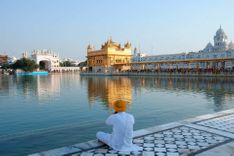
Sri Meenakshi-Sundareshwarar Temple
Enclosed by a roughly rectangular 6m-high wall, in the manner of a fortified palace, and with modern security measures to match, the Sri Meenakshi-Sundareshwarar Temple is one of the largest temple complexes in India. Much of it was constructed during the Nayak period between the sixteenth and eighteenth centuries, but certain parts are very much older.
For the first-time visitor, confronted with a confusing maze of shrines, sculptures and colonnades, and unaware of the logic employed in their arrangement, it’s very easy to get disorientated. Quite apart from the estimated 33,000 sculptures to arrest your attention, the life of the temple is absolutely absorbing, with the endless round of puja ceremonies, loud nagaswaram and tavil music, weddings, brahmin boys under religious instruction in the Vedas, the prostrations of countless devotees and the glittering market stalls inside the east entrance. If you’re braving the heat of late spring, check when the stunning Chithirai festival is taking place to celebrate the marriage of Meenakshi and Sundareshwarar (Shiva), marked by vivid chariot processions. Even if you’re not lucky enough to see a festival procession, something is always going on to make this one of the most compelling places in Tamil Nadu. Approximately fifty priests live and work here, recognizable by the white dhotis tied between their legs and silk cloth worn around their waists. You can roam freely within the complex but the main shrines can only be entered by Hindus.
Meenakshi: the goddess with the fish-shaped eyes
The goddess Meenakshi of Madurai emerged from the flames of a sacrificial fire as a 3-year-old child, in answer to the Pandyan king Malayadvaja’s prayer for a son. The king, not only surprised to see a female, was also horrified that she had three breasts. In every other respect, she was beautiful, as her name, Meenakshi (“fish-eyed”), suggests; fish-shaped eyes are classic images of desirability in Indian love poetry. Dispelling his concern, a mysterious voice told the king that Meenakshi would lose the third breast on meeting her future husband.
In the absence of a male heir, the adult Meenakshi succeeded her father as Pandyan monarch. With the aim of world domination, she embarked on a series of successful battles, culminating in the defeat of Shiva’s armies in his Himalayan abode, Mount Kailash. Shiva then appeared on the battlefield and upon seeing him, Meenakshi immediately lost her third breast thus fulfilling the prophecy. They then travelled to Madurai, where they were duly married. They assumed a dual role – firstly as king and queen of the Pandya kingdom, with Shiva assuming the title Sundara Pandya, and secondly as the presiding deities of the Madurai temple, into which they subsequently disappeared.
Today, their shrines in Madurai are the focal point of a hugely popular fertility cult centred on their “coupling”. The temple priests maintain that this ensures the preservation and regeneration of the universe, so every night the pair are placed in Sundareshwarar’s bedchamber – but not before Meenakshi’s nose ring is carefully removed so that in the heat of passion it won’t cut her husband. However, fidelity is never taken for granted, and has to be ritually tested each year when the beautiful goddess Cellattamman is brought to Sundareshwarar “to have her powers renewed”. After she is spurned, she flies into a fury that can only be placated with the sacrifice of a buffalo.
Vandiyur Mariamman Teppakulam
At one time, the huge Vandiyur Mariamman Teppakulam tank in the southeast of town, with its constant supply of water, flowing via underground channels from the Vaigai, was always full. Nowadays it is only filled during the spectacular Teppam floating festival (Jan/Feb), when pilgrims take boats out to the goddess shrine in the centre. Before their marriage ceremony, Shiva and Meenakshi are brought in procession to the tank, where they float on a beautifully illuminated raft pulled by devotees, which encircles the shrine. The boat trip is the overture to a seduction that reaches its passionate conclusion later that night in the temple. This traditionally makes the Teppam the most auspicious time of year for young couples to get married.
Thirumalai Nayak Palace
Today only a quarter of the seventeenth-century Thirumalai Nayak Palace, located 1.5km southeast of the Meenakshi Temple, survives. Much of it was dismantled by Thirumalai’s grandson, Chockkanatha Nayak, and used to build a new palace at Tiruchirapalli. The remains were renovated in 1858 by Lord Napier, then governor of Madras, and once again in 1971 for the Tamil World Conference. The palace originally consisted of two residential sections, a theatre, private temple, harem, royal bandstand, armoury and gardens. The Palace Museum in an adjacent hall includes unlabelled Pandyan, Jain and Buddhist sculptures, terracottas and an eighteenth-century print of the palace in a dilapidated state. A nightly sound-and-light show (in both English and Tamil) recalls the story of the Tamil epic, Shilipaddikaram, and the history of the Nayaks.
Tamukkam Palace: the Gandhi Memorial Museum
Across the Vaigai, 5km northeast of the centre near the Central Telegraph Office, stands Tamukkam, the seventeenth-century multi pillared and arched palace of Queen Rani Mangammal. Built to accommodate such regal entertainment as elephant fights, Tamukkam was taken over by the British, used as a courthouse and collector’s office, and in 1955 became home to the Gandhi and Government museums. The Gandhi Memorial Museum charts the history of India since the landing of the first Europeans, viewed in terms of the freedom struggle. The perspective is national, but where appropriate, reference is made to the role played by Tamils. Wholeheartedly critical of the British, it states its case clearly and simply, quoting the condemnation by Englishman John Sullivan of his fellow countrymen’s insulting treatment of Indians. One chilling artefact, kept in a room painted black, is the bloodstained dhoti the Mahatma was wearing when he was assassinated. Next door to the museum, the Gandhi Memorial Museum Library houses a reference collection, open to all, of fifteen thousand books, periodicals, letters and microfilms.
Top image: Sundareswarar Temple in Madurai, India © Rafal Cichawa/Shutterstock