Places to visit in Madhya Pradesh and Chhattisgarh
In the centre of Madhya Pradesh, the state capital Bhopal has a vibrant Muslim heritage and some interesting museums. The people of Bhopal suffered significantly when there was a gas leak incident from the nearby pesticide plant in 1984, the incident is considered to be the world's worst industrial disaster. Nearby Bhopal, is Sanchi, one of India’s most significant Buddhist sites. The hill station of Pachmarhi, meanwhile, has echoes of the Raj, numerous hiking routes and the little-visited Satpura National Park.
In the north, the city of Gwalior has a stunning hilltop fort and is within striking distance of Datia’s Rajput palace, the Scindia family’s mausoleums at Orchha and the atmospheric ruined capital of the Bundella rajas. Further east is the state’s biggest attraction, the cluster of magnificent sandstone temples at Khajuraho, renowned for their intricate erotic carvings.
Western Madhya Pradesh is home to Indore, a modern city of industry. Though of little interest in itself, Indore is a good base for exploring Mandu, the romantic former capital of the Malwa sultans, the Hindu pilgrimage centres of Omkareshwar and Maheshwar, and the holy city of Ujjain, one of the sites of the Kumbh Mela.
Nondescript Jabalpur is the biggest city in eastern Madhya Pradesh, a region that has few historic sites but does boast the Kanha, Bandhavgarh and Pench reserves, among the last strongholds for many endangered species, most notably the tiger. Alongside Orchha and Khajuraho, these parks are the only places in Madhya Pradesh or Chhattisgarh you’re likely to meet more than a handful of foreign tourists.
In November 2000, sixteen districts seceded from eastern Madhya Pradesh to form the state of Chhattisgarh. Violent Naxalite (Maoist rebel groups) activity in the region, arising from the exploitation of the area’s rich mineral resources (and of the tribal peoples who live on the land) has meant the state has until recently attracted a mere trickle of foreign visitors, but the ever-diminishing violence means this may soon change; the Chhattisgarh Tourism Board runs a string of well-located resorts and hotels, and independent hotels and tour operators are springing up in the most popular destinations.
The state is particularly fascinating for its many tribal groups, particularly in the Bastar region, which also boasts beautiful landscapes. However, before travelling anywhere south of the capital, Raipur, you must obtain up-to-date information about the state of security around your intended destination – and travel with a guide if you want to head into the countryside. Violent conflict between Naxalite guerrillas and security forces and state-sponsored right-wing militias, although on the wane, continues to occasionally erupt in remote southern parts of the state.
Brief History of Madhya Pradesh and Chhattisgarh
Any exploration of central India will be illuminated if you have a grasp of its long and turbulent history. Most of the marauding armies that have swept across the Subcontinent over the last two millennia passed through this corridor, leaving in their wake a bumper crop of monuments. The very first traces of settlement in Madhya Pradesh are the 10,000-year-old paintings on the lonely hilltop of Bhimbetka, near Bhopal. Aboriginal rock art was still being created here during the Mauryan emperor Ashoka’s evangelical dissemination of Buddhism, in the second century BC.
Madhya Pradesh only came into being after Independence from British rule, when the Central Provinces were amalgamated with a number of smaller princedoms. Since then, the state, more than 90% Hindu and with a substantial rural and tribal population, has remained far more stable than neighbouring Uttar Pradesh and Bihar. Major civil unrest between Hindus and Muslims was virtually unheard of until the Bhopal riots of 1992–93, sparked off by events in Ayodhya. Now Hindu-Muslim relations in Madhya Pradesh are relatively cordial again, the state has turned to focus on the latest enemy – recurring drought across the poverty-stricken plains and the social and environmental consequences of the damming of the Narmada River. The state remains one of India’s poorest, despite flourishing automotive, cement and soybean industries, and the state government sees tourism as one way of boosting Madhya Pradesh’s economic prospects. The tourist board is always coming up with plans to make the state more accessible, including a new intrastate air service
Best time to visit Madhya Pradesh and Chhattisgarh
The best time to visit both Madhya Pradesh and Chhattisgarh is during the relatively cool winter (Oct–March), though during the coldest months (Dec–Feb) it gets a bit chilly at night and in the early morning, and you may need a sweater or light jacket, especially in the upland areas. From April to June, daytime temperatures frequently exceed 40°C, but if you can stand the heat, this is the best time to catch glimpses of tigers in the national parks. The increasingly meagre rains finally sweep in from the southeast in late June or early July until September making the roads even more difficult than usual, though it’s a good opportunity to see the waterfalls in the Bastar region of Chhattisgarh at their impressive full flow.
Festivals in Madhya Pradesh
While Madhya Pradesh has one of the Kumbh Mela sites at Ujjain, it won’t be hosting it again till 2028. However, there are a couple of major arts festivals.
Chauragarh pilgrimage (Shivratri Mela; Feb/March)
Tens of thousands of pilgrims and sadhus make the 23km climb up Chauragarh Mountain in Pachmarhi to see the all-powerful lingam.
Khajuraho Festival of Dance (Feb)
One of India’s premier dance events, this free festival features traditional and classical dance from all over India.
Tansen Samaroh Festival (Nov/Dec)
A major four-day festival of Indian classical music to commemorate the life of the great sixteenth-century composer and musician Mian Tansen, held next to his tomb in Behat village, Gwalior.
Pachmarhi
Among the last tracts of central India mapped by the British, the Mahadeo Hills weren’t explored until 1857, when Captain J. Forsyth and his party of Bengal Lancers stumbled upon an idyllic saucer-shaped plateau at the heart of the range, strewn with huge boulders and crisscrossed by streams. Five years later a road was cut from the railhead at Piparia, and by the end of the century Pachmarhi had become the summer capital of the entire Central Provinces, complete with a military sanatorium, churches, clubhouses, racecourse and polo pitch. Aside from the faded Raj atmosphere and myriad walks and hikes, the main incentive to travel up here is in order to scramble around the surrounding forest in search of prehistoric rock art or to visit Satpura National Park, home to a handful of (elusive) tigers and leopards.
Pachmarhi town, more than 1000m above sea level, is clean, green and relaxed, despite the presence of a large military cantonment in its midst. It has retained a distinctly colonial ambience, enhanced by the elegant British bungalows and church spires that nose incongruously above the tropical tree line. In the evenings families stroll and picnic in the parklands, while army bands and scout troops march around the maidans.
Shivratri Mela
Popular during the summer with Indian tourists, especially on long holiday weekends, Pachmarhi remains sleepy for much of the rest of the year. The big exception to this is during the annual Shivratri Mela (Feb/March), when thousands of pilgrims pour through en route to the top of nearby Chauragarh Mountain. The festival marks the anniversary of Shiva’s tandav dance and his wedding anniversary.
Gwalior
Straddling the main Delhi–Mumbai train line, Gwalior is northern Madhya Pradesh’s largest city and boasts one of India’s most magnificent hilltop forts. The sandstone citadel, with its temples and palaces, peers down from the edge of a sheer-sided plateau above a haze of exhaust fumes and busy streets. The city’s other unmissable attraction is the extraordinarily flamboyant Jai Vilas Palace, owned by the local ruling family, the Scindias. Their personalities and influence are everywhere, from the chhatris (cenotaphs) north of Jayaji Chowk to the excellent Sarod Ghar classical music museum. Despite its proximity to Agra, 119km north, Gwalior sees few foreign tourists and its drab modern centre lacks the charm of its nearby Rajasthani counterparts. That said, it is a worthwhile place to pause for a day, particularly around late November or early December, when the old Mughal tombs host one of India’s premier classical music events, the Tansen Samaroh Festival.
Gwalior archeological museum
A short walk north of the Gwalior Gate, just outside the fort compound, the modest Gujuri Mahal was built by Man Singh to woo his favourite rani, Mrignayani, when she was still a peasant girl. The elegant sandstone palace now houses the Archeological Museum, whose large collection of sculptures, inscriptions and paintings is well worth a look, even if the labels are woefully uninformative. Highlights include the twin Ashoka lion capitals from Vidisha in gallery two, and gallery nine’s erotic bas-relief, but the most famous exhibit is the exquisitely carved salabhanjika, a small female figurine noted for her sensuous curves and sublime facial expression.
The Man Singh Palace
Entered via the Hathiya (“elephant”) Paur gateway, with its twin turrets and ornate blue tilework, the Man Singh Palace (sometimes called Man Mandir Palace) was declared “the noblest specimen of Hindu domestic architecture in northern India” by nineteenth-century explorer Sir Alexander Cunningham. Built between 1486 and 1517 by the Tomar ruler Man Singh, it’s also known as the Chit Mandir (“Painted Palace”) for the rich ceramic mosaics encrusting its facade. The best-preserved fragments of tilework, on its south side, can be seen from the bank left of the main Hathiya Paur gateway. Spread in luxurious bands of turquoise, emerald green and yellow across the ornate stonework are tigers, elephants, peacocks and crocodiles brandishing flowers.
By contrast, the interior of the four-storey palace is very plain. However, there are some fine pierced-stone jali screens, behind which the women of the palace would assemble to receive instruction from Gwalior’s great music gurus. The circular chambers in the lower storeys were once dungeons.
The Teli-ka-Mandir and Suraj Kund
On the south side of the plateau, the 30m-tall Teli-ka-Mandir is the fort’s oldest surviving monument. Dating from the mid-eighth century, it consists of a huge rectangular sanctuary tower capped with an unusual vaulted-arch roof, whose peepal-leaf shape derives from the chaitya windows of much earlier rock-cut Buddhist caves. In the aftermath of the 1857 Indian uprising, the Vishnu temple was used by the British as a soda factory, and restoration work continues. At the head of the Urwahi ravine, just north of the Teli-ka-Mandir, the Suraj Kund is the 100m-long tank whose waters are reputed to have cured the tenth-century ruler Suraj Sen, later Suraj Pal, of leprosy.
The Sasbahu mandirs
At the eastern edge of the fort, the Sasbahu, or “mother-and-daughter-in-law”, temples overlook the city near an unsightly TV mast. The larger one has a three-storey mandapa (assembly hall), supported by four intricate pillars, while the smaller one consists of an open-sided porch with a pyramidal roof. Both were erected late in the eleventh century and are dedicated to Vishnu.
The Sikh gurudwara
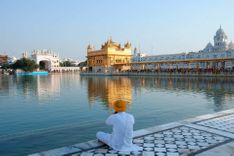
South of the Sasbahu mandirs, the huge, gold-tipped, white-domed marble building to the south is a modern Sikh gurudwara, built to commemorate a Sikh hero who was imprisoned in the fort. Before entering, cover your arms, legs and head, remove your socks and shoes and wash your feet in the tank at the bottom of the steps.
The Jain sculptures
Near the Urwahi Gate at the southern entrance to the fort, the sheer sandstone cliffs around the fort harbour some imposing rock-cut Jain sculptures. Carved between the seventh and fifteenth centuries, most of the large honey-coloured figures depict the 24 Jain teacher-saviours – the tirthankaras, or “Crossing Makers” – standing with their arms held stiffly at their sides, or sitting cross-legged, the palms of their hands upturned. Many lost their faces and genitalia when Mughal emperor Babur’s iconoclastic army descended on the city in 1527.
Ghaus Mohammed and Tansen tombs
The city’s most famous Muslim building is the sixteenth-century Tomb of Ghaus Mohammed, an Afghan prince who helped Babur take Gwalior Fort. It’s a fine specimen of early Mughal architecture, and a popular local shrine. Elegant hexagonal pavilions stand at each of its four corners; in the centre, the large central dome retains a few remnants of its blue-glazed tiles. The tomb’s walls are inlaid with exquisite pierced-stone jali screens.
The second and smaller of the tombs in the gardens is that of the famous Mughal singer-musician Tansen, one of the “Nine Jewels” of Emperor Akbar’s court. Every year, performers and aficionados from all over India flock here for Gwalior’s annual Tansen Samaroh music festival (Nov/Dec). Local superstition holds that the leaves of the tamarind tree growing on the plinth nearby have a salutary effect on the singing voice, which is why its bottom branches have been stripped bare.
The Jai Vilas Palace
The Jai Vilas Palace is one of India’s most grandiose and eccentric nineteenth-century relics, although the lack of labelling and information can make for a frustrating visit. It was built in 1875 during the reign of Maharaja Jayaji Rao Scindia, who dispatched his friend Colonel Michael Filose on a grand tour of Europe to seek inspiration; Filose returned with a vast shipment of furniture, fabric, paintings, tapestries and cut glass, together with the blueprints for a building that borrowed heavily from Buckingham Palace, Versailles, Greek ruins and Italian-Baroque stately homes. The result is a shamelessly over-the-top blend of Doric, Tuscan and Corinthian architecture.
The Scindias, who still occupy part of the palace, have opened two wings to the public. The first wing, a museum, includes countless Mughal paintings, Persian rugs, gold and silver ornaments and antique furniture that belonged to the estate of Louis XVI before the French Revolution, while a still more extravagant wing lies across the courtyard from the museum.
Sarod Ghar Museum
The Sarod Ghar Museum of music occupies the beautiful ancestral home of the Bangash family, whose ancestors, originally Afghan horse-traders who settled in India, produced a dynasty of musical virtuosos, including Ustad Hafiz Ali Khan and his son Ustad Amjad Ali Khan. The museum traces Gwalior’s rich musical legacy, from Tansen, who performed in Mughal emperor Akbar’s court, to the invention by Gulam Ali Khan Bangash of the sarod, whose ethereal tones accompany you as you progress through the galleries.
The Scindia chhatris
Two characteristically ostentatious Scindia family tombs are found in the south of Gwalior. Inside a walled courtyard, the Scindia chhatris feature intricate stonework and ornately painted scenes of life inside the nineteenth-century Maratha royal court. Built in 1817 to commemorate Maharaja Jiyaji Rao Scindia, the larger of the pair is most remarkable for the intricate outside panelling of interwoven flowers. The second chhatri is a more compact and finely detailed version of the former, constructed in 1843 for the recently departed Maharaja Janakaji Scindia; sculptures and carvings depict the hectic lifestyle of a king.