Explore Haryana and Punjab
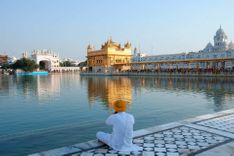
Even visitors without a religious bone in their bodies cannot fail to be moved by Amritsar’s resplendent Golden Temple, spiritual centre of the Sikh faith and open to all. Built by Guru Arjan Dev in the late sixteenth century, the richly gilded Harmandir rises from the middle of an artificial rectangular lake, connected to the surrounding white-marble complex by a narrow causeway. Every Sikh tries to make at least one pilgrimage here during their lifetime to listen to the sublime music (shabad kirtan), readings from the Adi Granth and also to bathe in the purifying waters of the temple tank – the Amrit Sarovar or “Pool of Immortality-Giving Nectar”.
The best time to visit is early morning, to catch the first rays of sunlight gleaming on the bulbous golden domes and reflecting in the waters of the Amrit Sarovar. Sunset and evenings are an excellent time to tune in to the beautiful music performed in the Harmandir. The helpful information office (daily 7am–8pm) to the right of the main entrance organizes guided tours, provides details on temple accommodation and has books and leaflets about the temple and Sikh faith.
-
Staying at the Golden Temple Complex
Undoubtedly the most authentic places to stay in Amritsar are the five Niwas or pilgrim hostels run by the Golden Temple management committee. Intended for Sikh pilgrims, these charitable institutions also open their doors to foreign tourists. Charges are nominal but stays are limited to a maximum of three nights.
The first building as you approach on the east side of the temple, is the Guru Arjan Dev Niwas, which has the check-in counter for all the niwas and simple, spacious rooms. The most comfortable of the five, is the new, excellent-value Guru Hargobind Niwas. The Sri Guru Nanak Niwas was where Bhindranwale and his men holed up prior to the Golden Temple siege in 1984.
Apart from the inevitable dawn chorus of throat-clearing, the downside of staying at these niwas is that facilities can be basic (charpoy beds and communal wash-basins in the central courtyard are the norm) and security can be a problem. It is advisable to book in advance as rooms and beds are almost always at a premium.
-
Golden rules
Golden rules
Visitors of all nationalities and religions are allowed into the Golden Temple provided they respect a few basic rules, enforced by patrolling guards. Firstly, tobacco, alcohol and drugs of any kind are forbidden. Before entering, you should also leave your shoes at the free cloakrooms, cover your head (cotton scarves are available outside the main entrance – or wear your Kullu hat) and wash your feet in the pool below the steps. Photography is permitted around the pool, but not inside any of the shrines.
-
The Parikrama
The Parikrama
The principal north entrance to the temple, the Darshini Deori, leads under a Victorian clocktower to a flight of steps, from where you catch your first glimpse of the Harmandir, floating serenely above the glassy surface of the Amrit Sarovar. Dropping down as a reminder of the humility necessary to approach God, the steps end at the polished marble Parikrama that surrounds the tank, its smooth white stones set with the names of those who contributed to the temple’s construction.
The shrines on the north edge of the enclosure are known as the 68 Holy Places. Arjan Dev, the fifth guru, told his followers that a visit to these was equivalent to a pilgrimage around all 68 of India’s most sacred Hindu sites. Several have been converted into a Gallery of Martyrs, in which paintings of glorious but gory episodes from Sikh history are displayed.
Four glass-fronted booths punctuate the Parikrama. Seated in each is a priest, or granthi, intoning verses from the Adi Granth (Sikh scriptures). The continuous readings are performed in shifts; passing pilgrims touch the steps in front of the booths with their heads and leave offerings of money.
At the east end of the Parikrama, the two truncated Ramgarhia Minars – brick watchtowers whose tops were blasted off during Operation Blue Star – overlook the Guru-ka-Langar and the main bathing ghats. Hang around here long enough and you’ll see a fair cross-section of modern Sikh society parade past: families of Jat farmers, NRIs (Non-Resident Indians) on holiday from Britain and North America and the odd group of fierce-looking warriors carrying lances, sabres and long curved daggers. Distinguished by their deep-blue knee-length robes and saffron turbans, the ultra-orthodox nihangs (literally “crocodiles”) are devotees of the militaristic tenth guru, Gobind Singh.
-
The Guru-ka-Langar
The Guru-ka-Langar
For Sikhs, no pilgrimage to the Golden Temple is considered complete without a visit to the Guru-ka-Langar. The giant communal canteen, which overlooks the eastern entrance to the temple complex, provides free food to all comers. Sharing meals with strangers reinforces one of the central tenets of the Sikh faith, the principle of equality, instigated by the third guru, Amar Das, in the sixteenth century to break down caste barriers.
Some ten thousand chapatti and black dhal dinners are dished up here each day in an operation of typical Sikh efficiency, which you can witness for yourself by joining the queues that form outside the hall (open 24hr). The meal begins after grace has been sung by a volunteer, or sevak, and continues until everyone has eaten their fill. By the time the tin trays have been collected up and the floors swept for the next sitting, another crowd of pilgrims has gathered at the gates, and the cycle starts again. Although the meals are paid for out of the temple’s coffers, most visitors leave a small donation in the boxes in the yard outside.
-
The Akal Takht
The Akal Takht
Directly opposite the ceremonial entrance to the Harmandir, the Akal Takht is the second most sacred shrine in the Golden Temple complex. A symbol of God’s authority on earth, it was built by Guru Hargobind in the seventeenth century and came to house the Shiromani Gurudwara Parbandhak Committee, the religious and political governing body of the Sikh faith founded in 1925.
During the 1984 siege, Bhindranwale and his army used this golden-domed building as their headquarters, fortifying it with sandbags and machine-gun posts. When Indian paratroopers tried to storm the shrine, they were mown down in their hundreds while crossing the courtyard in front of it: the reason why the army ultimately resorted to much heavier-handed tactics to end the siege. Positioned at the opposite end of the Amrit Sarovar, tanks pumped a salvo of high-explosive squash-head shells into the delicate facade, reducing it to rubble within seconds. The destruction of the Akal Takht offended Sikh sensibilities more than any other aspect of the operation. The shrine has been largely rebuilt and now looks almost the same as it did before June 6, 1984. Decorated with elaborate inlay, its ground floor is where the Adi Granth is brought each evening from the Harmandir, borne in a gold and silver palanquin.
-
The Jubi Tree
The Jubi Tree
The gnarled old Jubi Tree in the northwest corner of the compound was planted around 450 years ago by the Golden Temple’s first high priest, or Babba Buddhaya, and is believed to have special powers. Women wanting a son hang strips of cloth from its branches, while marriage deals are traditionally struck in its shade for good luck – a practice the modern temple administration frowns upon.
-
The Harmandir
The Harmandir
Likened by one guru to “a ship crossing the ocean of ignorance”, the triple-storey Harmandir, or “Golden Temple of God” was built by Arjan Dev to house the Adi Granth, which he compiled from teachings of all the Sikh gurus; it is the focus of the Sikh faith. The temple has four doors indicating it is open to people of all faiths and all four caste divisions of Hindu society. The large dome and roof, covered with 100kg of gold leaf, is shaped like an inverted lotus, symbolizing the Sikhs’ concern for temporal as well as spiritual matters.
The long causeway, or Guru’s Bridge, which joins the Harmandir to the west side of the Amrit Sarovar, is approached via an ornate archway, the Darshani Deorh. As you approach the sanctum check out the amazing Mughal-style inlay work and floral gilt above the doors and windows.
The interior of the temple – decorated with yet more gold and silver, adorned with ivory mosaics and intricately carved wood panels – is dominated by the enormous Adi Granth, which rests on a sumptuous throne beneath a jewel-encrusted silk canopy. Before his death in 1708, Guru Gobind Singh, who revised the Adi Granth, declared that he was to be the last living guru, and that the tome would take over after him – hence its full title, the Guru Granth Sahib. Granthis intone continuous readings from the text as the worshippers file past, accompanied by singers and musicians – all relayed by loudspeakers around the complex. Known as Shri Akhand Path, a single continuous reading of the Guru Granth Sahib is carried out in three-hour shifts and takes around 48 hours to complete.