Best things to do in Amritsar
From The Golden Temple to bedlam at the India–Pakistan border, here are the best things to do in Amritsar.
#1 Bow down at The Golden Temple
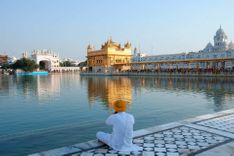
Even visitors without a religious bone in their bodies cannot fail to be moved by Amritsar’s resplendent Golden Temple, spiritual centre of the Sikh faith and open to all.
Built by Guru Arjan Dev in the late sixteenth century, the richly gilded Harmandir rises from the middle of an artificial rectangular lake, connected to the surrounding white marble complex by a narrow causeway.
Every Sikh tries to make at least one pilgrimage here during their lifetime to listen to the sublime music (shabad kirtan), readings from the Adi Granth and also to bathe in the purifying waters of the temple tank – the Amrit Sarovar or “Pool of Immortality-Giving Nectar”.
#2 See The Harmandir, the “Golden Temple of God”
Likened by one guru to “a ship crossing the ocean of ignorance”, the triple-storey Harmandir, or “Golden Temple of God” was built by Arjan Dev to house the Adi Granth, which he compiled from teachings of all the Sikh gurus; it is the focus of the Sikh faith.
The temple has four doors indicating it is open to people of all faiths and all four caste divisions of Hindu society. The large dome and roof, covered with 100kg of gold leaf, is shaped like an inverted lotus, symbolizing the Sikhs’ concern for temporal as well as spiritual matters.
The long causeway, or Guru’s Bridge, which joins the Harmandir to the west side of the Amrit Sarovar, is approached via an ornate archway, the Darshani Deorh. As you approach the sanctum check out the amazing Mughal-style inlay work and floral gilt above the doors and windows.
The interior of the temple – decorated with yet more gold and silver, adorned with ivory mosaics and intricately carved wood panels – is dominated by the enormous Adi Granth, which rests on a sumptuous throne beneath a jewel-encrusted silk canopy.
#3 Pay your respects at Jallianwalla Bagh
Just 100m northeast of the Golden Temple, a narrow lane leads between two buildings to Jallianwalla Bagh, a grassy compound whose prettiness belies a rather gruesome history – this was the site of one of the bloodiest atrocities committed by the British Raj, and today the park functions as a memorial to those martyred here.
A wall at the southwest corner sports 36 bullet holes created during the massacre; oddly, this has become a popular selfie spot with smiling domestic tourists. Coins are also thrown into Martyrs’ Well, housed under a pretty pink structure to the east of the park.
#4 Geek out at the Partition Museum
A relatively recent addition to the city is its Partition Museum, set in the pretty, redbrick Town Hall buildings; it’s the default thing to see in Amritsar when you’ve seen the Golden Temple and been to the border ceremony, and have run out of things to do.
Still, the exhibits are absorbing enough, with a series of artefacts, photos and documents charting the course of the independence movement, the subsequent demands for separation, and finally the partition and its consequences.
#5 Witness the bedlam at the India–Pakistan border
Every evening as sunset approaches, the India–Pakistan border closes for the night with a spectacular and somewhat Monty Pythonesque show. It takes place at a remote little place 27km west of Amritsar called Wagha (the nearest town, 2km away, is Attari), to which hundreds – often thousands – of Indians make their way each evening to watch the popular tourist attraction from what is effectively a small half-stadium.
The other (considerably smaller) half is over the border in Pakistan, and it likewise receives crowds each evening – strictly
gender-segregated, you’ll most likely wonder what they make of the Indian side, at which females are often encouraged to dance like mad to the sound of ear-splitting Indopop.
After the crowd has been built into something of a flag-waving frenzy, guards from both side – all sporting outlandish hats – perform synchronized speed marching along a 100m walkway to the border gate, where they turn and stomp back. The guards strut their military catwalk several times and then vanish into the guardhouse.