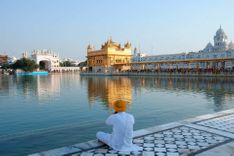
#5 Honour holy Harimandir Sahib
In Haji Ganj, an old part of town 10km east of Gandhi Maidan, congested lanes lead to Harimandir Sahib, the second holiest of the four great Sikh shrines known as takhts (thrones).
Set in an expansive courtyard off the main road, the dazzling white onion-domed marble temple is dedicated to Guru Gobind Singh, born in Patna in 1660.
Visitors can explore the courtyard and even venture inside where devotional music is often playing.
#6 See Napoleon’s four-poster bed at Qila House
A short way northeast of Harimandir Sahib, the private Qila House (or Jalan Museum) holds a fine collection of art, including Chinese paintings and Mughal filigree work in jade and silver.
Among the antiques are porcelain items that once belonged to Marie Antoinette, and Napoleon’s four-poster bed.
#7 Visit Vaishali, the site of the Buddha’s last sermon
Set amid paddy fields 55km north of Patna, the quiet village of Vaishali was the site of the Buddha’s last sermon. Named after King Visala, who is mentioned in the Ramayana, Vaishali is also believed by some historians to have been the first city-state in the world to practise a democratic, republican form of government.
After leaving his family and renouncing the world, Prince Gautama (Buddha) studied here, but eventually rejected his master’s teachings and found his own path to enlightenment.
He returned to Vaishali three times and on his last visit announced his final liberation – Mahaparinirvana – and departure from the world, in around 483 BC. A hundred years later, the second Buddhist Council was held in Vaishali and two stupas erected.
A small but well-presented archeological museum provides a glimpse into the ancient Buddhist world.
#8 Admire Madhubani folk art
Jitwarpur, a village on the outskirts of the small town of Madhubani, in northern Bihar, is home to a vibrant tradition of folk art.
Madhubani paintings by local women were originally decorations for the outside of village huts. Illustrating mythological themes – including images of local deities as well as Hindu gods and goddesses – the paintings were eventually transferred onto handmade paper, often using bright primary colours to fill the strong black line drawings.
Fabrics printed with Madhubani designs have become very chic; these days they tend to be professionally made elsewhere, and are sold in the expensive boutiques of India’s major cities, although you can still pick them up cheaply in Madhubani itself.
#9 Explore the peaceful Mahabodhi Temple
The elegant single spire of the Mahabodhi Temple rises to a lofty height of 55m, and is visible throughout the surrounding countryside. Within the temple complex, which is liberally sprinkled with small stupas and shrines, the main brick temple stands in a hollow encircled by a stone railing dating from the second century BC.
Unlike most popular temples in India, this UNESCO World Heritage Site exudes an atmosphere of peace and tranquillity. Extensively renovated during the nineteenth century, it is supposed to be a replica of a seventh-century structure that in turn stood on the site of Ashoka’s original third-century-BC shrine.
Inside the temple, a single chamber holds a large gilded image of the Buddha, while upstairs is a balcony and a small, plain meditation chamber. Shoes are tolerated within the grounds but not inside the temple.