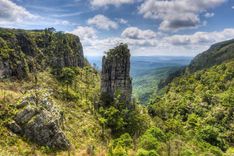
Where to go in the Western Cape
From the vineyards of the Winelands to the remote and windswept West Coast, with the arid Little Karoo in between, the Western Cape is packed with natural beauty and incredible food. It’s home to some of the best places to visit in South Africa, no matter if you’re here for wine, waves, or wide-open spaces.
Here are some of the top places to visit in the Western Cape:
Stellenbosch and Winelands
The Winelands are a gastronomic destination famed for fine wine and dining in scenic surrounds, making them an especially polished highlight of a South Africa tour. Limewashed Cape Dutch manors, housing some of the country’s best restaurants and guesthouses, are cradled in the belly of vine-combed valleys beneath mauve mountains.
The main wine routes unfurl from four towns: Stellenbosch, Paarl, Franschhoek and Somerset West. Franschhoek is the smallest, most romantic and exclusive of all the towns. A centre of culinary excellence, it is draped in a heavily cultivated Provençal character. In a region of impressive settings, it has the best – at the head of a narrow valley.
The university town of Stellenbosch, by contrast, has some attractive historical streetscapes, a couple of decent museums and cafés, and plenty of independent shops. Paarl, a pretty drive from Stellenbosch, is a workaday farming town overlooked by stunning granite rock formations. Beyond, the sprawling town of Somerset West boasts one outstanding attraction, Vergelegen, among the most impressive of the Wineland estates.
Cape Town
Crowned by Table Mountain, Cape Town is one of Africa’s most enticing cities. Close to the national park, the vibrant metropolis is a cultural and creative melting pot. In this extraordinary city, you can browse the world’s largest collection of contemporary African art, listen to a unique, evocatively Cape style of jazz, sip on wine in a historic Constantia estate, before partying the night away in a Long Street club. To appreciate Cape Town you need to spend time outdoors, as Capetonians do. They hike, picnic or sunbathe, often choose mountain bikes in preference to cars, and turn adventure activities into an obsession.
Pringle Bay
The coastal route along the R44 from Cape Town to Hermanus is one of the most spectacular drives in the country. The stretch is broken up by a series of mushrooming settlements, including Pringle Bay and Betty’s Bay. Pringle Bay is a small coastal village tucked away at the foot of the Hangklip in the Overberg region. The town and its surroundings are part of the Kogelberg Biosphere Reserve, a UNESCO World Heritage Site. Dolphins and whales are sometimes sighted just off the coast, while oystercatchers often nest on the sandy beach.
Garden Route
Driving the Garden Route is one of the top things to do in the Western Cape, and a standout experience on a luxury South Africa tour. This 200km sliver of coastal plain, dotted with empty beaches and tiny coves, stretches between Mossel Bay and Storms River Mouth. It has a legendary status as South Africa’s paradise – reflected in local names such as Garden of Eden and Wilderness. This soft, green, forested swathe is threaded by rivers, tumbling down from the mountains to the rocky shores and sandy beaches. The coast is dominated by three inlets: Mossel Bay, the closest to Cape Town; Knysna, its surrounding hills cloaked in ancient woodland; and Plettenberg Bay, home to good swimming beaches. The whole stretch is a vast adventure playground, from forest hikes to marine safaris and river tubing.
Route 62 and Little Karoo
One of the most exhilarating Western Cape travel experiences is driving the mountain route from Cape Town to Port Elizabeth, which runs largely along the R62 – hence Route 62. Less known than its coastal counterpart, the Garden Route, this trip takes you through dramatic mountain passes and crosses a frontier of dorps (farming towns) and drylands. This “back garden” of the Little Karoo is in many respects more rewarding than the Garden Route, being far less developed, with stunning landscapes, quieter roads and some wonderful small towns to visit.
West Coast
North of Cape Town, the remote and windswept West Coast is usually explored during the wild-flower months of August and September, when visitors converge on the West Coast National Park. In addition to its colourful botanical display, much of the park’s appeal lies in the uplifting views over the still lagoon to an olive-coloured hillside, the salty air, and the Atlantic mists vanishing in the harsh sunlight. It’s a birdwatcher’s paradise, with ostriches and thousands of migrating waders, plus tortoises galore. The West Coast’s other major draw, 200km north of Cape Town on the N7, is the Cederberg. This rocky wilderness has excellent hikes and hidden rock-art sites – the work of indigenous San people, who were virtually extinguished in the nineteenth century.
- Wine estate lunchesWine tasting is one of the most memorable things to do in the Western Cape. Eat alfresco and quaff fine vintages at the top restaurants in South Africa, while gazing out at beautiful vineyards and mountains.
- De Hoop Nature ReserveMassive dunes and edge-to-edge whales make this the most exciting coastal nature reserve in the country.
- Rooibos tea toursVisit a working rooibos farm to see where the tea is grown, and enjoy a tour and tea tasting led by a knowledgeable Western Cape guide.
- OudrifAn exceptional and remote retreat lodge on the edge of a gorge in the dry and dramatic redstone back country of the Cederberg.
- Ocean safarisEnrich your Western Cape travel by learning about whales and dolphins on an excursion around Plettenberg Bay.
- Storms River MouthA dramatic section of coast, where hillside forests drop away to rocky coastline and the Storms River surges out of a gorge into the thundering ocean.
- Route 62This mountainous inland route takes you via dozy villages, across spectacular passes and through semi-desert.
Garden RouteA road trip along the Garden Route is one of our ultimate things to do in the Western Cape.
Be sure to incorporate the Tsitsikamma section which has it all – indigenous forest, dramatic coastline, the pumping Storms River Mouth and South Africa’s flagship hike, the Otter Trail.
- Kirstenbosch National Botanical GardenThe beautiful timber-and-steel “Boomslang” walkway twists through the forest canopy at Cape Town’s Kirstenbosch National Botanical Garden, providing stunning views of Table Mountain and the Southern Suburbs.
- Explore local dorpsAn unsung South African pleasure is road tripping through the Karoo to elegantly decaying dorps (towns) to enjoy country hospitality, Cape Dutch architecture and off-grid relaxation. Meander slowly to the likes of Prince Albert and Nieu Bethesda.
To be fully prepared for your trip, be sure to check out our tips for visiting South Africa.
Route 62 and Little Karoo
The Little Karoo is hemmed in by a gauntlet of rugged mountains and steep-sided valleys, or poorts, that for centuries made this area virtually impassable for wheeled transport, adding real drama to a South Africa family self-drive trip. In the nineteenth century, the British began to tackle the problem, and dozens of passes were built through the Cape’s mountains. Many were engineered by the brilliant road-builder Andrew Geddes Bain and his son Thomas. In fact, whatever the Little Karoo lacks in museums and art galleries is amply compensated for by the towering drama of these Victorian masterpieces. Some of the best of these passes are listed below.
Between Ashton and Montagu, a 5km route that’s at its most dramatic as it cuts through a rock face into the Montagu Valley.
Reached from the summit of the Swartberg Pass, this is arguably the most awesome of all the passes, leading into a dramatic and lonely valley, all on gravel.
A tarred road through a gorge in the Swartberg, which keeps crossing a light-brown river, while huge slabs of folded and zigzagging rock rise up on either side.
On the R339, between the N2 (just east of Knysna) and Avontuur on the R62, a dramatic dirt road twisting through mountains, past a few isolated apple farms.
Between Oudtshoorn and Prince Albert, an over-the-Swartberg counterpart of Meiringspoort, with 1:7 gradients on narrow untarred roads, characterized by precipitous hairpins.
The Overberg Interior and Whale Coast
East of the Winelands lies a vaguely defined region known as the Overberg (Afrikaans for “over the mountain”), a varied and scenic addition to a South Africa tour. Of the two main routes through the Overberg, the N2 strikes out across the interior, a four- to five-hour stretch of sheep, wheat and mountains. Just north of the N2 is Greyton, the favoured weekend retreat of Capetonians, and the starting point of the Boesmanskloof Traverse, a terrific two-day trail across the mountains into the Karoo. The real draw of the area though, is the Whale Coast, based around Hermanus – the whale-watching capital of South Africa. Also along this section of coast is Cape Agulhas, the southernmost point on the continent, where rocks peter into the ocean. Nearby is the De Hoop Nature Reserve, an exciting wilderness of bleached dunes, craggy coast and more whales.