The Wild Coast region
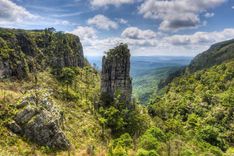
The Wild Coast region is aptly named: this is one of South Africa’s most unspoilt areas, a vast stretch of undulating hills, lush forest and spectacular beaches skirting a section of the Indian Ocean. Its undeveloped sandy beaches stretch for hundreds of kilometres, punctuated by rivers and several wonderful, reasonably priced hotels geared to family seaside holidays. The wildness goes beyond the landscape, for this is the former Transkei homeland, a desperately poor region that was disenfranchised during apartheid and turned into a dumping ground for Africans too old or too young for South African industry to make use of.
The Wild Coast region’s inhabitants are predominantly Xhosa, and those in rural areas live mostly in traditional rondavels dotting the landscape for as far as the eye can see. The N2 highway runs through the middle of the region, passing through the old Transkei capital of Mthatha and a host of scruffy, busy little towns along the way. To the south of the highway, the coastal region stretches from just north of East London to the mouth of the Mtamvuna River. With its succession of great beaches, hidden reefs, patches of subtropical forest, rural Xhosa settlements and the attractive little towns of Coffee Bay and Port St Johns (both popular with backpackers), this region offers the most deserted and undeveloped beaches in the country.
The Wild Coast, unlike the Western Cape Garden Route, is not a stretch that you can easily tour by car. There’s no coastal road, and no direct route between one seaside resort and the next. Yet in this remoteness lies the region’s charm. Resorts are isolated down long, winding gravel roads off the N2, which sticks to the high inland plateau. Choose one or two places to stay, and stay put for a relaxing few days. Most places along this stretch of coast are known simply by the name of the hotel that nominates the settlement, though you will also see the Xhosa name of the river mouth, on which each hotel is situated, on many maps.
Mthatha
Straddling the Mthatha River and the N2 highway 235km from East London, the fractious, shambolic town of MTHATHA (formerly Umtata) is the erstwhile capital of the Transkei and the Wild Coast region’s largest town. Unfortunately, it’s a pretty ugly place, its crowded and litter-strewn streets lined with nondescript 1970s office buildings, with the odd older architectural gem, albeit dilapidated. However, the town is useful for stocking up and drawing money, all of which can be done at the Spar Centre or Shell Ultra City on the edge of town. The only reason to venture into the town centre is to visit the Nelson Mandela Museum, housed in the old parliament, or bungha, built in 1927. The most interesting display in the museum traces the great man’s life with photos and other visual material. The museum co-ordinates guided trips to Qunu and Mveso, Mandela’s birthplace, from its sister museum, the Youth and Heritage Centre in Qunu.
Some Xhosa traditions
The Wild Coast region is largely populated by rural Xhosa, who still practise traditions and customs that have faded in more urban areas. Many people, for example, still believe that the sea is inhabited by strange people who do not always welcome visitors, which explains the relative scarcity of the activities you would normally find thriving among seashore-dwelling people, such as fishing and diving.
Initiation for teenage boys and young men is still common. Young men usually leave their homes to stay in "circumcision lodges", dress in distinctive white paint and costumes and learn the customs of their clan. At the circumcision ceremony the young men are expected to make no sound while their foreskin is cut off (with no anaesthetic). After the ceremony, they wash off the paint and wrap themselves in new blankets, and all their possessions are thrown into a hut and set alight – they must turn away from this and not look back. There follows a feast to celebrate the beginning of manhood and the start of a year-long intermediary period during which they wear ochre-coloured clay on their faces. After this, they are counted as men.
Like other African peoples, although they believe in one God, uThixo, or uNhkulukhulu (the great one), many Xhosa also believe that their ancestors play an active role in their lives. However, the ancestors’ messages are often too obscure to be understood without the aid of specialists, or amagqira.
The Xhosa are patriarchal by tradition, with women’s subordinate status symbolized by lobola, the dowry payment in cattle and cash that a prospective husband must make to her parents before he can marry her. If the woman is not a virgin, the man pays less. Married Xhosa women have the same right as men to smoke tobacco in pipes, and can often be seen doing so, the pipes’ long stems designed to prevent ash falling on babies suckling at their breasts. Pipes are shared, but each person must have their own stem, not just for matters of hygiene but also to prevent witchcraft: bits of the body make the most effective poisonous medicines against people, and that includes hair, skin and spittle.
The Xhosa did not wear cloth until it was introduced by Europeans, when it was quickly adopted. Today, what is now seen as traditional Xhosa cloth is almost always worn by women, mostly in the form of long skirts, beautifully embroidered with horizontal black stripes placed at varying intervals. The breasts of unmarried women were traditionally uncovered, while those of married women were usually covered with beads or matching cloth. These days, most women wear T-shirts, though almost all still cover their heads with scarves intricately tied to form two peaks above the forehead.
The great cattle killing
The 1850s were a low point for the Xhosa nation: most of their land had been seized by the British, drought had withered their crops, and cattle-sickness had decimated their precious herds. In 1856, a young woman called Nongqawuse, whose uncle Mhlakaza was a prophet, claimed to have seen and heard ancestral spirits in a pool on the Gxara River. The spirits told her the Xhosa must kill all their remaining cattle and destroy their remaining crops; if they did this, new cattle and crops would arise, along with new people who would drive the whites into the sea.
As news of her prophecy spread, opinion was sharply divided among the Xhosa – those whose herds had been badly affected by cattle-sickness were most inclined to believe her. A turning point came when the Gcaleka paramount chief Sarili became convinced she was telling the truth and ordered his subjects to start the cull. Thousands of cattle were killed, but when the "new people" failed to materialize, the unbelievers who had not killed their herds were blamed. By February 1857, the next date for the appearance of the new people, over 200,000 cattle had been slaughtered. When the new people failed once more to materialize, it was too late for many Xhosa. By July there was widespread starvation; 30,000 of an estimated population of 90,000 died of hunger.
The British administration saw the famine as a perfect way to force the destitute Xhosa into working on white settlers’ farms. To speed up the process, the Cape governor Sir George Grey closed down the feeding stations established by missionaries and laid the blame for the disaster on the Xhosa chiefs, imprisoning many of them on Robben Island.
The Eastern Cape’s coastal nature reserves
The Eastern Cape has some undeveloped and beautiful coastal reserves that are reached on difficult dirt roads and suitable for a stay of a few days, rather than for the day. All accommodation is self-catering, and there are no shops or facilities in the reserve, so you need to be fully self-sufficient and stock up before you leave the N2.
Dwesa Reserve
Situated between Kob Inn and Coffee Bay, Dwesa Nature Reserve has well-sited wooden chalets (R200), equipped with gas fridges and stoves, and is one of the best places to stay on the coast, boasting rare animals such as tree dassies and samango monkeys, as well as red hartebeest, blesbok, blue wildebeest and buffalo.
To get to the reserve, turn east off the N2 at Idutywa towards the coast and continue for 73km or so; the road forks right to Kob Inn and left to Dwesa.
Hluleka Nature Reserve
One of the loveliest of the Wild Coast reserves, Hluleka Nature Reserve consists of coastal forest whose coral trees flower scarlet in July and August, a strip of grassland and outstanding sandy beaches interspersed with rocky outcrops tattooed with extraordinary wind-shaped rock formations. In the grassland strip, you’re likely to see wildebeest, zebra and blesbok. Accommodation is in seven spacious self-catering chalets, on stilts overlooking the sea, sleeping up to four people (R600).
You can reach Hluleka along the difficult coastal road from Coffee Bay. Heading towards the N2 from Coffee Bay for a short distance, take the Mdumbi turn on the right, and continue for some 30km, when signs to Hluleka appear. Alternatively – and more easily – take the Hluleka turning 30km along the R61 from Mthatha to Port St Johns, and continue for another 57km to the coast.
Mkhambathi Nature Reserve
Largest of the Eastern Cape reserves, Mkhambathi consists almost entirely of grassland, flanked by the forested ravines of two rivers, and a ravishing coastline of rocky promontories and deserted beaches. There’s plenty of game: you’re likely to see eland, hartebeest, wildebeest and blesbok, as well as Cape vultures. The highlight, though, is the Mkhambathi River itself, which cuts through the middle of the reserve down a series of striking waterfalls, of which the Horseshoe Falls near the sea are the most spectacular.
To get to Mkhambathi, turn towards the coast at the Mkhambathi signpost at Flagstaff on the tarred R61. From Flagstaff, the reserve is 70km away on a dirt road, which is very variable in quality. Although the road to the reserve restcamp is fine, driving anywhere in the park except to the beach requires a high-clearance vehicle.
Addo Elephant National Park
A Big Five reserve, Addo Elephant National Park is just 73km north of Port Elizabeth, and should be your first choice for an excursion – for just one day or for several. You can also stay at one of the nearby private reserves – especially if you just want to be pampered. On the N2 highway between PE and Grahamstown alone, there are three: Shamwari, Amakhala and Lalibela, while Schotia, 1km off the N10/N2 interchange, has exciting night drives and is the least upmarket. One big attraction of Addo and these private reserves is that, unlike the country’s other major game parks, they benefit from the fact that the Eastern Cape is malaria-free.
Addo is currently undergoing an expansion programme that will see it become one of South Africa’s three largest game reserves, and the only one including coastline. Elephants remain the park’s most obvious drawcard, but with the reintroduction in 2003 of a small number of lions, in two prides (big cats last roamed here over a century ago), as well as the presence of the rest of the Big Five – buffalo, hippos and leopards – it has become a game reserve to be reckoned with. Spotted hyenas were also introduced in 2003 as part of a programme to re-establish predators in the local ecosystem. Other species to look out for include cheetah, black rhino, eland, kudu, warthog, ostrich and red hartebeest.
East London
EAST LONDON, the second-largest city in the Eastern Cape, is the obvious jumping-off point for exploring the Transkei. But without fine, warm weather, the city is dreary. What does happen takes place along the beachfront, where there’s a plethora of places to stay, eat and drink. Nahoon Beach is a great surfing spot, and the town has a dedicated and lively surfing scene. It’s also gradually becoming a place for black holidaymakers – a post-apartheid phenomenon. The beaches to the east of town are very beautiful, with long stretches of sand, high dunes, estuaries and luxuriant vegetation, and good swimming.
East London’s drab city centre is dominated by Oxford Street, parallel to Station Street and the train station. Although a major traffic thoroughfare, it is largely deserted at night, when you shouldn’t wander around alone. The newly upgraded Vincent Park Centre on Devereux Avenue is a popular shopping centre with cinemas and restaurants. It is 5km north of the city centre (leave the centre on Oxford St, and turn right into Devereux just beyond the museum), in the midst of the salubrious suburbs of Vincent and Stirling. This is the best place for shopping, or to find anything practical such as banks and the post office. Apart from a couple of handsome buildings, East London’s Victorian heart has progressively been demolished, though the city centre’s principal landmark, the splendid terracotta and lace-white City Hall, opened in 1899, remains. Over the road is a rather lifeless statue of martyred Black Consciousness leader Steve Biko.
Away from the holiday strip, East London is dominated by an industrial centre served by Mdantsane, a huge African township 20km from the city towards King William’s Town.
Grahamstown
Just over 50km inland from Port Alfred, GRAHAMSTOWN projects an image of a cultured, historic town, quintessentially English, Protestant and refined, with reminders of its colonial past in evidence in the well-preserved architecture.
Dominated by its cathedral, university and public schools, this is a thoroughly pleasant place to wander through, with well-maintained colonial Georgian and Victorian buildings lining the streets, and pretty suburban gardens. Every July, the town hosts an arts festival, the largest of its kind in Africa, and purportedly the second largest in the world.
As elsewhere in South Africa, there are reminders of conquest and dispossession. Climb up Gunfire Hill, where the fortress-like 1820 Settlers Monument celebrates the achievement of South Africa’s English-speaking immigrants, and you’ll be able to see Makanaskop, the hill from which the Xhosa made their last stand against the British invaders. Their descendants live in desperately poor ghettos here, in a town almost devoid of industry.
Despite all this, and the constant reminders of poverty, Grahamstown makes a good stopover, and is the perfect base for excursions: a number of historic villages are within easy reach, some game parks are convenient for a day or weekend visit and, best of all, kilometres of coast are just 45 minutes’ drive away.