Brief history of the North West Province
San hunter-gatherers were the province’s first inhabitants: they were displaced 500–1000 years ago by cattle-herding Iron-Age peoples from the north, who pitched their first settlements on low ground near watercourses. These settlements developed into stone-walled towns on hilltops; and by 1820, the largest, Karechuenya (near Madikwe), was estimated to have more inhabitants than Cape Town. By the nineteenth century, the dominance of the Rolong, Taung, Tlhaping and Tlokwa clans was established. European observers classified them all as Tswana, but it’s unclear whether these people regarded themselves as very different from people further east classified as “Sotho”.
The outbreak of intense inter-clan violence in the early 1800s was due to displacements caused by the expansion of white trekboers, and the growing availability of firearms. Victory went to those who made alliances with the new arrivals, whether Griqua from the Northern Cape or Afrikaners from further south. However, the clans’ victories were short-lived and their Griqua and Afrikaner allies soon evicted them from their land and forced them into service. Various mini-states were formed until, in 1860, they were all amalgamated to form the South African Republic (ZAR), with Pretoria as its capital.
The first Anglo-Boer War (1877–81) left most of the province unaffected. Of far greater impact was the second Anglo-Boer War (1899–1902). As well as the celebrated siege of Mafikeng, where British and Tswana forces held out for 217 days against Afrikaner troops, there were protracted skirmishes up and down the Vaal River. After the British victory, both Afrikaner and Tswana had their lands torched and many were thrown into concentration camps.
The Union Treaty of 1910 left the province, as the western part of the Transvaal, firmly in Afrikaner hands. Its smaller dorps soon became synonymous with rural racism, epitomized in the 1980s by the fascistic AWB led by Eugene Terreblanche, whose power base was here. In addition, the province played a relatively minor role in the national struggle against apartheid due to the absence of a significant black working class after the migration of many Tswana men to work in the gold mines of the Witwatersrand.
In 1977, the Bophuthatswana Bantustan homeland – or “Bop” – was created around Mmabatho in the western part of the province out of the old “native reserves”, the poor-quality land into which Tswana had been forced. Far from being a long-awaited “independent” homeland for the blacks in this area, Bop proved to be a confusing amalgamation of enclaves, ruled by the corrupt Lucas Mangope, who grew rich on the revenues from Sol Kerzner’s casinos in Sun City and Mmabatho and the discovery of platinum. Bophuthatswana’s short life came to an end in March 1994, a month before South Africa’s elections, when its army mutinied. Mangope called in hundreds of armed AWB neo-fascists to help quell the uprising, but the AWB – and Mangope – were ingloriously defeated.
Bojanala Region
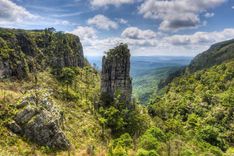
Bordering Gauteng, Bojanala Region lies in North West Province’s northeastern bushveld and is a popular weekend destination for Jo’burgers. One of the more distinctive parts of this largely empty and flat province is the Magaliesberg mountain range, which gets its name from the Tswana chief Mogale of the Kwena clan. Kwena people lived here from the seventeenth century until 1825, when most of them were forced out by the Ndebele chief Mzilikazi. Afrikaner farmers continued the process of eviction, and today the dispossession and expulsion of the Kwena in the Magaliesberg is complete.
Great chunks of the Magaliesberg have been fenced off and turned into time-shares or resorts, but there are oases of unspoilt nature, notably Kgaswane Mountain Reserve – accessed from the region’s main town, Rustenburg – and the Mountain Sanctuary Park, both preserved in something like their previous natural state and well stocked with wildlife.
Further north, occupying an ancient volcanic crater, is the outstanding Pilanesberg National Park – the “Big Five” mainstay of Gauteng-based safari operators. If you’re in the mood for a fun-in-the-sun water park and some surreal tourist opulence, Sun City is worth checking out, if only as a stopover on your way in to Pilanesberg.
Kgaswane Mountain Reserve
Kgaswane Mountain Reserve spans a spectacular forty-square-kilometre portion of the Magaliesberg, making it a rewarding wild stop on a South Africa road trip. It is dotted with rock formations, created by millennia of erosion, areas of dry veld and streams coursing through the valleys. The reserve’s unique flora includes aloes indigenous to the Magaliesberg and the discreet frithiapulchra, a succulent with only its leaf tips exposed, flowering between November and March. The many crags are perfect for predatory birds; keep a lookout for the rare black eagle, Martial eagle and Cape vulture, as well as parrots and paradise flycatchers. Kgaswane is also home to eight hundred antelopes, representing most of South Africa’s species, and also zebras. Predators are few in number and limited to caracal, aardwolf, black-backed jackals and the elusive leopard.
Exploring Kgaswane
The reserve can be explored on a day or two-night hike, or by bicycle (bring your own). There are two short trails for day hikes. The two- to three-how 5km Peglarae Trail follows a relatively easy path through rocky terrain and takes in most of the reserve’s best features and views. Shorter and flatter is the 2km Vleiramble to a viewing hut on the vlei, popular with birders. Overnight hikes follow the Rustenburg hiking trail (19.5km or 23.5km) and last two days and two nights.
Pilanesberg Game Reserve
Adjacent to Sun City and home to a huge variety of animals, the PILANESBERG GAME RESERVE is North West Province’s biggest tourist draw. The artificially created reserve was, until 1979, occupied by farmers and the Tswana people, who were unceremoniously evicted when Operation Genesis saw over six thousand animals shipped in from all over the country to fill the park. Just two to three hours’ drive from Pretoria and Jo’burg, Pilanesberg is definitely the place to come to see some game if you’re based in Gauteng and have only limited time in South Africa. Like any other game parks, you’ll get the most from your visit if you stay in or near the reserve so that you’re in the best position to head out at prime game-viewing time: at dawn, before the day visitors arrive.
Don’t let the crowds or the managed nature of the place put you off: the park offers game-viewing thrills aplenty, with a good chance of seeing all of the Big Five, along with hippo, brown hyena, giraffe and zebra. The majority of antelope species are here, too, and there’s a vast array of birdlife – over 365 species recorded so far. At night, some fantastic creatures emerge, including civet, porcupine and caracal, though you’ll be lucky to spot them.
Covering some 650 square kilometres, and with 200km of good-quality tar and gravel roads, you’ll need at least a day to do Pilanesberg justice. The reserve is easily explored by car, especially with the official map (for sale at the gates and camp shops). The park’s many beautiful hills – the result of an unusual volcanic eruption that occurred 1200–1300 years ago – are in some ways Pilanesberg’s finest feature, though they are often ignored by visitors more interested in scouring their slopes for wildlife. Pilanesberg’s natural focus, for visitors and wildlife alike, is the alkaline Lake Mankwe ("place of the leopard"), whose goings-on are best observed from several walk-in hides. The various picnic spots and hides dotted around are ideal for breaking the drive – the hides in particular aren’t used by many visitors and as a result can be cool, peaceful places to appreciate the natural surroundings. If you’re self-driving, don’t hesitate to ask the safari jeep drivers for sighting tips; all of them are in radio contact with each other and know exactly what’s going on.
The Central Region
Thanks to its scrawny and desolate dryness, North West Province’s Central Region feels especially remote, and there are not all that many towns worth visiting. Mmabatho, once the capital of Bophuthatswana and now incorporated into neighbouring Mafikeng, the provincial capital, forces reluctant bureaucratic pilgrimages on people from all over the province. The region’s appeal lies elsewhere, in the brooding plains and lush river valleys of Marico and the rarely visited game reserves, including Madikwe on the Botswana border. And then there are the people themselves: local Tswana and Afrikaners are both short on English but long on hospitality, at least to visitors, a trait best experienced at the village of Groot Marico, famed nationwide for its mampoer peach brandy and quintessentially laidback spirit.
Groot Marico
GROOT MARICO, a tiny, dusty and characterful dorp resting contentedly by the banks of the Marico River, just south of the N4 and 90km west of Rustenburg, gained fame through Herman Charles Bosman’s short stories based on his time as a teacher here. In mid-October, Groot Marico hosts the literary Bosman Weekend, drawing fans of one of South Africa’s best-loved authors from far and wide. At other times, visit the Herman Charles Bosman Living Museum on Fakkel Street which includes a re-creation of the school where Bosman taught and provides insight into his life. Nearby, the Art Factory on Paul Kruger Street sells Tswana cultural artefacts and locally made Afrikaner crafts such as wooden pipes, whips and clocks.
Although prone to stultifying heat, particularly in summer, the hills of the Marico district around the town are good for hiking, and when it all gets too much you can make for the river for cool relief. The water of the Marico Oog ("Marico Eye"), a spring 20km south of town, is particularly clear and refreshing: festooned with water lilies and surrounded by beautiful dolomitic rocks, it makes a tranquil place for a picnic, and can be paradise for birdwatchers, with over four hundred species recorded here. It’s also a favoured spot for scuba divers; contact the town’s information centre for more details.
Mampoer
According to legend, a Pedi chief by the name of Mampuru introduced the art of distilling peach brandy to the Boers. Named mampoer in his honour, the fearsomely strong spirit has inspired locals and visitors alike ever since. Any fruit can be used to make mampoer, but peach is the most traditional: until 1878, much of North West Province’s farmland grew peach trees solely devoted to this purpose. Things changed with the ZAR government’s distilling tax, and the new licensing system introduced in 1894, when thousands of mampoer stills were destroyed. A few, however, escaped detection. A local story recounts that one farmer cleaned out his entire drainage system, but made no attempt to conceal his fifteen barrels of mampoer. The inspectors found the barrels, split them open and poured the entire contents down the drain. Meanwhile, the canny farmer had his family stationed in the field where the pipe ended up with every container the household possessed, and managed to recover fourteen of the fifteen barrels.
If you want to sample and buy mampoer, head for Maruthwane Farm, 12km west of Groot Marico on the N4 (open daily 9am–5pm), where you can also see demonstrations of how the stuff is made. In the old days the alcohol content was measured by throwing a chunk of lard into a sample: if it floated halfway, the mampoer was perfect. Nowadays, you just hold a match over it – the higher and cleaner the blue flame, the better the brew. Groot Marico’s information office organizes mampoer tours.
Mafikeng
Mafikeng, 25km south of the Ramatlabama border post with Botswana, offers a unique portrait of the vision of apartheid and its deep contradictions. Acting as a shopping and transport hub for the wide area of farmland that surrounds it, it is most famous for Baden-Powell and the Boer siege of 1899–1900 (see The siege of Mafikeng).
The town’s main attraction is the Mafikeng Museum, housed in the impressive former town hall, which was built in 1902, two years after the siege ended. There’s a restored steam locomotive outside, in use from 1901 until 1971 when it pulled the Kimberley–Bulawayo Express. Inside, you’ll find San hunting weapons and poisons, and a life-size re-creation of a traditional Tswana hut, complete with its trademark enclosed porch. The siege of Mafikeng is given a room of its own, filled with classic British imperial memorabilia, from weaponry to a wonderful collection of photos. Keep an eye out too for the fascinating exhibit on Mafikeng and the railways, which provides evidence of the connection between their spread from Cape Town and Rhodes’ mission to colonize Africa.
The 46-square-kilometre Mafikeng Game Reserve is worth a quick drive around for its acacia-strewn bushveld landscape and herbivorous plains game, including white rhino and buffalo. Cooke’s Lake, in the reserve’s western corner next to town, is reasonably good for waterfowl and mongooses (and the snakes they prey on).
The siege of Mafikeng
Mafikeng was besieged within three days of the start of the second Anglo-Boer War (1899–1902) by generals Snyman and Cronje. Colonel Robert Baden-Powell (founder of the Boy Scouts) had the task of defending the town. This he did for 217 days, from October 16, 1899, until May 17, 1900, when relief arrived from Rhodesia and from the south. In the process, Baden-Powell became a British household name and hero, and the exuberant scenes of jubilation in London that greeted news of the relief gave rise to a new word in the English language: maffick, which meant to celebrate unduly.
Strategically, Mafikeng was irrelevant to the war; Baden-Powell’s real achievement was to distract the six thousand Afrikaners besieging the town from fighting elsewhere. He relied heavily on the Barolong people for defence, labour and reconnaissance, but failed to record this either in his dispatches to London or in his memoirs, despite the fact that four hundred Barolong lost their lives during the siege – twice as many as British. Some of the British casualties of the siege are marked by white iron crosses in the town’s cemetery on Carrington Street, next to the railway sidings. Until the 1980s this was a whites-only cemetery, and today it still commemorates only the Europeans who died during the siege.
The Barolong also received far fewer rations, and over one thousand subsequently died of starvation; they received none of the £29,000 raised in Britain for the rehabilitation of Mafikeng. To add insult to injury, not one Barolong was decorated for bravery, in contrast to the plentiful medals dished out to the British regiments, and none of the promises Baden-Powell made about land grants to them was ever kept. An important legacy of the involvement of the black population was the diary of the siege kept by Sol Plaatje, one of the first black writers to make an impact on English literature, who was later to become a founder member of the South African Native Congress, forerunner to the ANC.
Madikwe Game Reserve
Tucked up in the very north of the province near the Botswana border lies the 765-square-kilometre Madikwe Game Reserve, one of South Africa’s largest wildlife areas and a rewarding stop on a self-drive South Africa tour. The reserve was established in 1991 from reclaimed farmland, and thanks to Operation Phoenix, which saw the reintroduction of over eight thousand animals, Madikwe’s largely low-lying plains of woodland and grassland are now amply stocked with the Big Five, plus dozens of other mammals, including cheetah, wild dogs, spotted hyena and most of Southern Africa’s plains antelopes. Twitchers won’t be disappointed, with some 350 bird species recorded so far; the Marico River, on the eastern border, and the koppies scattered all around, are particularly rewarding birding areas.
Long promoted as South Africa’s "bijou reserve", the low tourist density so liberally vaunted in the brochures no longer quite rings true given that around twenty lodges vie for your trade, although Madikwe does remain one of the least known of South Africa’s large wildlife areas. Access is reserved to guests of its lodges and day visitors, who must book a package through one of the lodges that includes a game drive and lunch; independent day visits are not allowed.